Quantum Measurement
- Observables as operators, eigenvalues as outcomesnot yet tested
- Why a superposition becomes one outcomenot yet tested
- The cat sealed in the box with the poisonnot yet tested
- Copenhagen, many-worlds, Bohm, and QBismnot yet tested
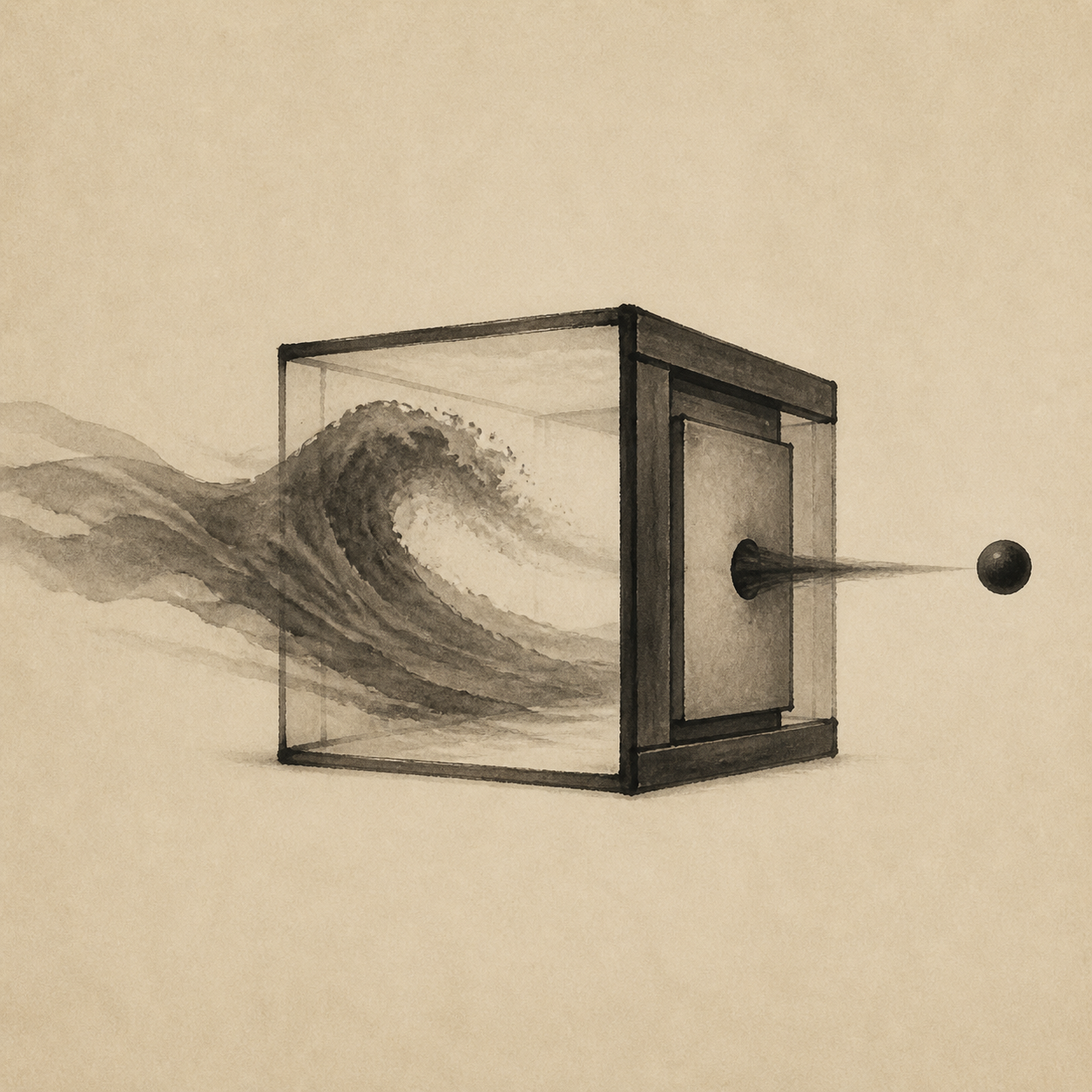
In 1935 Erwin Schrödinger — the same Schrödinger who had derived the central equation of quantum mechanics nine years earlier — published a thought experiment intended to ridicule the prevailing interpretation of his own theory. Imagine, he wrote, a cat sealed in a box with a radioactive atom, a Geiger counter, and a vial of poison gas. If the atom decays, the counter trips, the vial breaks, the cat dies. Quantum mechanics applied to the whole apparatus before the box is opened says the atom is in a superposition of decayed and undecayed; the cat is therefore in a superposition of dead and alive. That seems absurd, Schrödinger said. And yet the equation says it. The measurement problem — what happens, physically, when an observation collapses a superposition into a single outcome — has, almost a century later, no consensus answer.
Quantum systems evolve unitarily under the Schrödinger equation — deterministically and reversibly. Measurement, however, is described separately, by an additional rule that has no derivation from the rest of the theory. An observable (position, momentum, energy, spin) is represented by a Hermitian operator; the eigenvalues of the operator are the possible measurement outcomes; the eigenvectors are the corresponding eigenstates. When a measurement is made on a system in state |ψ⟩, the outcome is a particular eigenvalue with probability |⟨eigenvector|ψ⟩|² — the Born rule. After the measurement the system is in the eigenstate corresponding to the measured eigenvalue; the wavefunction has collapsed. Collapse is irreversible, instantaneous, and probabilistic, and it does not follow from the Schrödinger equation: it is added by hand.
The measurement problem: what physical process effects collapse, and at what stage in the chain from quantum system to macroscopic observation does it happen? Decoherence theory (Zeh, Zurek, since the 1970s) explains how superpositions become effectively classical when entangled with a complex environment — off-diagonal elements of the density matrix decay rapidly through environmental interaction — but does not pick out a single outcome from the diagonal. The interpretive options remain open. The Copenhagen interpretation (Bohr, Heisenberg) treats measurement as a primitive: collapse just happens, and asking what is happening physically is illegitimate. Many-worlds (Everett, 1957): all outcomes occur in branching parallel universes, and the appearance of collapse is the observer entangling with a particular branch. Bohmian mechanics: hidden variables determine outcomes and nothing collapses. QBism: probabilities are an observer's subjective beliefs and collapse is Bayesian updating. All make the same experimental predictions; all disagree about what is happening.