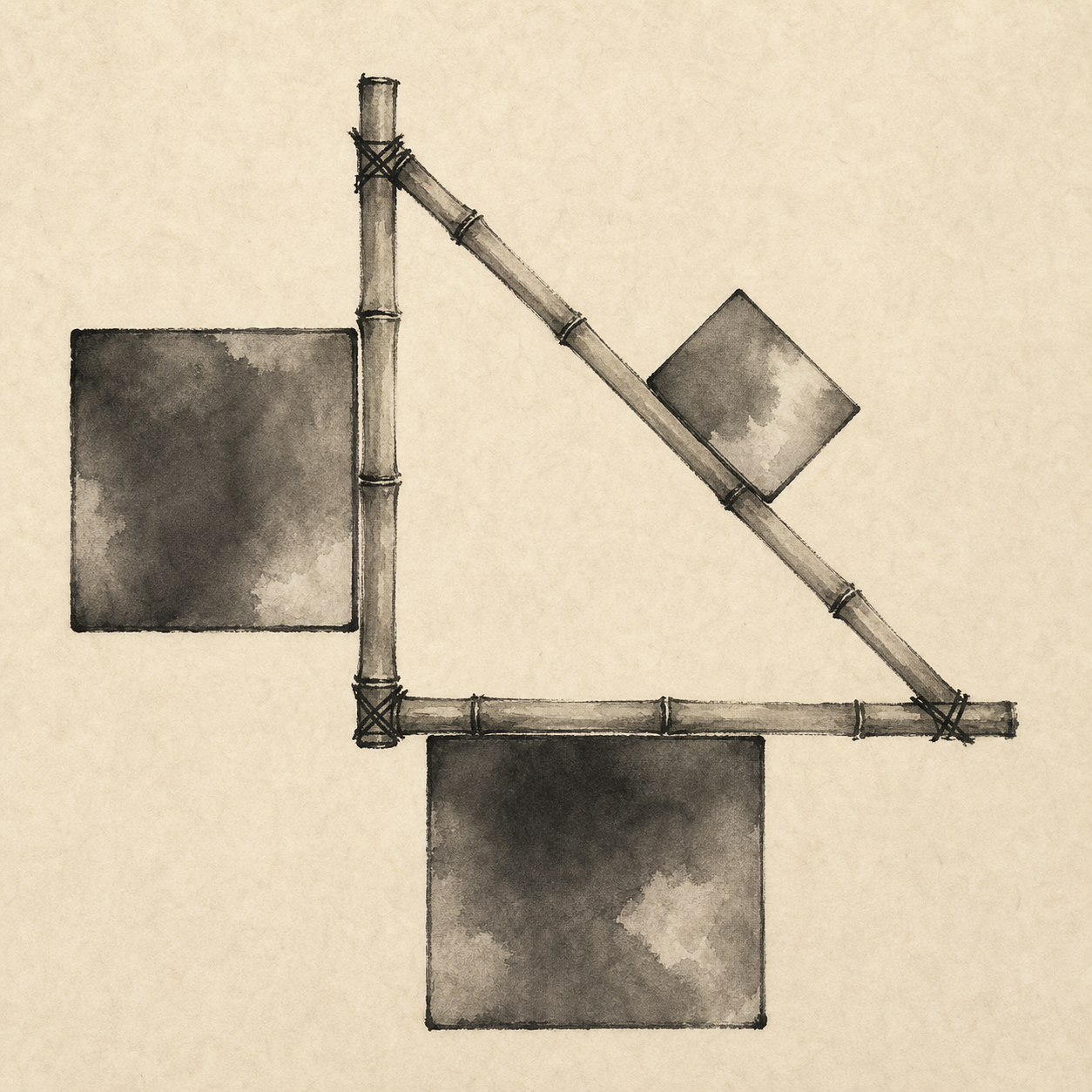
Pythagorean Theorem
- a² + b² = c² in right trianglesnot yet tested
- Area and circumference of a circlenot yet tested
- Volume and surface area of a spherenot yet tested
- The constant πnot yet tested
The most famous equation in mathematics — a² + b² = c² — was not discovered by Pythagoras. Babylonian clay tablets from around 1800 BCE, more than a millennium before the Greek philosopher's birth, list Pythagorean triples (3-4-5, 5-12-13, and so on) with a precision that suggests the relation was already understood. The Egyptians used 3-4-5 ropes to lay out right angles for pyramids. What Pythagoras (or his school) supposedly added — around 530 BCE — was the first proof: a logical argument that the relation holds for every right triangle, not just the ones the surveyors had measured. Whether the historical Pythagoras actually proved it is anyone's guess. The cult that followed his name was secretive, vegetarian, and terrified of irrationals: legend has it that the cult member who first realized that √2 cannot be written as a ratio of whole numbers — a direct consequence of the theorem applied to a unit square's diagonal — was drowned at sea to prevent the news from spreading.
The statement is austere: in a right triangle, the square of the hypotenuse equals the sum of the squares of the other two sides. The theorem has more known proofs than any other in mathematics — over three hundred and sixty catalogued, including one (Garfield's) authored by a future U.S. president while sitting in Congress. Its consequences ripple outward through nearly all of geometry. The distance formula — d = √((x₂−x₁)² + (y₂−y₁)²) — is Pythagoras applied twice. The Euclidean metric, the standard way to measure distance in any number of dimensions, generalizes Pythagoras: ‖v‖ = √(v₁² + v₂² + ... + vₙ²). The law of cosines extends Pythagoras to non-right triangles: c² = a² + b² − 2ab·cos(γ), recovering the original when γ = 90°. Pythagorean triples — integer solutions like (3, 4, 5), (5, 12, 13), (8, 15, 17) — form an infinite family parameterizable by simple rules. Fermat's Last Theorem — the conjecture that aⁿ + bⁿ = cⁿ has no integer solutions for any n > 2 — is a statement about the failure of Pythagorean-style relations at higher exponents; it stood unproven for 358 years until Andrew Wiles settled it in 1995, in a proof of more than 100 pages that touches almost every branch of modern number theory. The deepest observation, however, is that Pythagoras' theorem characterizes Euclidean geometry: change the formula for distance, and you get non-Euclidean geometries — Riemannian, hyperbolic, spherical — each appropriate to different curvatures of space, and one of them eventually turning out to describe the actual universe via general relativity.