Public-Key Cryptography
- Trapdoor functions: RSA factoring and discrete logsnot yet tested
- Signatures, hashing, and hybrid encryptionnot yet tested
- The key-distribution and trust problem (PKI)not yet tested
- Shor's algorithm and post-quantum migrationnot yet tested
In 1976, Whitfield Diffie and Martin Hellman solved a problem three thousand years old. For all of prior history, two people could exchange secret messages only if they had first, somehow, shared a secret key in private — a hopeless requirement for strangers meeting on an open network. Diffie and Hellman showed how two parties who had never met could conjure a shared secret in full public view, an eavesdropper hearing every word yet unable to reconstruct it. A year later Rivest, Shamir, and Adleman turned the idea into RSA, where anyone can publish a lock that only they hold the key to open. It sounds impossible. The entire architecture of the modern internet rests on the fact that it is not.
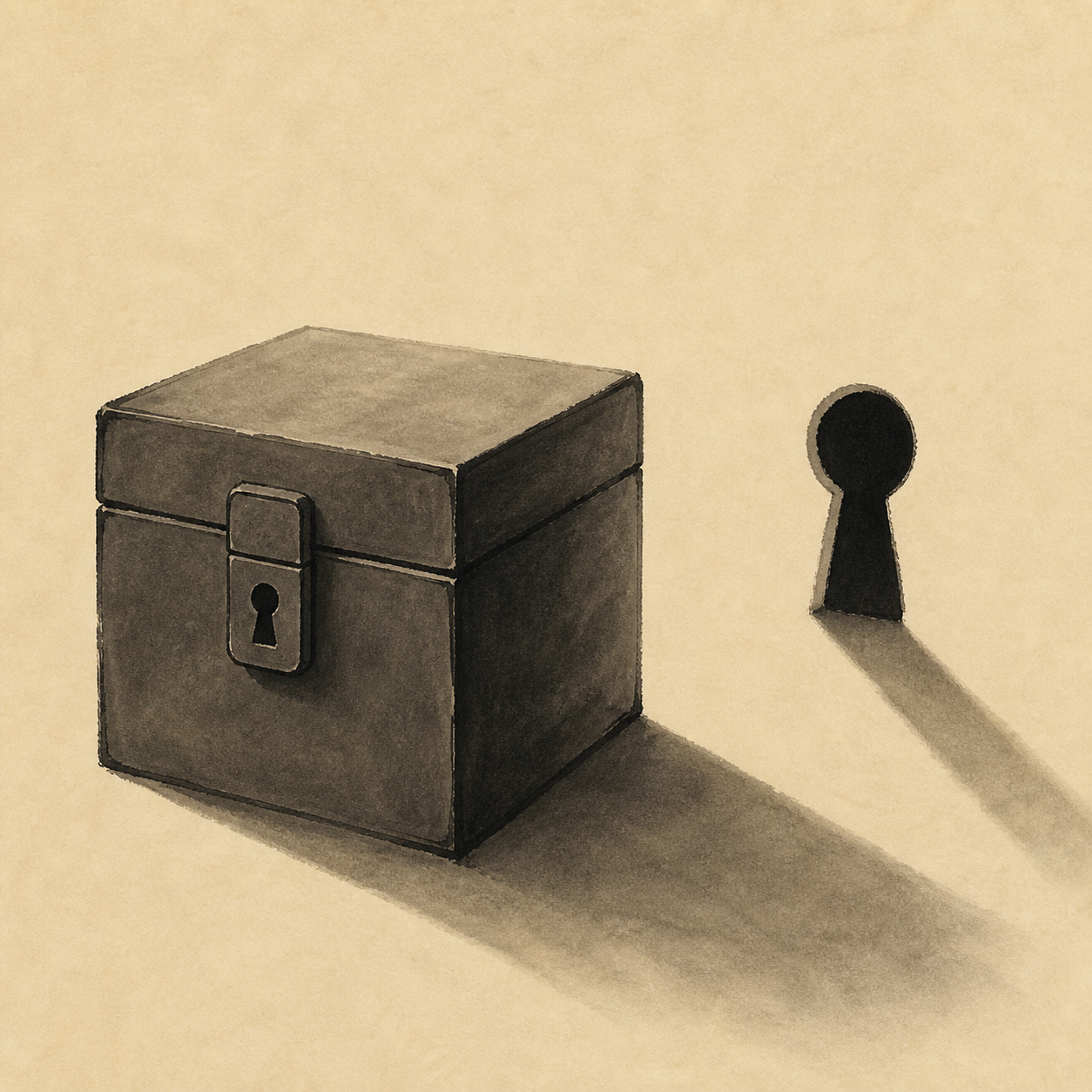
The whole edifice rests on one kind of asymmetry: a mathematical operation easy to perform but, in practice, impossible to undo. Multiply two large prime numbers and the product appears at once; hand someone that product and ask them to recover the original primes, and the fastest computers on Earth would grind away for longer than the universe has existed. Encryption hides a message behind such a one-way door, and only the holder of the secret — the two primes, in RSA's case — can walk back through it. Everything the internet trusts is built on a small set of these doors. But here is the unsettling part: no one has ever proven that any of them is genuinely hard to undo. Their difficulty is believed, not established — a wall no one has yet found a way over, which is not at all the same as a wall that cannot be climbed. Should someone discover a fast way to factor, a vast portion of the world's secure communication would silently fall open. There is a subtler gap too. Public keys solve how to send a secret to a stranger, but not how to know the stranger is who they claim to be; the padlock labeled 'your bank' must be trusted to really be your bank's, and that trust leans on a fragile scaffolding of certificate authorities working out of sight. And one specific storm is now visible on the horizon: in 1994 Peter Shor proved that a large enough quantum computer could factor numbers quickly, breaking RSA and its relatives outright. No such machine exists as of 2026, but the danger is concrete enough that new 'post-quantum' schemes, built on different and harder-to-reverse problems, were standardized in 2024 and are now being rolled out.