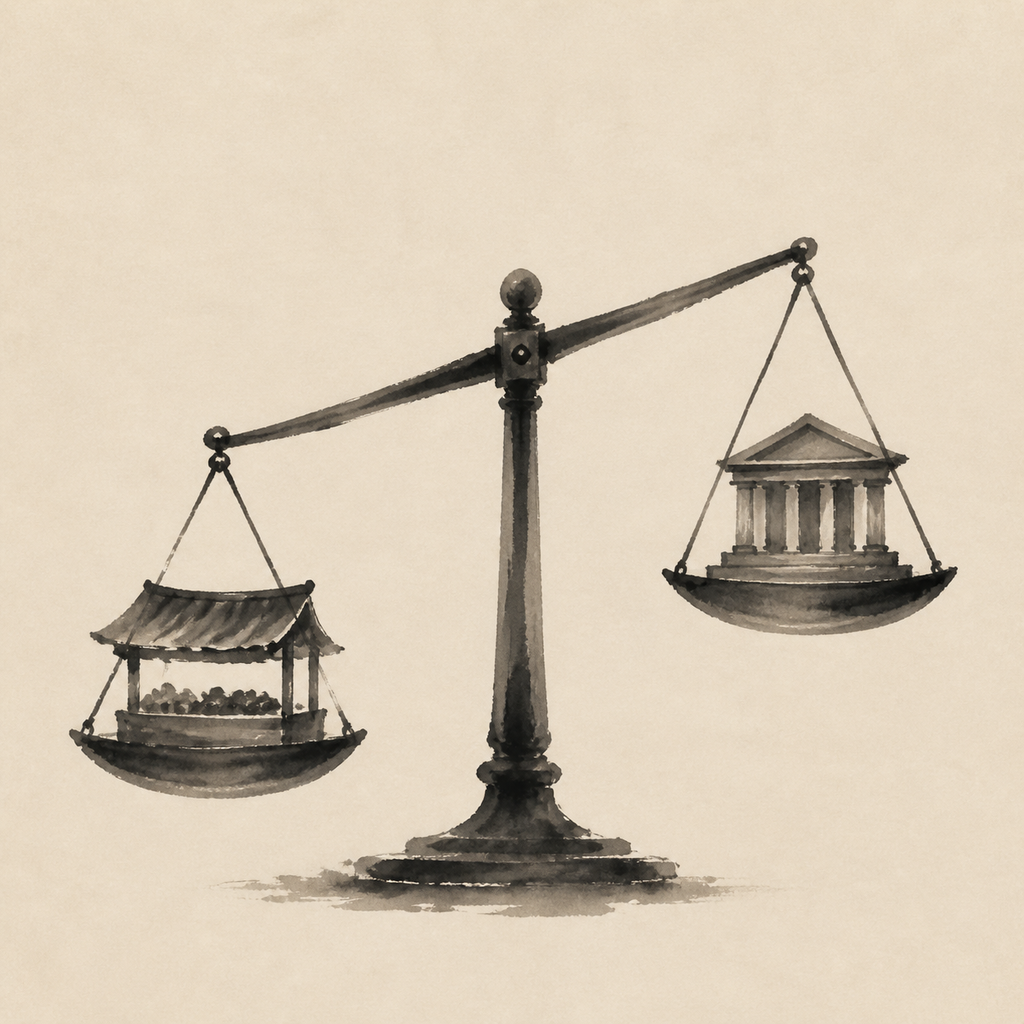
Public Choice & Government Failure
- Government failure as the mirror of market failurenot yet tested
- Rational ignorance, capture, and rent-seekingnot yet tested
- Rules of the game over policies within themnot yet tested
Most introductory economics teaches market failure: situations where the unregulated market produces inefficient outcomes, with the implicit conclusion that government intervention can do better. In 1962, the American economists James Buchanan and Gordon Tullock at the University of Virginia published The Calculus of Consent, applying the same economic toolkit to government decision-making and arguing that politicians and bureaucrats are also self-interested agents responding to incentives, not selfless welfare-maximizers. The discipline that grew from this — public-choice theory — produced a symmetric analysis: markets fail, but governments also fail, and the question is which institutional arrangement fails less in a given domain. Buchanan won the 1986 Nobel Prize for the work, and the framework has substantially shaped constitutional design, regulatory analysis, and political economy.
Grant the symmetry and the results follow almost mechanically. Start with the voter: a single ballot decides an election so rarely that the hours needed to become genuinely informed buy almost nothing. Staying ignorant is not laziness but a correct reading of the return on attention — rational ignorance — which makes the electorate's inattention structural rather than something exhortation can fix. Now notice who does find it worth paying attention. A sugar quota costing each consumer a few euros a year while delivering millions to a few hundred growers will be defended ferociously by the growers and ignored by everyone else, because only the growers have enough at stake to show up. This asymmetry of intensity — concentrated benefits, diffuse costs — is the field's most portable result: a policy can persist for decades while imposing net losses, provided the losses are spread thin enough that no one finds it worth fighting. The same incentive-reading applies inside institutions. A regulator depends on the industry he regulates for the technical information he needs to regulate at all, and often for his next job; his picture of the world drifts toward the industry's without anyone offering a bribe, which is why capture is better understood as a gradient than a crime. And wherever the state can grant a licence, a tariff, or a protected monopoly, that grant is a prize worth competing for — so effort flows into rent-seeking, and the loss is not the transfer itself but everything spent contesting it. If incentives generate the behaviour, reform belongs at the level that sets incentives, which is why Buchanan's later work insisted the decisive choices are constitutional — rules chosen before you know which seat you will occupy — rather than policy fought from a seat you already hold. The strongest objection is that the motive is too thin: people vote, serve honestly, and blow whistles against their own interest, and several of the sharper empirical predictions have not held. What survives is the methodological demand — that government be analysed with the same unsentimental eye as the market, and that benevolence be treated as a claim needing evidence rather than a default.