Proteins & Enzymes
- Amino acids linked by peptide bondsnot yet tested
- Enzymes as protein catalystsnot yet tested
- The folding problem and AlphaFoldnot yet tested
- Misfolding and aggregation diseasesnot yet tested
In 1838 the Dutch chemist Gerardus Mulder introduced Berzelius's new word protein (from Greek prōteios, "of first importance") for a class of nitrogen-rich substances he believed shared a common composition. He was wrong about the composition but right about the importance: proteins are the molecular machines life is built from — catalyzing every biochemical reaction as enzymes, providing structural support (collagen, keratin, actin), transmitting signals (hormones, receptors), recognizing foreign substances (antibodies), transporting cargo (hemoglobin, kinesins), generating motion (myosin), and reading, copying, and repairing the genome. For most of the twentieth century, predicting a protein's three-dimensional structure from its amino-acid sequence — the protein folding problem — was considered one of biology's deepest unsolved challenges. In 2020, DeepMind's AlphaFold 2 largely solved it.
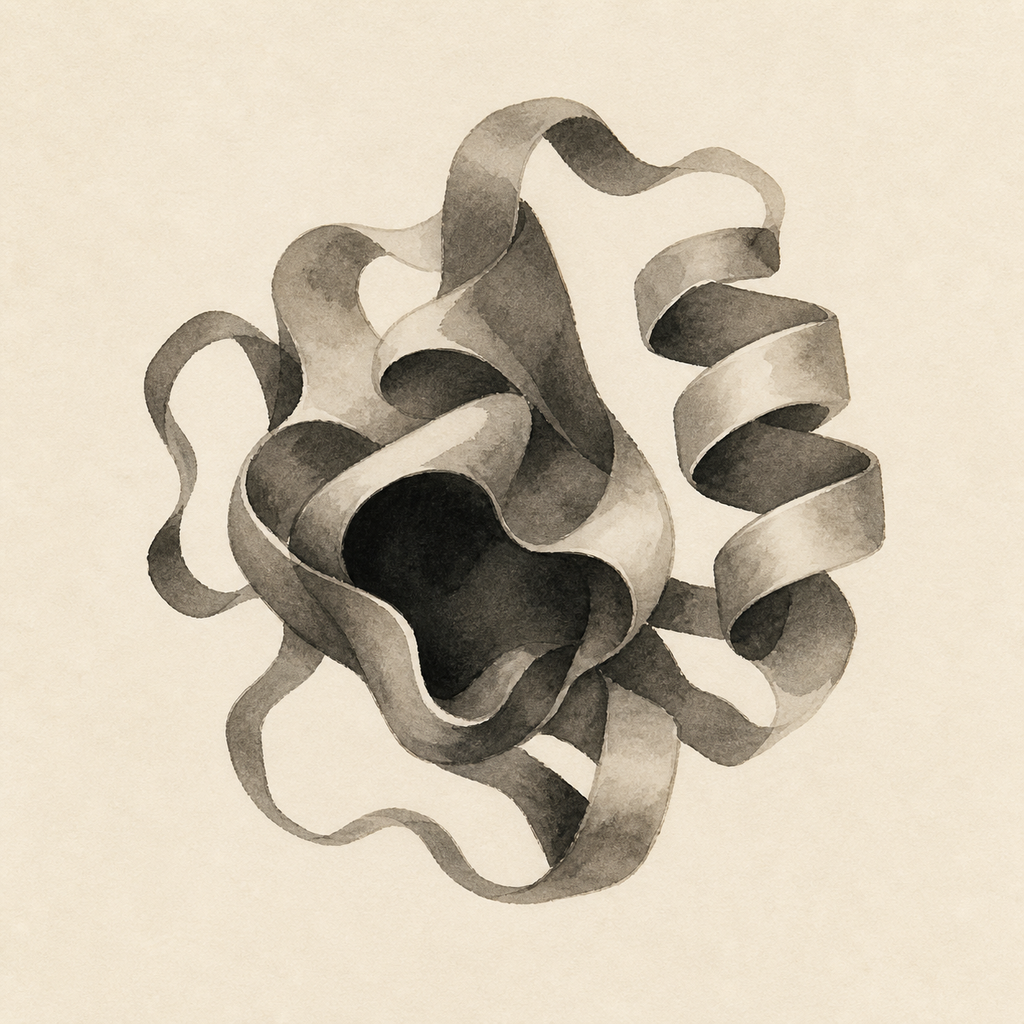
A protein is a chain — a string of amino acids drawn from an alphabet of twenty, linked in whatever order the gene dictates. Left in water, that limp chain collapses within moments into a specific, intricate three-dimensional shape, and the shape is everything: it decides whether the protein cuts other molecules apart, ferries oxygen, or lashes a cell together. What drives the folding is mostly a simple aversion — the amino acids that repel water bury themselves in the interior, dragging the chain into a compact ball, with subtler forces tuning the final contour. The pivotal discovery, made by Anfinsen around 1960, is that the instructions for the fold are written into the sequence itself: unravel a protein and let it refold, and it finds its way back to precisely the same shape. In principle, then, the sequence alone should determine the structure. In practice this remained one of biology's great unsolved problems for fifty years, because the number of shapes a chain could in theory take is astronomical — more arrangements than there are atoms in the universe — and singling out the one correct fold defeated every method tried. Enzymes reveal why the shape matters so exquisitely: a working enzyme is a fold contoured to cradle the exact molecule it acts on and to steady the strained, fleeting arrangement of a reaction caught halfway through, which is how it can hurry a chemical step along by a factor of billions. And when a protein folds wrongly and clumps together, the result is ruin — the plaques and tangles of Alzheimer's, the aggregates of Parkinson's, are misfolded proteins that have lost their proper shape.