Planetary Formation & The Snow Line
- Flattened gas-and-dust disks around young starsnot yet tested
- The snow line dividing rock from gas giantsnot yet tested
- Hot Jupiters, migration, and the Nice modelnot yet tested
- ALMA, PDS 70, and JWST imaging formationnot yet tested
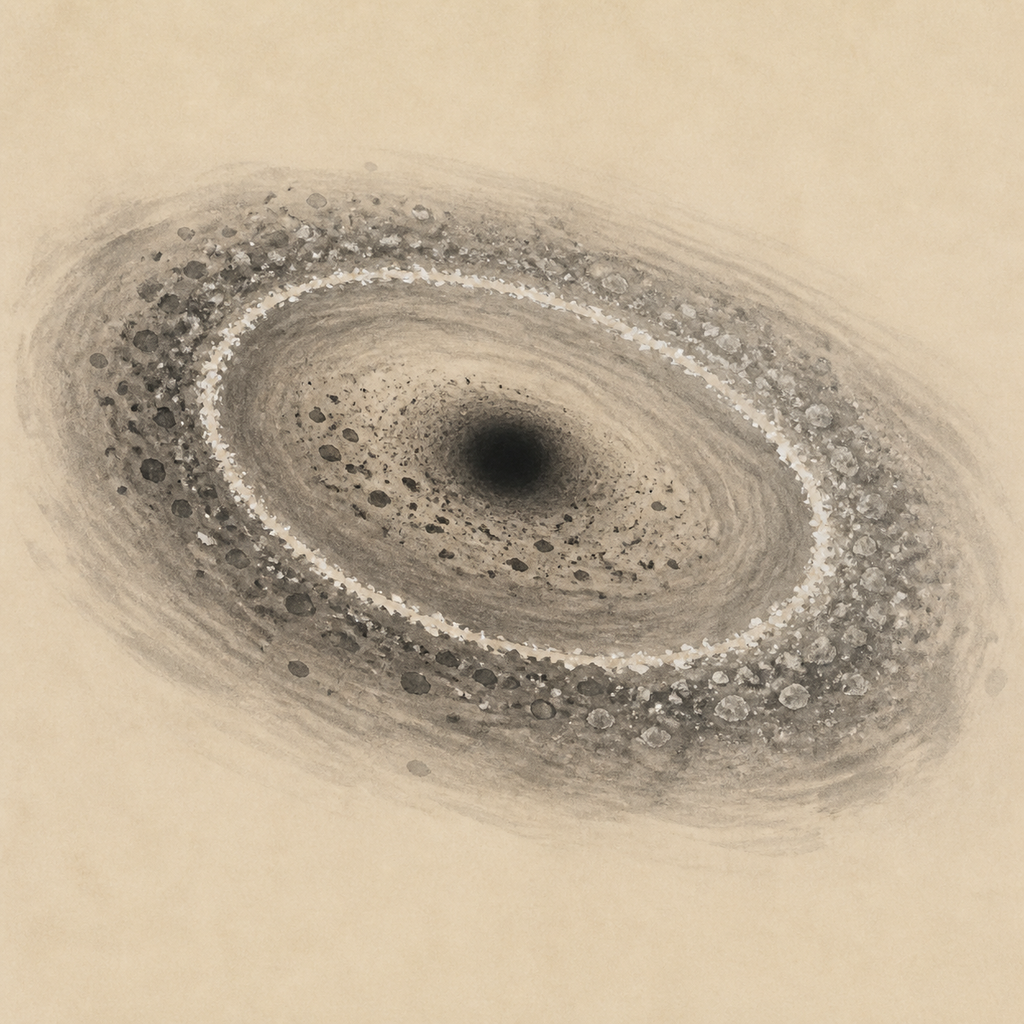
Pierre-Simon Laplace, in his Exposition du système du monde (1796), proposed that the solar system formed from a slowly spinning gaseous nebula that collapsed under its own gravity, flattened into a disk, and condensed into the Sun and planets. The hypothesis was speculative — the observations needed to test it would not arrive for two centuries — but Laplace had the right shape. In 2014, the ALMA radio interferometer in Chile resolved the protoplanetary disk around the young star HL Tau and saw exactly that: a flat dust disk, hundreds of AU across, threaded with dark concentric gaps where forming planets were sweeping their orbits clean. The picture has held: planetary systems form in flattened disks of gas and dust around young stars, on timescales of a few million years.
The single most important condition is the snow line, the radius beyond which the disk is cold enough for water to condense as solid ice rather than vapour. In the early solar system that line sat near 3 AU. Inside it, only refractory minerals — silicates, iron — could form solid grains, perhaps 1% of the disk's mass: not much to build with, which is why the inner planets stayed small and rocky. Outside the snow line, ices added several percent more solid mass, and the larger reservoir let cores grow rapidly to ~10 Earth masses — large enough to accrete the surrounding hydrogen and helium gas before the disk was blown away, perhaps 5–10 million years after collapse. Beyond the snow line you get gas giants; inside it, rocky worlds. The structure of the solar system is a fingerprint of one geometric line in the disk.
The Laplacian picture had planets forming where they ended up. The discovery of hot Jupiters — Jupiter-mass exoplanets in four-day orbits — broke that assumption: there is no plausible way to assemble a Jupiter so close to a star. The current understanding is that planets migrate through their disks, exchanging angular momentum with the gas. The Nice model (Tsiganis et al., 2005) proposes that Jupiter and Saturn drifted into a 1:2 mean-motion resonance about 3.9 billion years ago, jolted Uranus and Neptune outward, and flung small icy bodies inward. The late heavy bombardment — the spike in lunar cratering — is read as the consequence. Today's architecture is not the formation architecture.