Photography
- Daguerre 1839 and Talbot's negative-positive calotypenot yet tested
- Photons, silver halides, and the exposure trianglenot yet tested
- Mimesis surrendered: Impressionism to Cubismnot yet tested
- Winning the fine-art argument and the digital turnnot yet tested
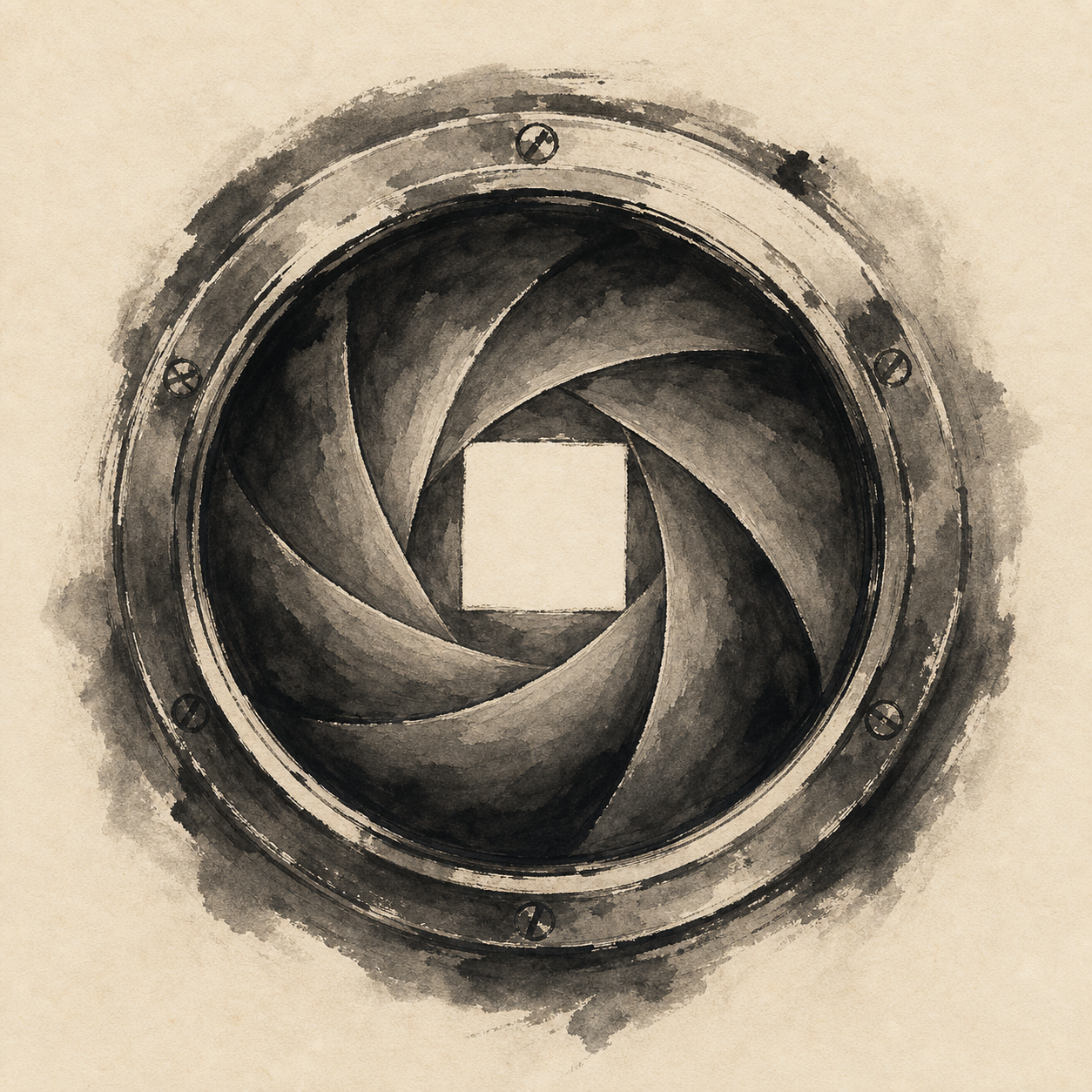
On 7 January 1839, François Arago announced to the French Academy of Sciences that Louis Daguerre had developed a process to produce fixed images from a camera obscura — direct chemical recordings of what the eye saw — and the French government promptly purchased the rights and gifted the process to the world. Two years later, William Henry Fox Talbot in England patented the calotype, the first negative-positive photographic process, and that lineage runs directly through film and digital to the contemporary smartphone. Photography's arrival was the most consequential single event in the history of representational art, because a machine could now draw what the eye saw with a fidelity no draughtsman could match — and the question for painting, what is painting for now that photography exists, drove the next century of art.
Photography reduces to a chemistry of photons striking a photosensitive surface (silver halides or digital photodiodes) and producing a latent image then developed, with modern colour photography using three layers — red, green, blue — or, in digital, a Bayer filter over the sensor. The optical control surface is small but expressive: the exposure triangle of aperture, shutter speed, and ISO sets exposure, while wide aperture produces shallow depth of field, fast shutter freezes motion, slow shutter renders motion as blur. What photography did to painting is the most-told story of its first century: the realist project was photography's last major rival in mimesis, and once the new medium was widely available painters moved deliberately away — Impressionism prioritized subjective light, Post-Impressionism further, Cubism abandoned single-viewpoint perspective entirely, so that by 1910 painting's avant-garde had given up representation. Photography in turn became its own art form: a first generation (Cameron, Brady) treated it as a technical novelty, a second (Stieglitz, Steichen, Strand) argued for photography as fine art and won, and by mid-century the medium had its own canon (Ansel Adams, Cartier-Bresson, Walker Evans, Diane Arbus, Robert Frank). Its third effect — on journalism, science, history, and personal memory — made photography the visual technology of the modern era. The digital transition has changed what photography is: smartphones matched casual-DSLR quality in the 2010s, computational photography (multi-frame stacking, AI noise reduction, AI-driven HDR) now extends capabilities beyond what optics alone can do.