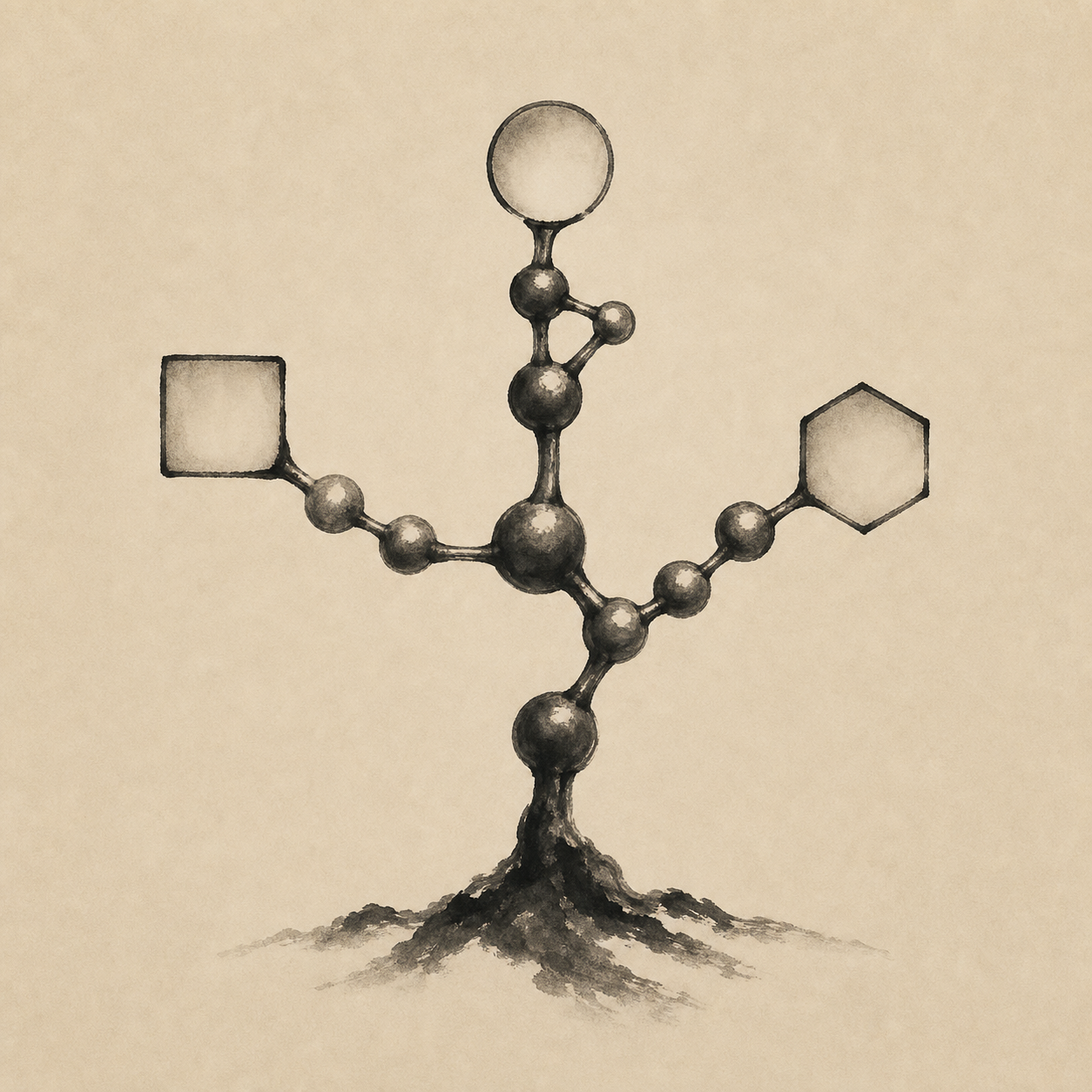
Organic Functional Groups
- Carbon's four-bond backbonenot yet tested
- Hydroxyl, carboxyl, carbonyl groupsnot yet tested
- Ethanol, acetone, and their classesnot yet tested
In 1828, Friedrich Wöhler, a German chemist working in Berlin, accidentally synthesized urea — previously thought to be uniquely produced by living organisms — from the inorganic compound ammonium cyanate. The result, communicated in a letter to his teacher Jöns Jacob Berzelius, was long credited with demolishing the prevailing doctrine of vitalism, the belief that organic compounds required a vital force unique to living things to produce; Wöhler wrote: I must tell you that I can make urea without thereby needing to have kidneys, or anyhow, an animal, be it human or dog. Organic chemistry — the chemistry of carbon — became, after Wöhler, a unified discipline connected to the rest of chemistry rather than a separate science of the living, and functional groups — small, recurring atomic arrangements that confer characteristic chemistry on a carbon skeleton — became the organizing principle that made the field's millions of compounds tractable.
Carbon is the unique foundation of organic chemistry because of its bonding versatility: four valence electrons, the ability to form long chains and rings, equal facility forming single, double, and triple bonds, and a self-bonding ability that lets it construct frameworks of arbitrary size. Most chemistry of carbon-rich molecules is conducted by substituents on the carbon skeleton — the functional groups. The hydroxyl (−OH) of alcohols and phenols is polar, hydrogen-bonds, and oxidizes to aldehydes, ketones, and carboxylic acids; the carbonyl (C=O) of aldehydes and ketones is highly reactive and underwrites much of synthetic organic chemistry; the carboxyl (-COOH) is acidic (pKa 4–5) and dimerizes in solution; the ester (R-COO-R') makes pleasant smells and is hydrolyzed by acid, base, or enzymes; the amino (−NH₂) is basic and polar; the amide (R-CO-NR'R'') links amino acids into proteins as the peptide bond and is unusually stable to hydrolysis; the phosphate (-OPO₃²⁻) builds the high-energy bonds in ATP and the backbone of DNA and RNA; sulfhydryl (-SH) and disulfide (-S-S-) bridges stabilize protein structure in cysteine residues; and the aromatic ring (benzene and its derivatives) gives the remarkable stability of delocalized π-electrons. The combinatorial power is what makes organic chemistry the most diverse branch of chemistry — about twenty functional groups, combined on carbon skeletons of essentially arbitrary length and shape, produce on the order of 10⁸ known compounds and an estimated 10⁶⁰ possible drug-sized molecules. Reaction mechanisms organize around functional-group transformations — substitution and elimination, addition to carbonyls, oxidation/reduction, condensation, cycloaddition — and retrosynthetic analysis (E. J. Corey, Nobel 1990) treats target molecules as products of disconnections at strategic functional groups, working backward to commercially available starting materials.