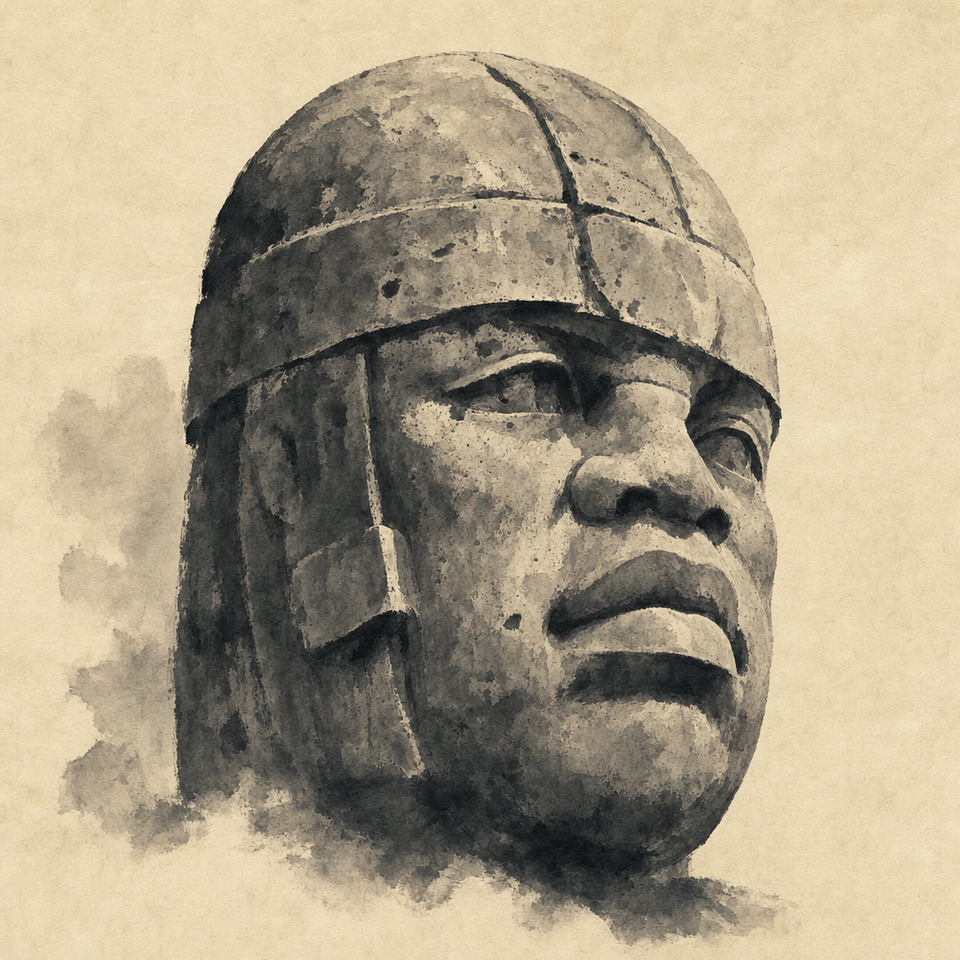
Olmec & Chavín
The Americas, in genetic isolation from Eurasia for roughly twelve thousand years, independently produced complex civilizations — without wheat, without horses, without iron, without the wheel as a working technology, without writing in most cases. The Olmec on the Mexican Gulf coast, around 1200 BCE, carved colossal basalt heads weighing twenty tons each and hauled them dozens of kilometres from the quarries without draft animals or wheels. Chavín de Huántar, high in the Peruvian Andes around 900 BCE, built a labyrinthine stone temple riddled with hidden galleries and water channels engineered to roar during ceremonies, while priests, plied with cactus hallucinogens, performed before crowds drawn from across the region. Two hemispheres ran the experiment of civilization in parallel, and never compared notes.
The Olmec and Chavín are the mother cultures of two great civilizational lineages — the Mesoamerican (Maya, Teotihuacan, Toltec, Aztec) and the Andean (Moche, Wari, Inka). The Olmec, centred on San Lorenzo and later La Venta, bequeathed downstream the long-count calendar, the ritual ballgame, jaguar-deity iconography, and very likely the earliest Mesoamerican glyphs. Chavín spread no empire at all but radiated a religious style — fanged, snarling, ecstatic — across the Peruvian highlands and coast for some five centuries, the first time the Andes shared a single visual cult. Each lineage independently developed monumental architecture, calendrical astronomy, complex polities, and forms of writing or quipu-style record-keeping, on a timeline running roughly parallel to the Old World. The Maya invented the concept of zero and tracked Venus's cycle to within minutes a year over centuries; their full glyphic script could write any sentence in their language. Teotihuacan grew to perhaps 125,000 people, among the largest cities on Earth in its day, laid out on a rigid grid around the Avenue of the Dead. The Inka state connected a large Andean population through roads, suspension bridges, relay stations, labour obligations, and knotted-cord records. Exchange included state redistribution, household reciprocity, and some market activity, while quipu served administrative purposes unlike Eurasian scripts. The American civilizations are not a delayed echo of Old World ones; they are an independent run of the experiment, arriving at cities, states, and high astronomy by entirely different roads, with different solutions to the same problems.