Ocean Acidification
- 8.2 → 8.1 as a 30% rise in H⁺not yet tested
- CO₂ dissolving and the carbonate-ion costnot yet tested
- Corals, pteropods, and the saturation horizonnot yet tested
- Oyster hatcheries and compounding reef stressnot yet tested
Surface-ocean pH has fallen from a preindustrial value of about 8.2 to roughly 8.1 over the last two centuries. Stated that way, the change sounds trivial. Stated correctly, it is staggering: pH is logarithmic, so a 0.1-unit drop is a roughly 30% rise in hydrogen-ion concentration in the largest body of water on Earth, accomplished against the backdrop of an ocean that had been chemically near-stationary for tens of millions of years. The shift is the direct chemical fingerprint of fossil-fuel CO₂. Roughly a third of every kilogram of carbon humans have burned has dissolved into seawater, and the ocean has remembered every gram of it.
Carbon dioxide does not sit inertly in seawater. It hydrates to carbonic acid, dissociates to bicarbonate and a free proton, and on a longer time-horizon some of those bicarbonate ions release a second proton to become carbonate. The full system — CO₂ ⇌ H₂CO₃ ⇌ HCO₃⁻ ⇌ CO₃²⁻ — is a buffer, and like any buffer it absorbs added acid by shifting its equilibria. The cost of this absorption is a falling carbonate-ion concentration: each H⁺ added consumes a CO₃²⁻ to form HCO₃⁻. That hidden bookkeeping is what makes acidification matter biologically.
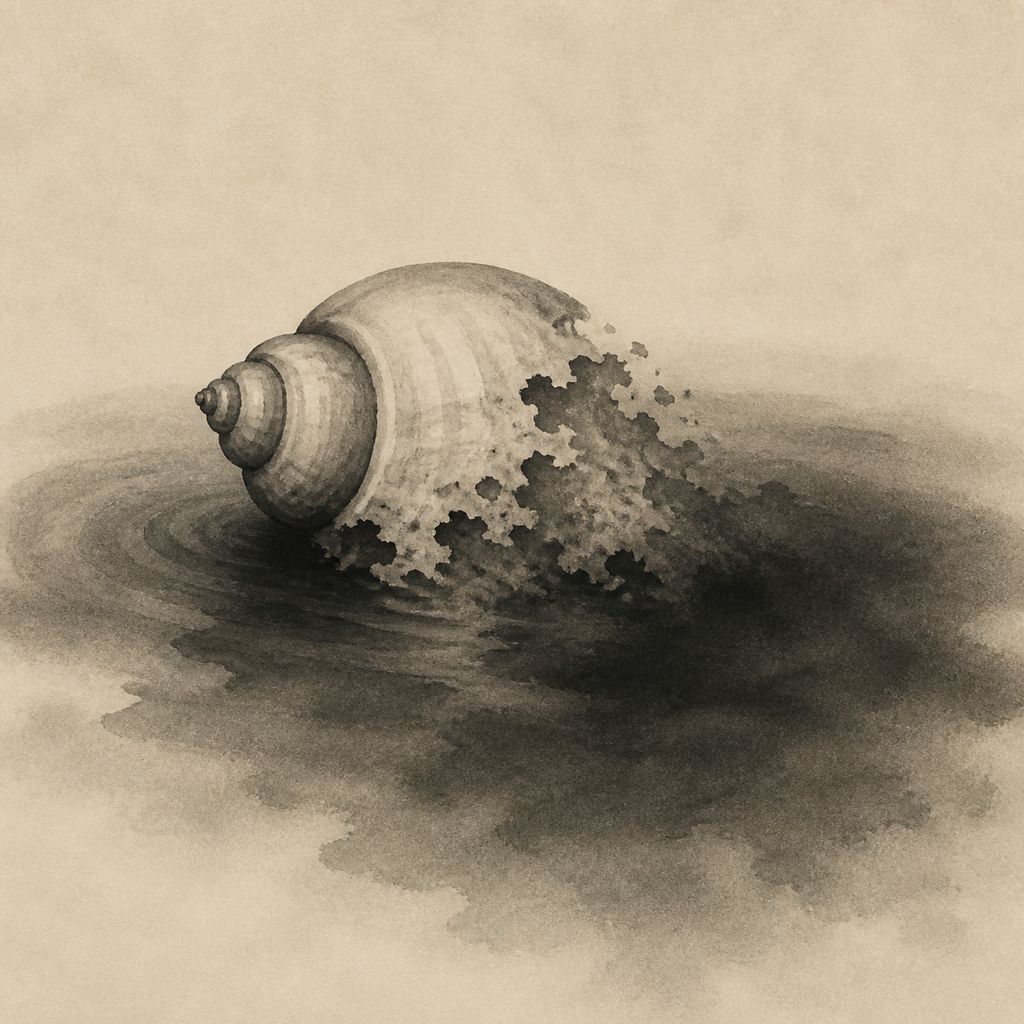
Marine calcifiers — corals, mussels, oysters, sea urchins, and most consequentially the carbonate-shelled plankton (coccolithophores, foraminifera, and the pteropod sea-snails that anchor polar food webs) — build their skeletons out of calcium carbonate, and the ease of doing so depends on how saturated the surrounding water is with carbonate. Below a critical depth — the carbonate saturation horizon — seawater is undersaturated, and shells start to dissolve faster than organisms can build them. That horizon has risen by tens to hundreds of meters since 1850 in many basins, and in parts of the Southern Ocean it now reaches almost to the surface. A young oyster larva trying to lay down its first shell in increasingly corrosive water is, biochemically, in the same situation as a mason given progressively softer brick: at some point the structure will not stand.