Nitrogen, Phosphorus & The Nutrient Cycles
- Haber-Bosch fixing of atmospheric N₂not yet tested
- Nitrogen as the limiting nutrientnot yet tested
- Phosphorus, apatite rock, and peak supplynot yet tested
- Doubled flux and transgressed boundariesnot yet tested
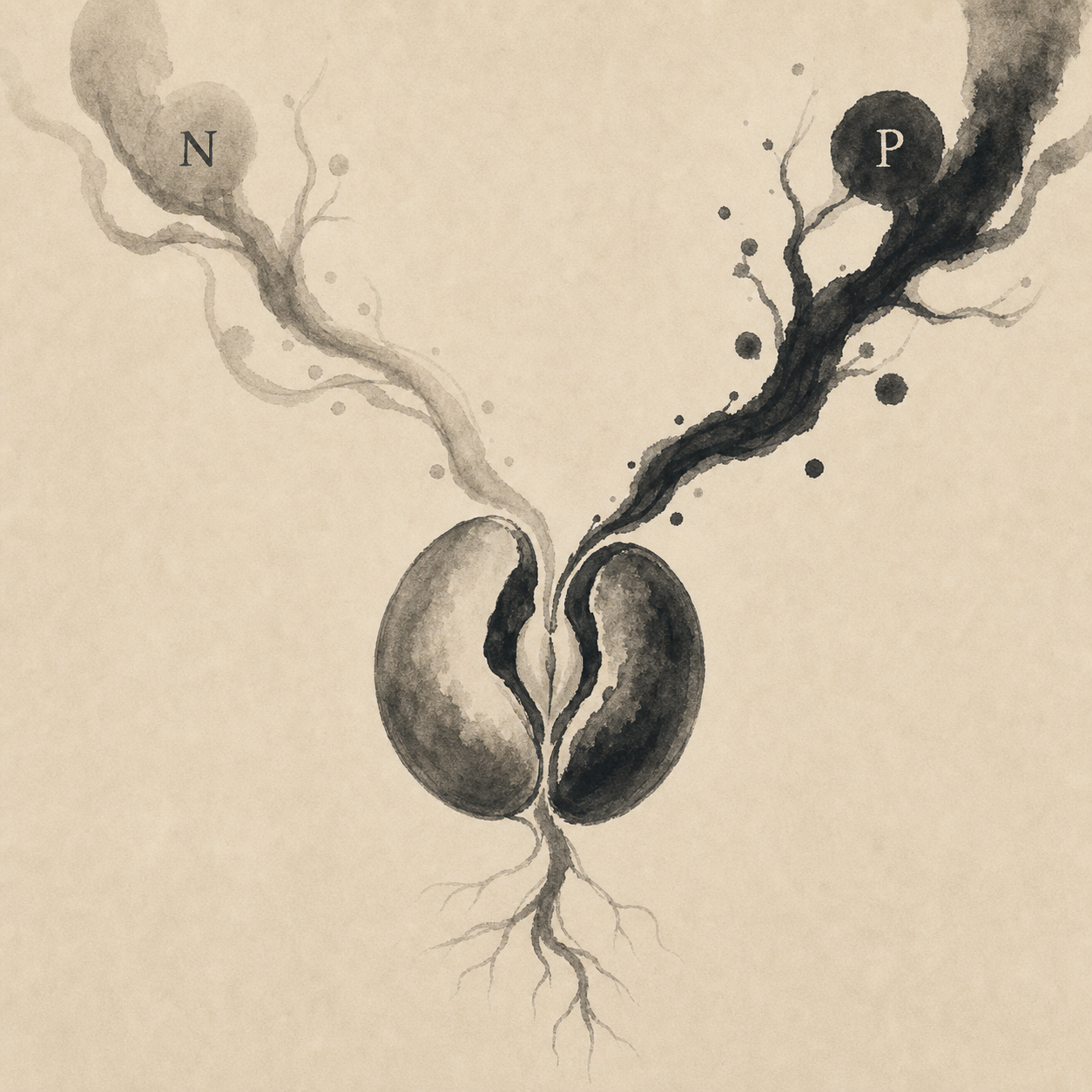
In 1909, the German chemist Fritz Haber developed a process to combine atmospheric nitrogen (N₂) with hydrogen under high temperature and pressure to produce ammonia (NH₃). The chemistry was difficult: N₂ is one of the most stable molecules in the universe, with a triple bond; fixing it requires conditions near 400°C and 200 atmospheres. Carl Bosch at BASF industrialized the process at scale by 1913. The Haber-Bosch process now consumes roughly 1-2% of all global energy use and produces ~150 million tonnes of fixed nitrogen per year — roughly doubling the planet's active nitrogen flux. About half of the nitrogen in the protein in every living human body has passed through this industrial process. Roughly half the people now alive would not be alive without it. Vaclav Smil's Enriching the Earth (2001) is the canonical history. The process is the single most-important industrial-chemistry development of the twentieth century and one of the largest human perturbations of any planetary biogeochemical cycle.
Nitrogen is the most-common limiting nutrient in terrestrial ecosystems. Plants and most other organisms cannot use atmospheric N₂ directly; they require fixed nitrogen in the form of ammonia, nitrate, or organic compounds. Before humans, the budget was set by natural sources — biological fixation by Rhizobium and other bacteria added perhaps 200 Mt of fixed nitrogen per year, and denitrification by anaerobic bacteria closing the loop. Anthropogenic fixation — Haber-Bosch ammonia plus the NOₓ produced as a byproduct of fossil-fuel combustion — has roughly doubled the active flux. The doubled nitrogen flows through agricultural systems (fertilizer → crops → food → human waste → river → ocean) and through unintended pathways: atmospheric NOₓ becoming acid rain, nitrate leaching into groundwater, runoff fueling coastal blooms. Phosphorus is the cycle's other limiting nutrient and chemically simpler — there is no atmospheric phase, no gaseous form under ambient conditions. The phosphorus cycle is weathering-limited on geological timescales: phosphate rock (apatite) is mined and processed into fertilizer. World phosphate reserves are finite, and roughly 70% sit in Morocco and Western Sahara. Cordell et al. (2009) raised peak phosphorus concerns; immediate-term reserves are not depleting, but the strategic concentration of supply is real, and the EU has had phosphate rock on its Critical Raw Materials list since 2014. The Rockström planetary-boundaries framework places biogeochemical flows (N and P together) among the nine boundaries the Earth system can tolerate, and counts it among those already transgressed. The proposed safe nitrogen-flux boundary is ~62 Mt/yr against current >150 Mt/yr; for phosphorus, ~6.2 Mt/yr against ~14 Mt/yr. The argument is that the aggregate stress — eutrophication of coastal waters, acid deposition on terrestrial ecosystems, soil acidification — is qualitatively destabilizing relative to Holocene baselines.