Neurotransmitters
- Glutamate excites, GABA inhibits fast signallingnot yet tested
- Dopamine, serotonin, acetylcholine, and peptidesnot yet tested
- Ionotropic vs metabotropic, reuptake and degradationnot yet tested
- Psychiatric and recreational drugs on the same targetsnot yet tested
By the early 1960s the psychopharmacological revolution had already happened — chlorpromazine (1952) for psychosis, imipramine (1957) for depression, meprobamate and the benzodiazepines (1960) for anxiety, lithium (rediscovered 1949) for mania — and yet no one knew how any of these drugs worked: the clinical effects were obvious, the molecular mechanisms guesses. The breakthrough came when Arvid Carlsson, a Swedish pharmacologist working in Lund, showed in 1957 that reserpine — a hypertension drug that caused depression as a side effect — depleted dopamine in the brain, and that L-DOPA could replace it. The implication was epochal: specific small molecules, present in tiny quantities at synapses, governed mood and movement. Carlsson eventually shared the 2000 Nobel Prize, and the half-dozen molecules that do most of the brain's signalling have in the six decades since become the most-targeted protein family in the entire pharmacopeia.
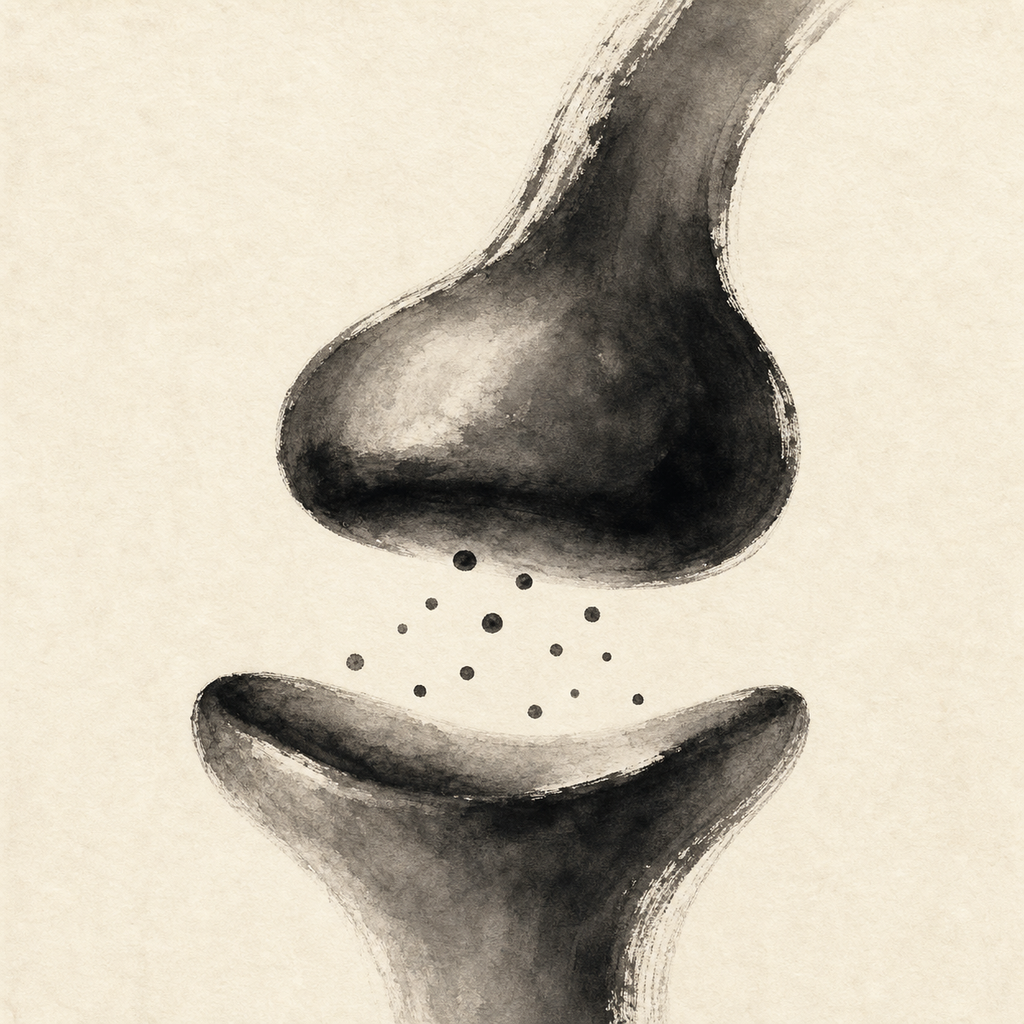
Neurotransmitters are small molecules released by neurons at synapses to alter the behaviour of the postsynaptic cell, and they fall into a few classes that do qualitatively different jobs. The amino acids carry the bulk of fast signalling — glutamate is the dominant excitatory transmitter (~80% of cortical synapses), GABA the dominant inhibitory (~15%), and almost all moment-to-moment information transfer runs through them. The monoamines — dopamine (motivation, motor control, reward-prediction error), serotonin (mood, sleep, appetite; ~90% of body serotonin lives in the gut), norepinephrine (arousal, fight-or-flight), and histamine (wakefulness) — are modulatory rather than primary, acting slowly across populations of neurons, while acetylcholine (Loewi 1921, the first transmitter discovered) runs the neuromuscular junction and cortical attention circuits, and neuropeptides (endorphins, oxytocin, orexin) and the gas-phase nitric oxide round out the list. Receptors split into two architectures: ionotropic (ligand-gated ion channels, fast and direct) and metabotropic (G-protein-coupled, slow but vastly amplifying), and most transmitters carry multiple receptor subtypes — serotonin has at least 14, acetylcholine splits into muscarinic and nicotinic families, dopamine into D1-like and D2-like. Clearance happens through reuptake transporters (SERT is the SSRI target, DAT the cocaine and amphetamine target), enzymatic degradation (acetylcholinesterase is the target of both nerve agents and Alzheimer's drugs; monoamine oxidase the target of MAOIs), or diffusion. The clinical implications are vast — antidepressants target monoamine systems, antipsychotics block dopamine D2 plus serotonin 5-HT2A, benzodiazepines potentiate GABA-A, stimulants raise cortical dopamine and norepinephrine, opioid analgesics target endogenous opioid receptors — and the striking fact is that the recreational pharmacopeia uses largely the same molecular targets for different purposes: alcohol enhances GABA and inhibits glutamate, caffeine blocks adenosine, nicotine binds nicotinic ACh receptors, cannabis hits CB1, and psychedelics bind 5-HT2A.