Negative Feedback
- Output counteracts further changenot yet tested
- Setpoint, error, and correctionnot yet tested
- Homeostasis: the body's balancing loopsnot yet tested
James Watt, building his improved steam engines in Birmingham in 1788, fitted them with a device used since the seventeenth century to regulate grain mills. Two heavy metal balls hung from hinged arms above the engine's vertical shaft; as the engine spun faster the balls flew outward, lifting a sleeve that progressively closed the steam-admission valve; as it slowed they dropped and the valve reopened. The centrifugal governor was the first widely deployed self-regulating machine in industrial history, and the engine that wore one could run for hours at steady speed without an operator's attention. Eighty years later James Clerk Maxwell read a paper to the Royal Society titled simply On Governors (1868); it gave the first rigorous mathematical analysis of when feedback loops stabilize and when they oscillate, founding control theory.
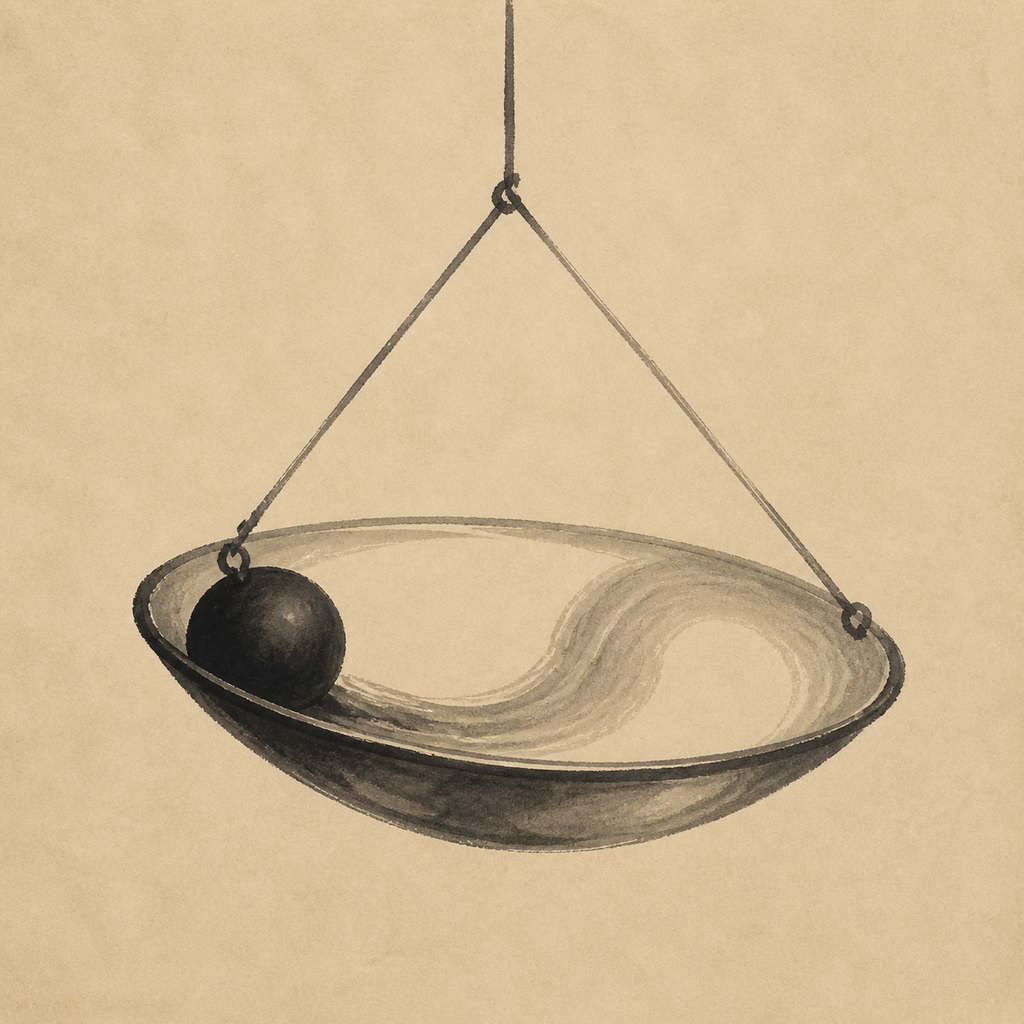
A negative-feedback loop is a closed-loop arrangement in which a deviation from a setpoint triggers a correction proportional to the deviation, driving the system back. The structure has four parts — measurement of the controlled variable, comparison against the setpoint, an error signal, and an actuator whose action reduces the error — and is the structural signature of stability. Body temperature: a rise above 37 °C triggers vasodilation and sweating; a fall triggers vasoconstriction and shivering. Blood pH: deviations from 7.4 are corrected by respiratory rate on a timescale of seconds and by renal bicarbonate excretion on a timescale of hours. Walter Cannon named the biological version homeostasis in 1926; Norbert Wiener's 1948 Cybernetics generalized the framework to biology, society, and computation, and gave the field its name. Thermostats drive a room toward setpoint, cruise control drives a car toward target speed, the Taylor rule drives inflation toward target — the mathematics is the same. Maxwell's paper established that not every feedback loop stabilizes. Too much gain overshoots and oscillates; so does too much delay between measurement and action. The Routh-Hurwitz criterion (1875, 1895) gave an algebraic test for stability. Harold Black's 1927 invention of the negative-feedback amplifier at Bell Labs — sketched on a copy of The New York Times during his Hudson ferry commute — made high-quality long-distance telephony possible by trading raw gain for linearity. Harry Nyquist (1932) and Hendrik Bode (1945) supplied the frequency-domain tools — Nyquist criterion, gain margin, phase margin — that remain the standard analysis. The PID controller is the workhorse industrial implementation, present in essentially every modern process-control system from steel mills to spacecraft.