Nash Equilibrium
- No profitable unilateral deviationnot yet tested
- Nash, Princeton, A Beautiful Mindnot yet tested
- Prisoner's Dilemma and zero-sum gamesnot yet tested
- Game theory as strategic interactionnot yet tested
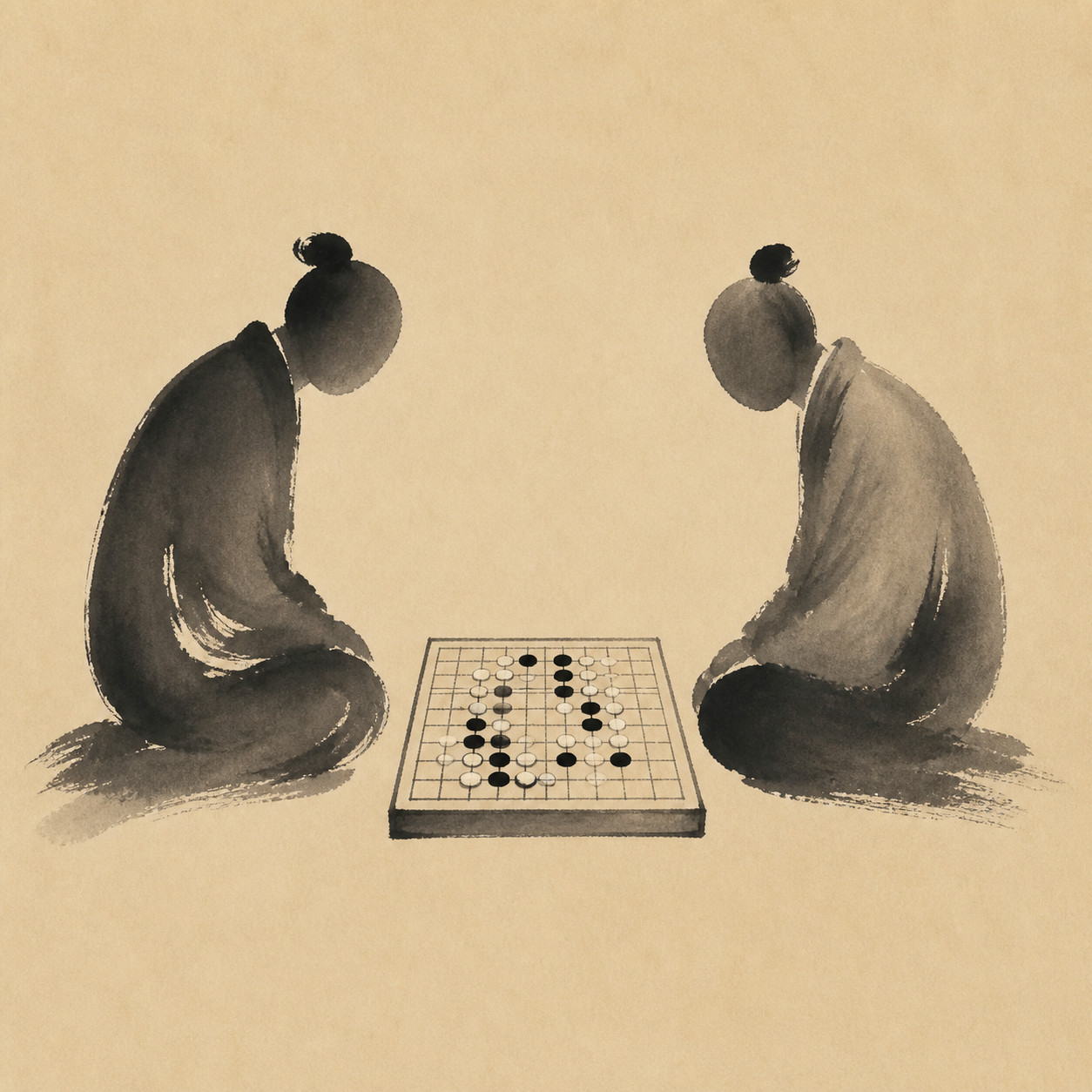
In 1950, John Forbes Nash — twenty-one and a graduate student at Princeton — submitted a 27-page PhD dissertation defining what is now called a Nash equilibrium: a configuration of strategies in a game such that no player can improve her outcome by unilaterally changing her strategy. The existence theorem he proved (every finite game with mixed strategies has at least one Nash equilibrium) used a fixed-point argument from Kakutani — technically straightforward, conceptually transformative. It became the unifying concept of game theory, the framework in which strategic interaction — oligopoly pricing, arms races, evolutionary biology, dating markets, AI alignment — could be analyzed with the same tools. Nash's 1994 Nobel and the public story of his schizophrenia recovery (A Beautiful Mind, 1998/2001) gave the concept a public face few mathematical objects achieve.
A game is a triple — a set of players, a set of strategies available to each, and a payoff function mapping combinations of strategies to outcomes — and a Nash equilibrium is a strategy profile in which each player's strategy is a best response to the others, so no one has a unilateral incentive to deviate. The concept matters because it generalizes equilibrium — the central concept of supply-and-demand analysis — to settings with strategic interaction and interdependence. The most-cited example is the Prisoner's Dilemma, where both players defect even though both would do better by cooperating, and the same structure recurs in arms races, climate cooperation, public-goods provision, and antibiotic stewardship. Other workhorse cases include Bertrand competition (two firms set prices, equilibrium is marginal cost and zero profit), Cournot competition (quantity-setting yields an outcome between monopoly and perfect competition), and the Hawk-Dove model from evolutionary biology, where Maynard Smith's evolutionary stable strategy is a Nash equilibrium with mutation-stability. The concept has been refined — subgame perfect equilibrium (Selten) eliminates non-credible threats in sequential games, Bayesian Nash equilibrium (Harsanyi) handles incomplete information, correlated equilibrium (Aumann) admits coordination devices. Four standard objections recur: many real games have multiple Nash equilibria and the theory does not predict which will emerge (selection requires focal points — Schelling 1960 — or evolutionary dynamics), actual humans do not compute equilibria and behavioural game theory finds systematic deviations, the common knowledge of rationality assumption is rarely met, and the equilibrium is a prediction about behaviour rather than a recommendation. What survives is that Nash equilibrium remains the most-used framework for reasoning about strategic interaction.