Napoleon & the Napoleonic Order
Between 1799 and 1815, a Corsican artillery officer named Napoleon Bonaparte rose from the coup of 18 Brumaire to emperor of the French, conquered most of continental Europe, and was finally defeated by a coalition of Britain, Russia, Prussia, and Austria. He crowned himself in Notre-Dame in 1804; he won at Austerlitz and lost half a million men in the snows of the 1812 Russian campaign. He was exiled twice — to Elba, then, after the Hundred Days and Waterloo, to St. Helena, where he died in 1821. He is the model for every modern military adventurer — and, more importantly, the administrator who finally consolidated the French Revolution's legal reforms into a system that the rest of Europe would imitate for the next two centuries.
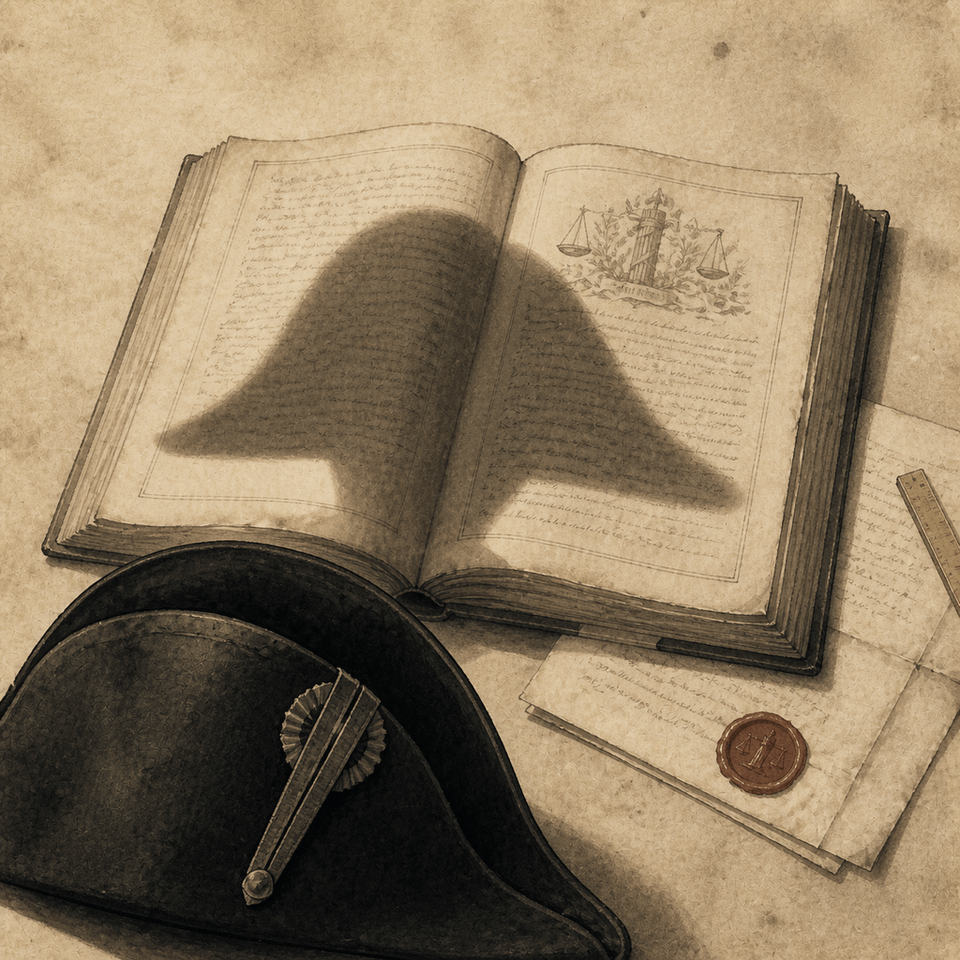
Napoleon's military genius — the manoeuvre on the central position, the corps system, the use of massed artillery as a decisive arm — is what every military academy still teaches. But his durable legacy is the Code Napoléon (1804): a single, accessible civil law code, replacing the roughly 360 overlapping medieval and feudal jurisdictions of the old regime. Equality before the law, property rights, secular marriage and divorce, abolition of feudal privilege — codified in plain articles a literate peasant could read. It was illiberal in places (women lost legal autonomy; the wife owed obedience), but its clarity was revolutionary. The Code was imposed across French-occupied Europe and survived its imposer. Modern French, Belgian, Dutch, Italian, Spanish, Portuguese, Polish, and — via colonial transmission — Latin American, Egyptian, and Québécois civil law are all Napoleonic. His other legacy is the modern state: centralized administration, a professional salaried civil service recruited by merit, the lycée, prefects governing the departments, the cadastre mapping property for taxation, the Banque de France, and a gendarmerie enforcing rural order. The template is recognizable in nearly every continental European country, and the rationalist ambition — that an entire society could be re-engineered from a desk — is itself part of the inheritance.