Mendelian Inheritance
- Mendel and the pea experimentsnot yet tested
- Alleles and dominant–recessive ratiosnot yet tested
- Chromosomes and parental transmissionnot yet tested
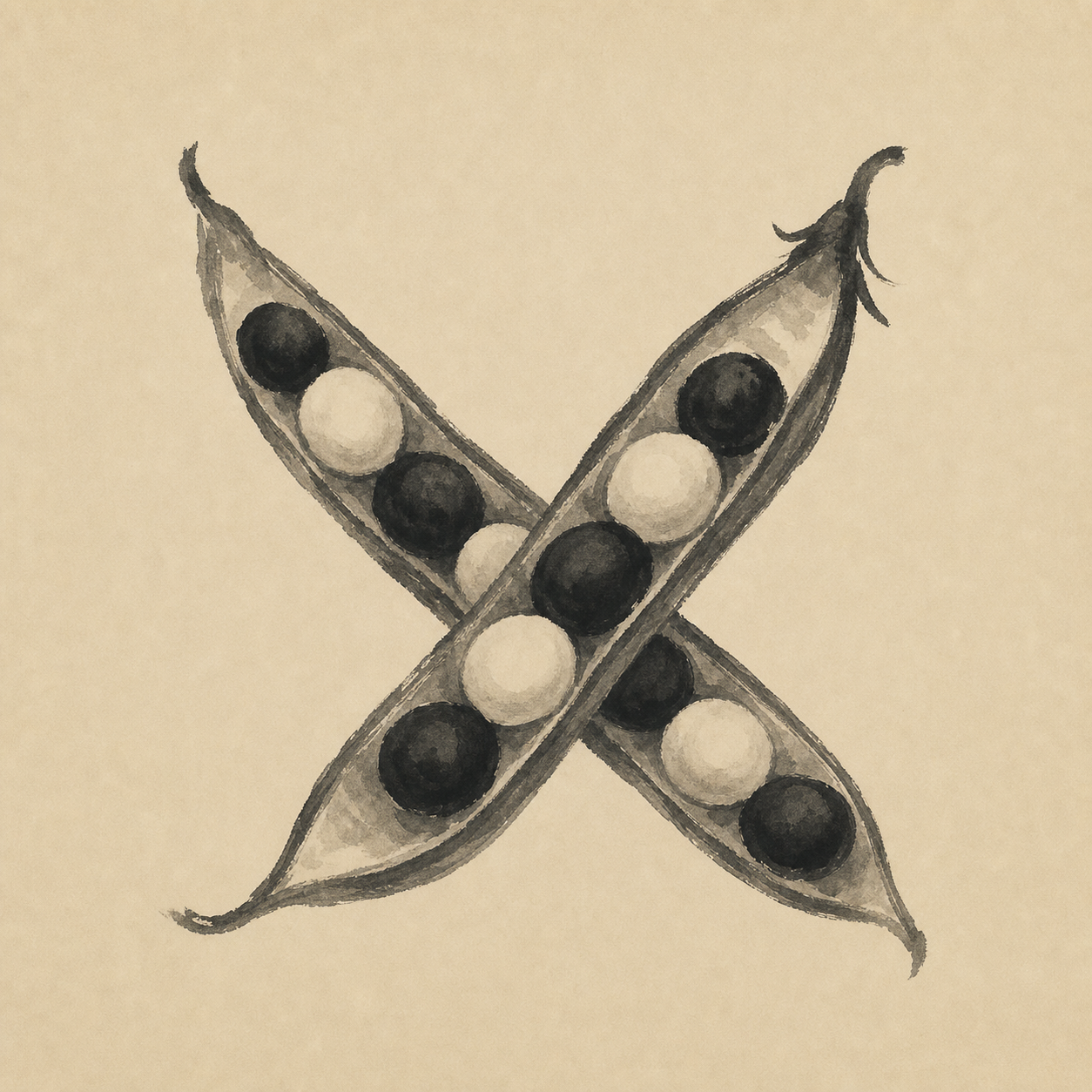
From 1856 to 1863, an Augustinian friar named Gregor Mendel grew somewhere around 28,000 pea plants in the garden of his monastery in Brno and counted their offspring. He had picked seven pairs of contrasting traits — tall versus short, yellow seed versus green, round versus wrinkled — and tracked the ratios across generations. The numbers were not random: roughly 3:1 in the second generation, 9:3:3:1 when he tracked two traits at once. Mendel published in 1866 in a regional journal that no one read for thirty-four years; in 1900, three botanists rediscovered the paper independently and, finding his name in their literature searches, named the laws after him. The science of genetics was founded backwards — its discoverer long dead, his laws bearing the name of a man whose work had already been sitting on European library shelves for a generation.
Mendel's central discovery was that inheritance is particulate. The dominant nineteenth-century picture had been blending: a tall parent and a short parent should produce intermediate children, with variation washing out across generations like cream stirred into coffee. Mendel's ratios said the opposite. Each parent contributed discrete copies of each trait, those copies segregated cleanly during gamete formation, and traits could disappear in one generation only to re-emerge in the next at predictable frequencies. The physical basis was worked out around 1903, when Sutton and Boveri identified Mendel's abstract "factors" with the chromosomes biologists had been watching divide under the microscope. Thomas Hunt Morgan's fly room at Columbia then showed that genes which failed to assort independently were linked on the same chromosome, and that the frequency of recombination between them measured their physical distance — the trick that let geneticists draw chromosome maps decades before anyone could read DNA chemically.
What Mendel found in his pea garden turned out to be the clean corner of a much messier landscape. His seven traits were, by accident, controlled by single genes mostly on different chromosomes; most human variation is not like that. Single-gene disorders — sickle-cell, cystic fibrosis, Huntington's, the roughly seven thousand other Mendelian conditions catalogued — follow Mendel's ratios precisely and are now the easy targets for genetic counseling and the first generation of gene therapies. But most common diseases are polygenic: hundreds or thousands of variants, each contributing a small effect, summed against a background of environment and chance. The genome-wide association era since 2005 has identified tens of thousands of disease-associated variants, and polygenic risk scores aggregating them now outperform Mendelian-disease screening for clinical prediction of common conditions. Hardy-Weinberg's 1908 statement of allele-frequency conservation is, in this larger frame, the null hypothesis against which evolution is detected — departures from it are the signal that selection, drift, mutation, or migration are at work.