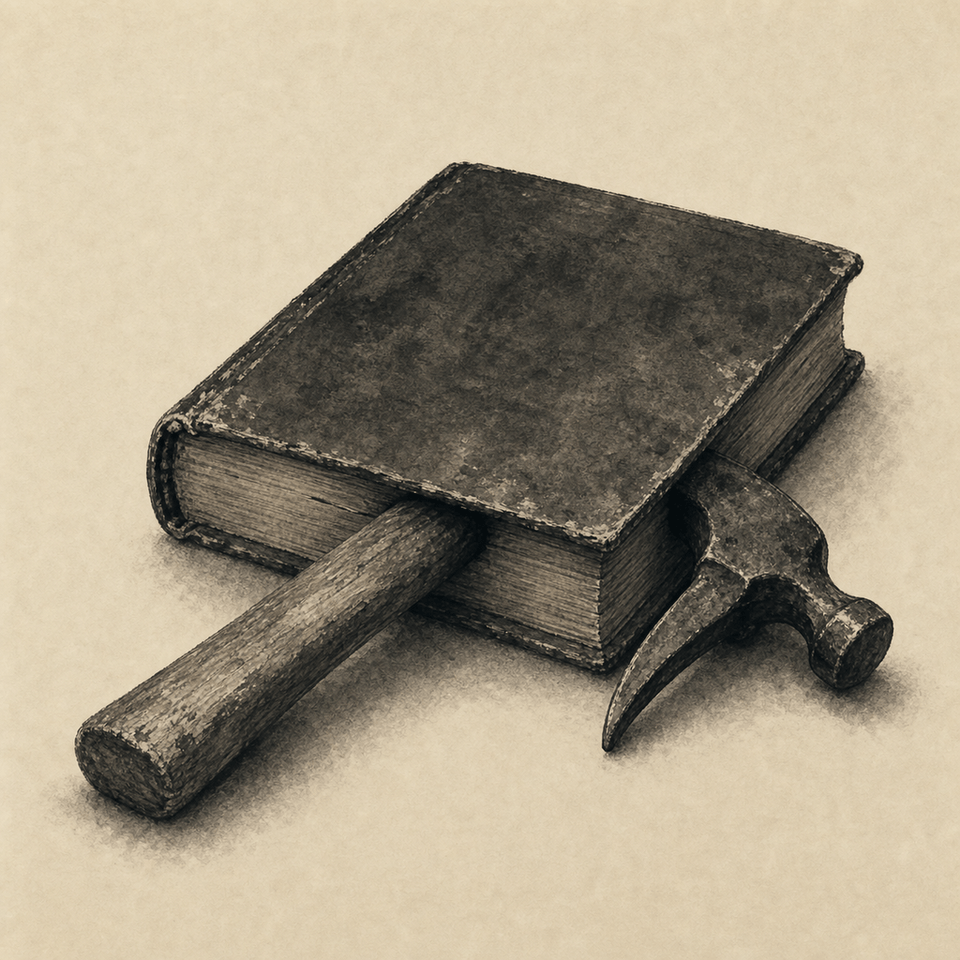
Marx & the Labour Question
Karl Marx, a German exile working in the Reading Room of the British Museum between 1850 and his death in 1883, produced the most influential analysis of industrial capitalism ever written — Das Kapital, whose first volume appeared in 1867 while its author lived on handouts from Engels, a Manchester cotton manufacturer whose family firm was itself part of the system Marx anatomized. He was not original in noticing that the new order was producing extraordinary wealth alongside extraordinary misery — Engels, Dickens, and a thousand reformers had said the same. He was original in offering a theoretical structure that claimed to explain why this was inevitable, how the wealth was extracted, what would happen next, and what the working class should do about it.
Marx's empirical claims were more durable than his predictions. At the core was his theory of surplus value: that profit comes from paying workers less than the value their labour adds, so exploitation is not an abuse of the system but its engine. His description of commodification — that under capitalism, more and more aspects of human life become things to buy and sell — has proved enduringly accurate. His analysis of crises of overproduction, in which industrial economies periodically produce more than their underpaid workers can buy, anticipated the business cycle that mainstream economists have studied ever since; the slumps of 1873, 1929, and 2008 each rhymed with his account. His critique of alienation — that workers do not own what they produce, do not control how they work, and are reduced to instruments of someone else's capital — speaks more clearly to the gig economy than to its nineteenth-century targets. His predictions — proletarian revolution, the immiseration of the workers, the collapse of capitalism into communism — have not aged well; the working classes of the developed world mostly bought houses, joined unions, and voted social democrat, and capitalism proved able to reform itself, partly by conceding the welfare state that Marxists thought it never would. But the frame — that economic structure shapes politics, that class is a useful unit of analysis, that capitalism has internal contradictions that periodically explode — is now part of the standard equipment of any thoughtful observer of the modern world, used daily by people who have never read a word of him.