Marches & Sousa
- Sousa as the Beethoven of the marchnot yet tested
- From janissary bands to Civil War town bandsnot yet tested
- The fixed arc of Sousa formnot yet tested
- Wind ensembles and marching bands todaynot yet tested
John Philip Sousa (1854–1932) directed the United States Marine Band from 1880 to 1892 and then founded the Sousa Band, the most popular concert ensemble in the world from 1892 to roughly 1925. He wrote 136 marches. Five — Stars and Stripes Forever (1896), The Washington Post March (1889), Liberty Bell March (1893), Semper Fidelis (1888), and The Thunderer (1889) — are the definitive examples of the form. Stars and Stripes Forever was designated the national march of the United States by an act of Congress signed in December 1987. Sousa's place in the march tradition is roughly the place Beethoven holds in the symphony: not the inventor, but the figure whose work fixed the genre's canonical shape.
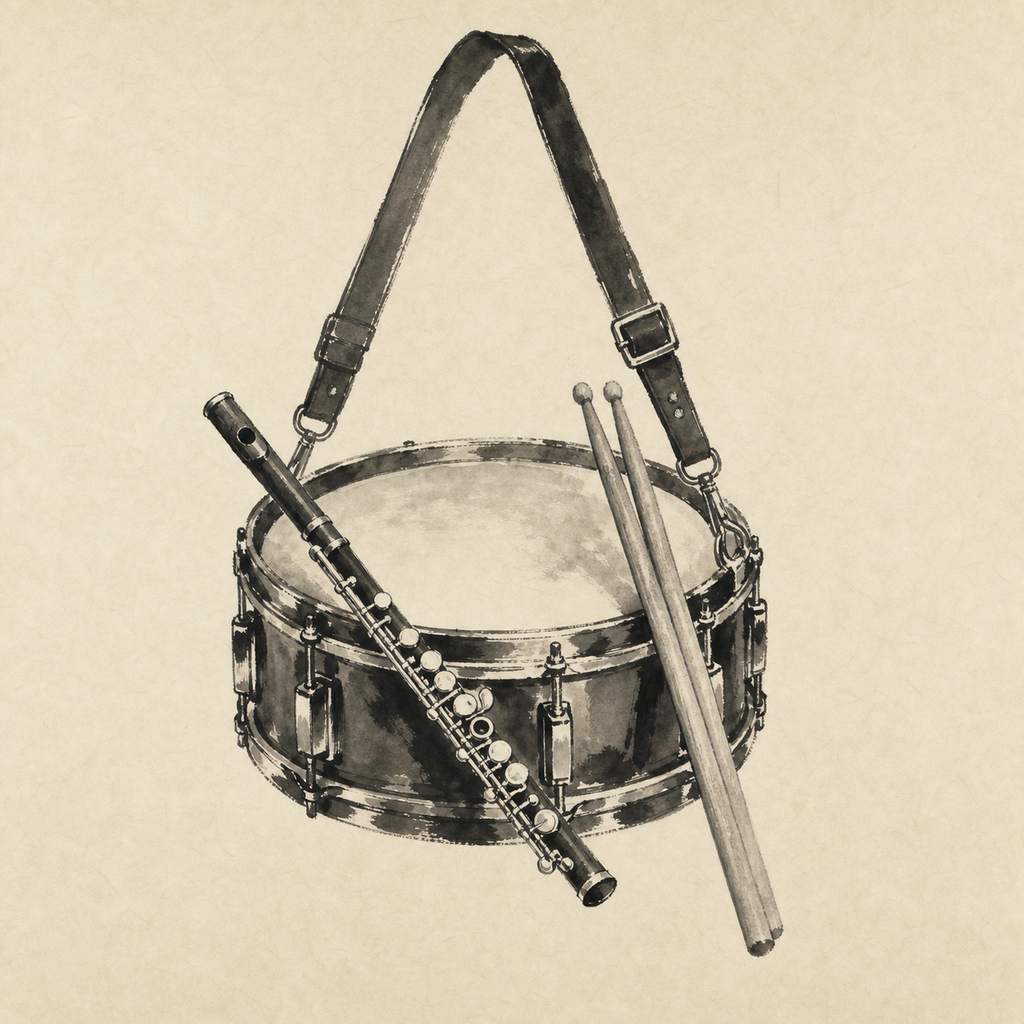
The march as a musical form descends from European military music — the Ottoman janissary bands' brass-and-percussion ensembles that traveled with Suleyman's army impressed European observers from the sixteenth century, and Frederick the Great's Prussian drill regulations of the 1740s codified marching tempo (Quick Step at ~120 bpm) and the function of music as drill regulator. The American Civil War mass-produced brass bands on both sides; after the war the surplus instruments and trained players seeded the town band tradition, and the United States Marine Band — the President's Own, founded 1798 — became the country's flagship ensemble. Sousa form (the canonical American march structure) follows a fixed arc: introduction (often a four-bar fanfare), first strain (in the home key, repeated), second strain (frequently more contrapuntal, repeated), trio (in the subdominant key, lyrical, often quieter), break strain (loud, contrapuntal, the dramatic centre), trio reprise with grandioso (the famous piccolo countermelody in Sousa's most-played march is the textbook example). Meter is almost always 2/4 (the military quickstep) or 6/8 (the quickstep in compound meter). Instrumentation centres on brass and percussion with woodwind colour; piccolo and snare drum are the two voices most identified with the form. Adjacent traditions: the Strauss family's Radetzky March (1848) extended the form into Viennese ballroom music; Edward Elgar's Pomp and Circumstance Marches (1901–1930) — especially No. 1, the source of Land of Hope and Glory — became the British equivalent of Sousa; Tchaikovsky's 1812 Overture incorporates an explicit military-march vocabulary. Karl King, Henry Fillmore, and Edwin Franko Goldman continued the American march tradition into the mid-twentieth century.