Linear Transformations
- T(au + bv) = a·T(u) + b·T(v)not yet tested
- Every linear map is a matrix on a basisnot yet tested
- Rotations, reflections, projections, shearsnot yet tested
- Kernel, image, and the rank-nullity theoremnot yet tested
In 1872, the German mathematician Felix Klein — twenty-three years old and freshly appointed to a chair at Erlangen — published, for the occasion of his appointment, a programme proposing a radical reorganization of geometry. Geometry, Klein argued, is the study of which properties are invariant under which transformations. Euclidean geometry is what survives under rotations, reflections, and translations. Affine geometry is what survives under linear maps that preserve parallel lines. Projective geometry is what survives under arbitrary projections. The transformations come first; the geometry is what's left over. The Erlangen Programme reorganized nearly all of nineteenth-century geometry, and it elevated transformations themselves — particularly linear ones — into the central object of study.
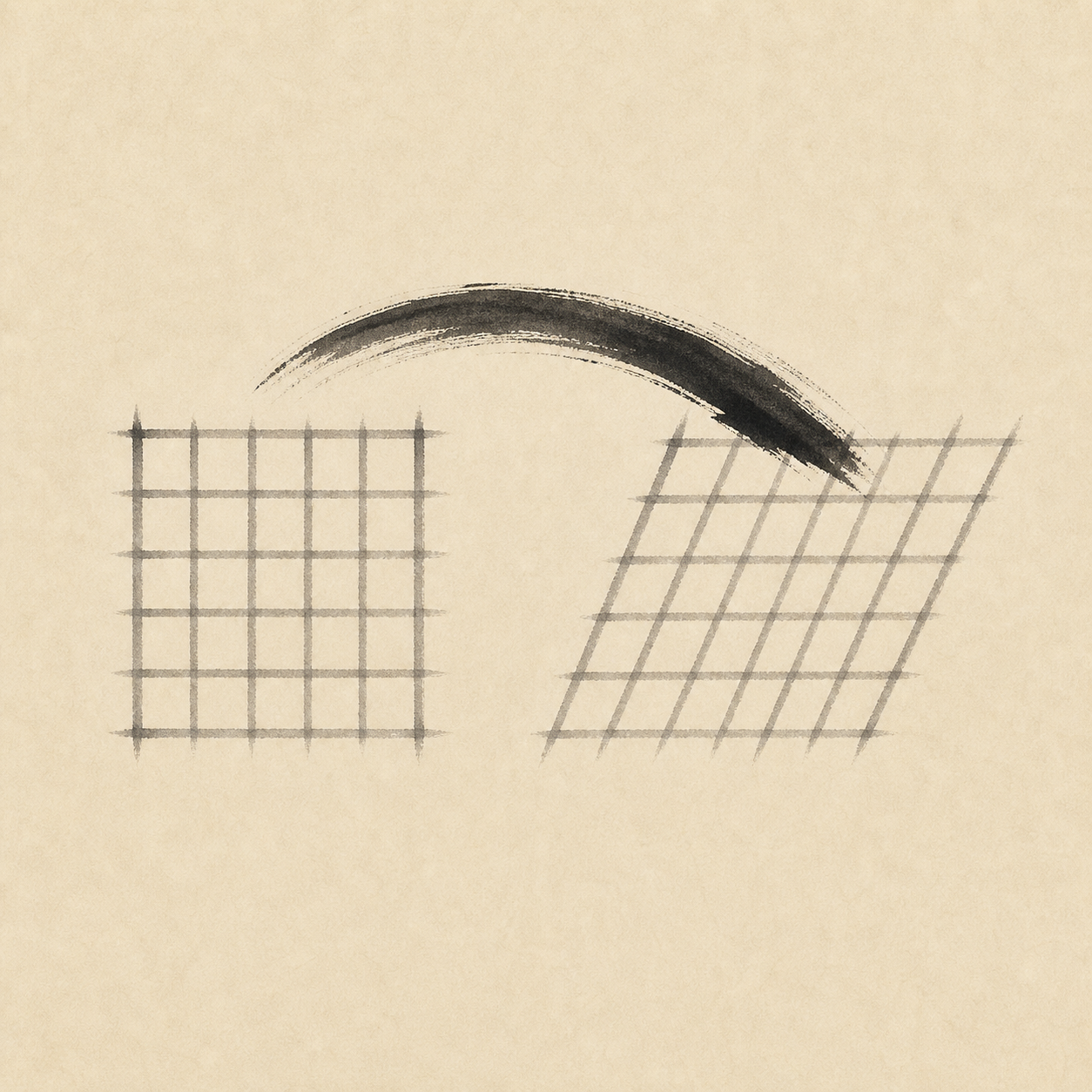
A linear transformation T: V → W is a function between vector spaces that preserves the vector-space operations: T(au + bv) = a·T(u) + b·T(v) for any vectors u, v and any scalars a, b. The condition is mild but powerful: it says the transformation respects both addition and scaling, which is enough to determine T's behavior on the entire space from its behavior on a basis. Once you know what T does to each basis vector, you know what it does to everything — by linearity, you just take the appropriate combination. This is the deep connection between linear transformations and matrices: choose a basis for V and W, and every linear transformation between them is exactly captured by an m×n matrix, where the columns are the images of V's basis vectors. The matrix and the transformation are two views of the same thing. Composition of transformations corresponds to multiplication of matrices — that is why matrix multiplication has the rule it does. Geometric examples in 2D are easy to visualize: rotation by angle θ, reflection across a line, projection onto an axis, scaling by different factors in different directions, shearing (slanting one axis relative to another). Each is a different matrix, and combining them combines the matrices. The kernel of T is the set of vectors that get sent to zero — the directions T destroys. The image is the set of vectors T can produce. The rank-nullity theorem says these two pieces account for all of V: dim(V) = dim(kernel) + dim(image), one of the cleanest balance equations in mathematics.