Linear Perspective
- Brunelleschi's peephole-and-mirror demonstrationnot yet tested
- Parallel lines converging at a vanishing pointnot yet tested
- Leonardo's haze: distant things turn bluernot yet tested
- Modernism's refusal of Brunelleschi's contractnot yet tested
In 1413, the Florentine architect Filippo Brunelleschi set up a small painted panel in the doorway of the cathedral, drilled a peephole through the back of it, and held up a mirror at arm's length. A passer-by looking through the hole saw, in the mirror, the painted Baptistery — and could verify, by lowering the mirror, that the painted image and the real building were geometrically identical. From this small experiment came the spatial system Western painters would use for the next five centuries. Linear perspective — a precise mathematical procedure for projecting three-dimensional space onto a two-dimensional surface — had been invented, and Western painting would never look the same.
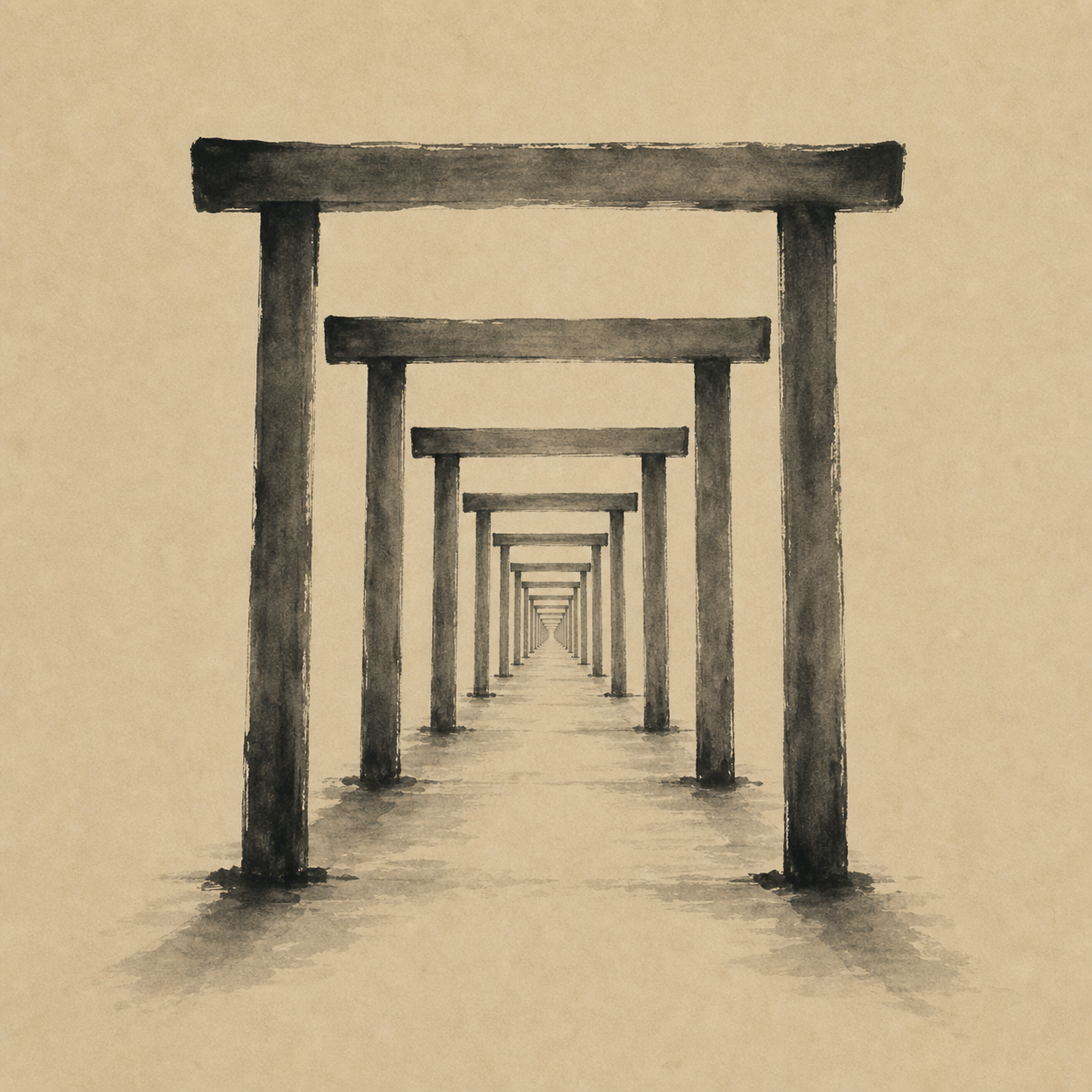
Linear perspective rests on a single geometric observation: parallel lines in three-dimensional space appear to converge at a vanishing point on the picture plane. Brunelleschi's contemporary Leon Battista Alberti codified the technique in his 1435 treatise Della Pittura, providing step-by-step instructions for constructing a one-point perspective grid: choose a horizon line, place a vanishing point on it, draw orthogonals from the picture's edges to that point, and the receding floor tiles, ceilings, and architectural lines fall into geometrically consistent place. Two-point perspective (two vanishing points on the horizon, used for objects viewed at an angle) and three-point perspective (a third vanishing point above or below, used for extreme upward or downward views) extend the technique. The mathematics is projective geometry — the study of properties preserved under projection from a viewpoint to a plane — though it would not be formally axiomatized until Desargues in the seventeenth century. Atmospheric perspective (Leonardo da Vinci's contribution): distant objects appear bluer, paler, and less distinct because the intervening air scatters short-wavelength light — a principle that turns out to be physical optics anticipating Rayleigh scattering by 400 years. The technique made possible spatial illusionism of unprecedented accuracy: Masaccio's Trinity (1427), Piero della Francesca's Flagellation (~1455), Raphael's School of Athens (1509–11) all stage figures in mathematically coherent architectural spaces. Trompe-l'œil ceiling paintings — Andrea Pozzo's Apotheosis of Saint Ignatius (1688–94) — extended the trick to make solid ceilings appear to open into infinite skies. Modernist painting (1880–) deliberately broke with linear perspective: Cézanne's planar simultaneities (Mont Sainte-Victoire), Cubism's multiple viewpoints (Picasso's Les Demoiselles d'Avignon), abstract expressionism's flatness (Pollock's Convergence) — each move was, partly, a refusal of Brunelleschi's contract.