Inequality Politics & Policy
- Occupy, Brexit, and Trumpism as consequencesnot yet tested
- Wealth taxes and direct income transfersnot yet tested
- Reshaping pre-tax wages and the deeper rulesnot yet tested
- Who bears decarbonization and AI's costsnot yet tested
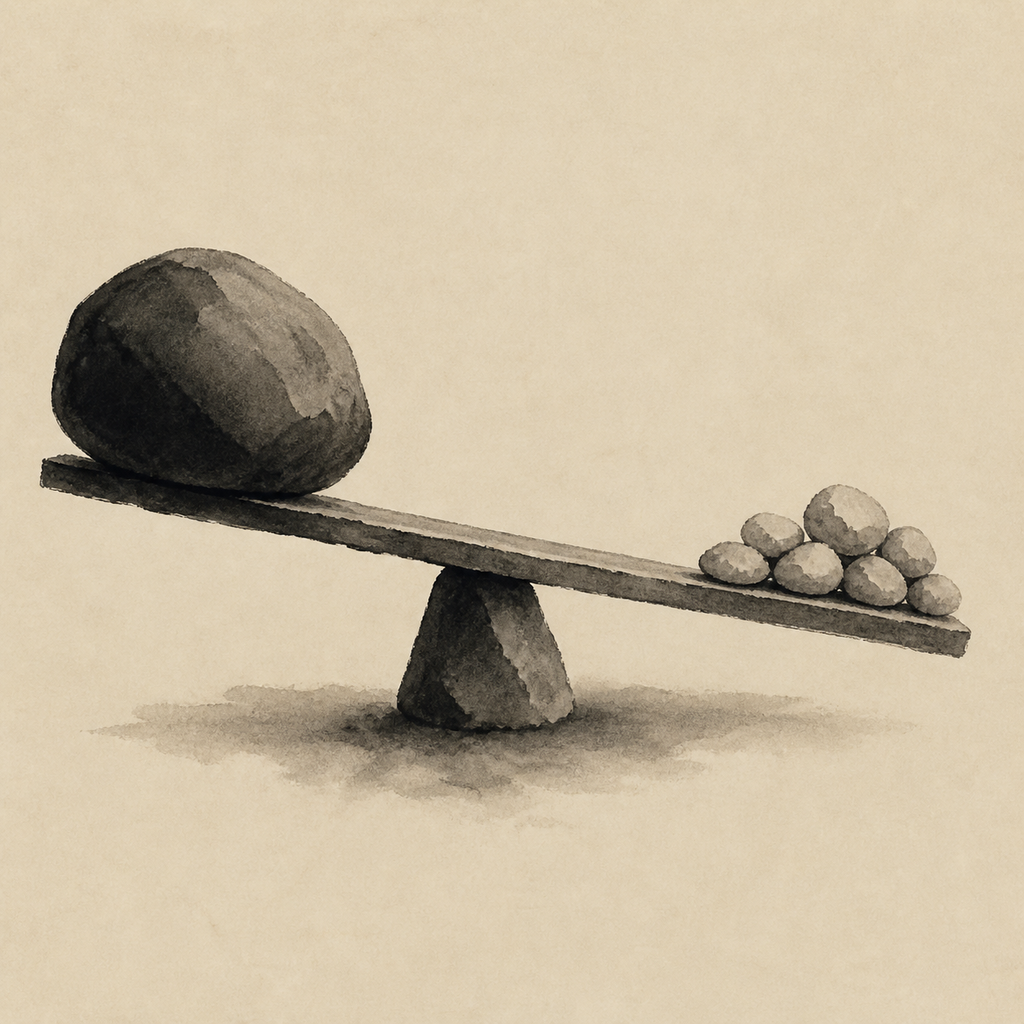
Inequality is the central political-economy question of the post-2008 period. It is measured by tools now common in ordinary debate: the Gini coefficient, which compresses a distribution into one number between zero and one, and the top-1% income share, whose climb since 1980 is the headline statistic — though income and wealth inequality move differently, and the wealth gap is wider. The Occupy movement (2011), Brexit (2016), Trumpism (2016 and 2024), the French gilets jaunes protests (2018), and the broader populist surge across advanced economies have prompted research into whether rising inequality contributed to these otherwise very different movements. The causal direction is contested — populism may also reflect immigration, cultural change, the decline of trust in institutions — but the correlation between rising inequality and rising populism is robust enough that taking it seriously has become mainstream. The political class did not see this coming; the inequality data was visible for two decades before the politics caught up.
Before the politics come the causes, and economists disagree about their weighting. Four candidates recur: skill-biased technological change, which raises the premium on education; globalization and trade, which exposed advanced-economy workers to low-wage competition; the decline of organized labour's bargaining power, as union density fell and firms grew more concentrated; and Thomas Piketty's claim that whenever the return on capital exceeds the growth rate — his r > g — inherited wealth tends to pull ahead of earned income, so that the share going to owners rises across generations unless something interrupts it. How much weight each driver carries is itself contested, and the answer points toward different remedies. Policy responses then fall into four broad families. Progressive taxation targets the post-tax distribution: Piketty's proposal for a global wealth tax; Saez and Zucman's specific US proposals; the international agreement on a 15% global minimum corporate tax (2021); estate and capital-gains tax reform. Transfer programmes deliver income directly to lower-income households: the US expanded child tax credit of the 2021 American Rescue Plan halved child poverty for the year it was in force, and was allowed to expire; universal basic income proposals; the European welfare states' more comprehensive systems. Labour-market policy changes pre-tax distribution by reshaping how wages are set: sectoral bargaining, minimum-wage increases, antitrust action against monopsonistic labour markets. Predistribution — a term coined by Jacob Hacker — changes the deeper rules so the pre-tax distribution is less unequal: competition policy, education access, housing supply, the structure of corporate ownership. Each lever trades off against others — higher taxes against growth, minimum wages against employment, transfers against work incentives — and each is contested. Underlying all of it is a further distinction, between inequality of outcome and inequality of opportunity: a society may tolerate large gaps if mobility is high, but mobility has itself fallen where outcomes have diverged.