Indian Classical Music
- Raga as melodic personality, not scalenot yet tested
- Tala: the cyclic rhythmic gridnot yet tested
- Alap, jor, jhala and khayal vs kritinot yet tested
- Hindustani north, Carnatic southnot yet tested
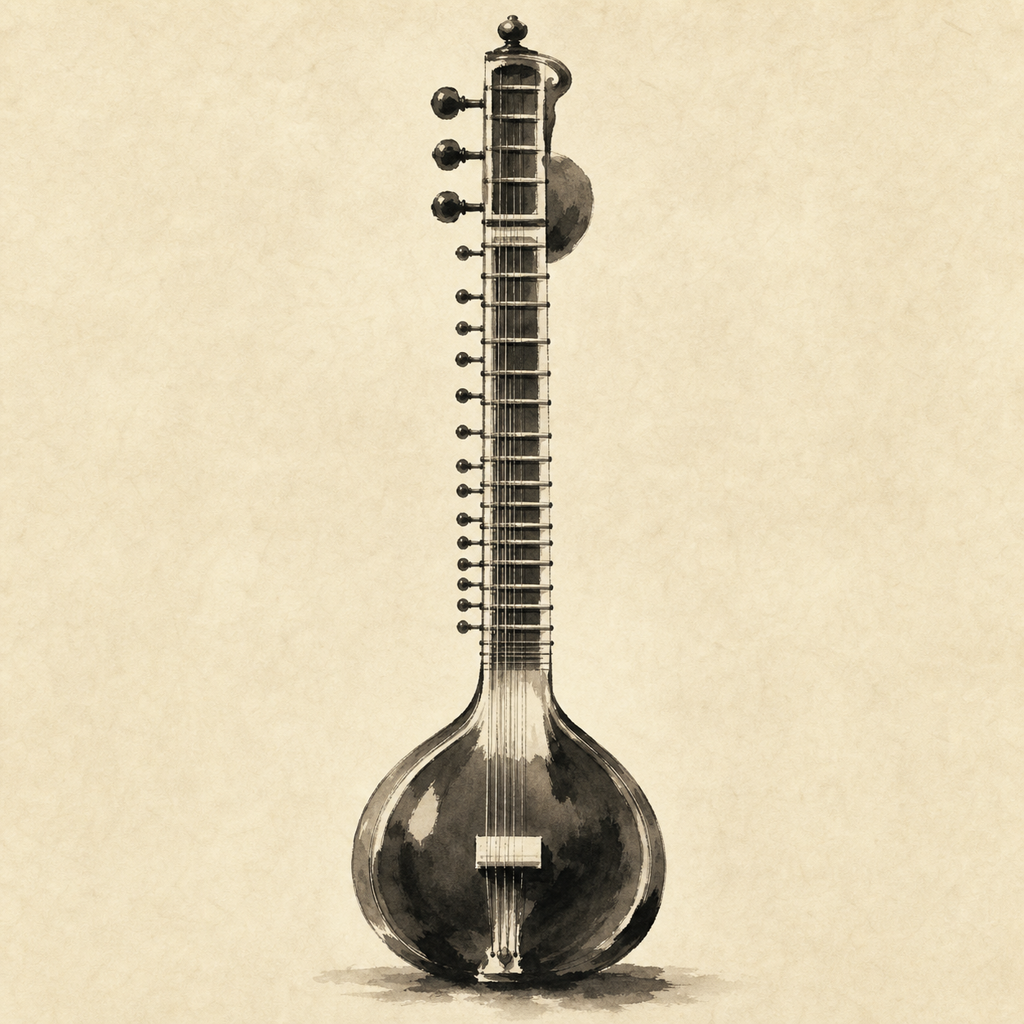
Indian classical music is two great traditions grown from one root — Hindustani in the north, Carnatic in the south — that parted ways after Persian and Central Asian currents reached the Muslim courts of the medieval north. What binds them is not a repertoire of set pieces but a way of learning: the guru-shishya parampara, an apprenticeship in which a student lives inside a teacher's practice for years before ever performing in public. The music passes from person to person, with almost nothing written down. When Ravi Shankar placed the sitar in the hands of a spellbound George Harrison in the 1960s, a Western audience met, for the first time, a music built on principles it had no words for.
At the center stands the raga, the concept Western theory simply lacks. A raga is not a scale. It is closer to a melodic personality: a small set of signature phrases (its pakad), a particular way of rising and falling, a required mood, even an attachment to a time of day or a season. Two ragas can draw on exactly the same notes and remain entirely different beings, because what defines a raga is not its pitches but how one must move through them. A musician does not so much play a raga as inhabit it, improvising within its law for an hour at a stretch. Rhythm is handled with equal subtlety by the tala, a fixed cycle of beats — seven, twelve, sixteen — that the listener holds internally, so that every phrase is heard leaning toward the cycle's downbeat. A Hindustani performance unfolds this as a slow unveiling: an unmetered opening that explores the raga alone, before the drum enters and the pulse gathers toward a racing climax. The instruments are famous in the West — the sitar above all, the fretless sarod, the bamboo flute, the paired tabla drums — but they are vessels, not the point. The point is that everything of value here lives in the playing and the lineage behind it, never on a page. A raga is less a composition than a discipline, handed from one body to the next.