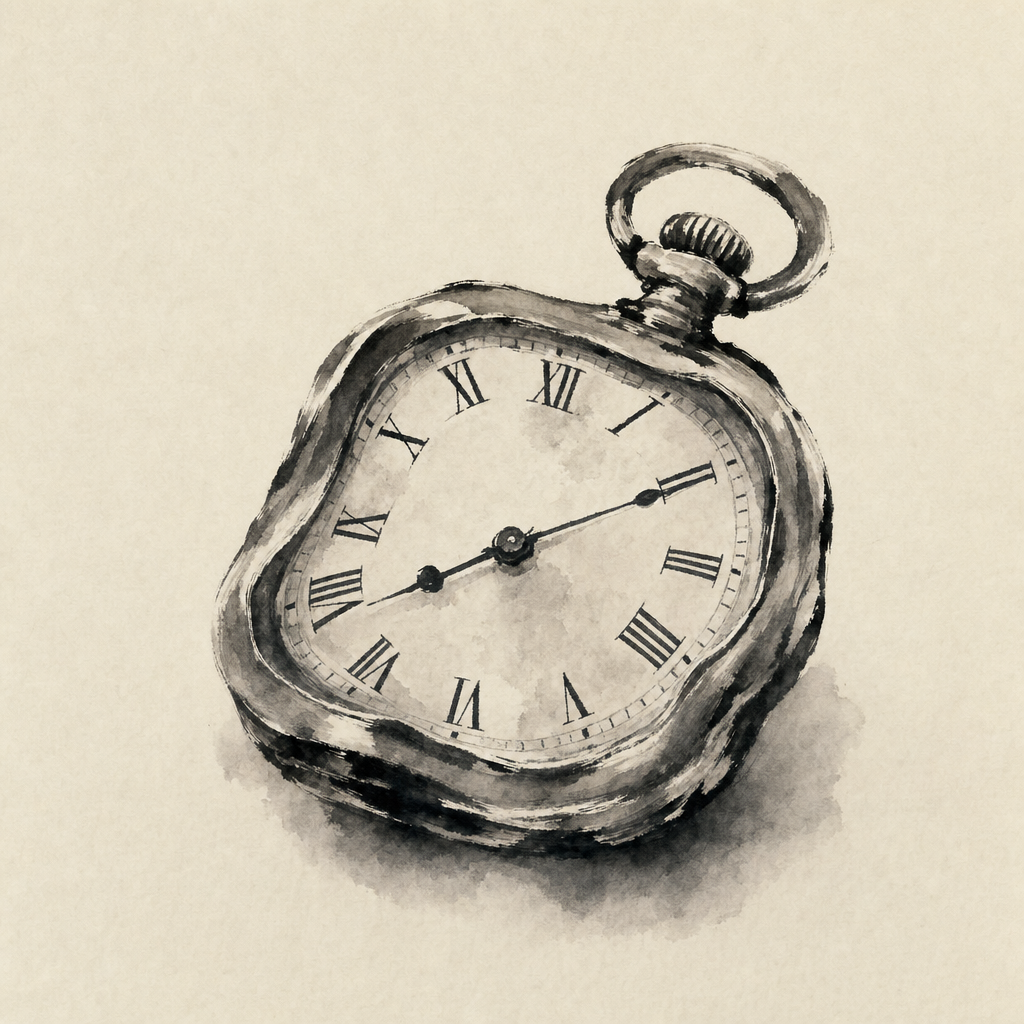
General Relativity
- Mass curves spacetime; geometry is gravitynot yet tested
- Mercury, light-bending, time dilationnot yet tested
- Black holes and gravitational wavesnot yet tested
- Singularities and the quantum-gravity gapnot yet tested
In November 1915, after eight years of dead-ends and one famous breakdown, Albert Einstein published the field equations of general relativity. The struggle had begun with a single image — a man in a falling elevator feels no weight — that persuaded Einstein gravity and acceleration are locally indistinguishable, the insight he called his happiest thought. The theory replaced Newton's universal gravitation — a force acting instantaneously at a distance — with something stranger and more elegant: matter and energy curve spacetime, and what we call gravity is the geometry of that curvature. Falling bodies follow straight lines through curved space; planets orbit because the Sun has bent the geometry around it. Mass tells space how to curve; space tells mass how to move. The theory was confirmed in 1919 by a British eclipse expedition and made Einstein, almost overnight, the most famous scientist in the world.
At the theory's heart sits the equivalence principle — in a sealed, freely falling cabin no experiment can tell gravity from acceleration — and the eight-year struggle was the labour of turning that intuition into the field equations. There is no force in this picture, only the shortest paths through a warped geometry. The predictions have held up for a century. The first triumph was retrospective: Mercury's perihelion precession, a tiny anomaly that had defied Newtonian astronomers for decades, falls out of the equations exactly, and Einstein reportedly suffered heart palpitations when the numbers matched. The 1919 eclipse confirmed light bending around the Sun — the effect now underlying gravitational lensing — while gravitational time dilation, clocks running slower in stronger gravity, is corrected for in GPS satellites, which without relativity would drift by about 38 microseconds per day and render navigation useless within hours. Black holes and gravitational waves, both latent in the 1916 equations, took a century to observe directly. The theory's only known failure is at singularities, where general relativity and quantum mechanics give incompatible answers — the quantum gravity problem is unsolved a century later.