Gene Regulation
- Transcription factors, enhancers, and chromatinnot yet tested
- Splicing, microRNAs, and protein turnovernot yet tested
- Master regulators and Yamanaka reprogrammingnot yet tested
- Cancer as broken gene regulationnot yet tested
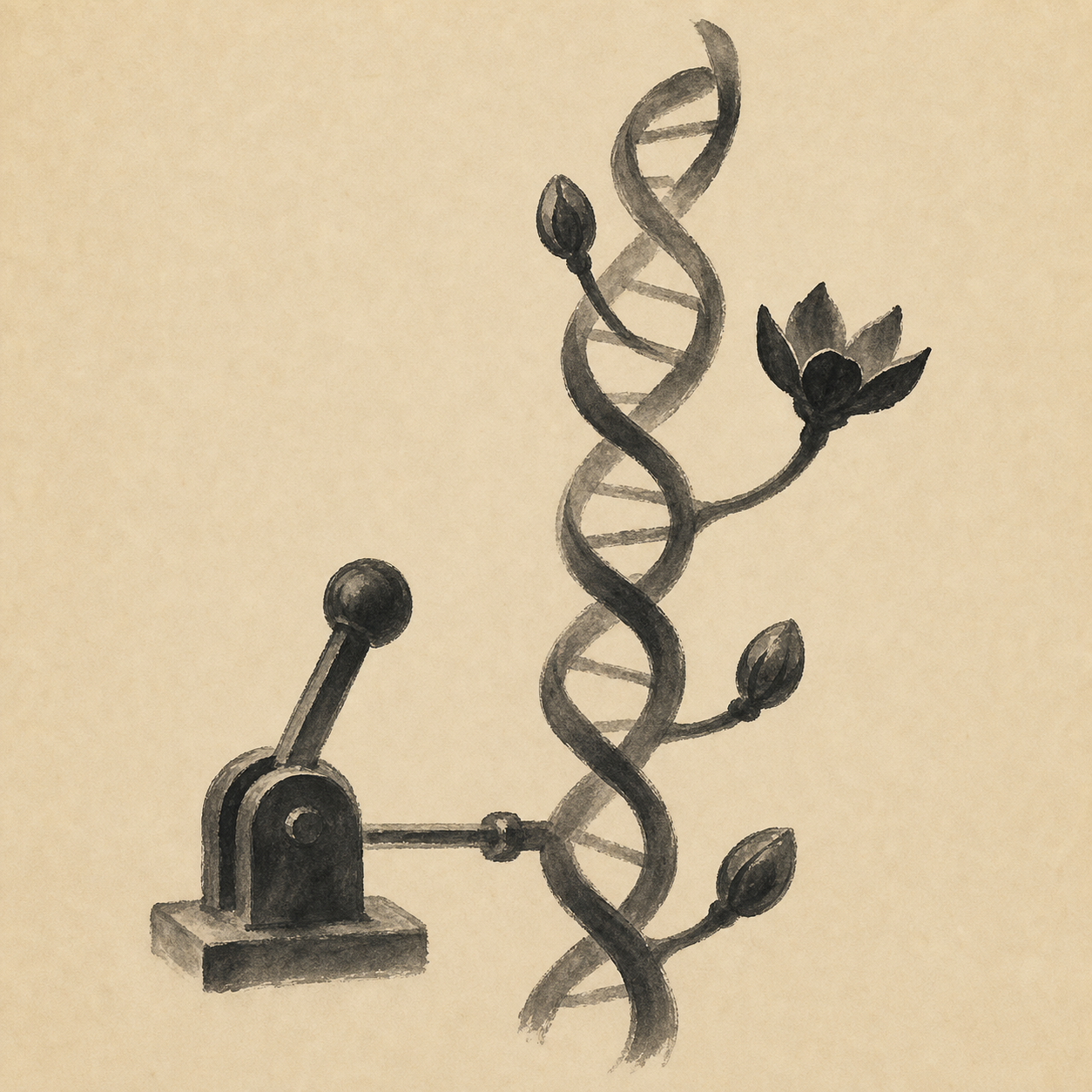
Every cell in your body — neuron, hepatocyte, muscle fibre, hair-follicle root — contains the same DNA: ~20,000 genes, 3 billion base pairs, identical down to the last G and C. Yet liver and brain do utterly different things because in each cell type a different subset of those genes is being expressed. The organism is built not by what genes you have but by which ones are running, when, and how much; gene regulation — the orchestration of which genes are transcribed in which cells — answers one of biology's deepest puzzles, and the field is still working out how the orchestra plays.
Gene expression has multiple regulatory checkpoints. Transcriptional regulation determines whether a gene is transcribed at all — transcription factors bind specific DNA sequences and recruit or block RNA polymerase II, enhancers loop in 3D to contact promoters from tens of thousands of bases away, repressors block transcription. Jacob and Monod's 1961 lac operon in E. coli (Nobel 1965) was the first regulatory system worked out: lactose-metabolizing genes transcribed only when lactose is present and glucose absent — gene regulation as chemical computation. Chromatin regulation packages DNA with histones into nucleosomes; histone modifications (methylation, acetylation, phosphorylation) and DNA methylation (at CpG dinucleotides) open or close genome regions — heterochromatin dense and silent, euchromatin loose and permissive. Post-transcriptional regulation runs through mRNA splicing (most human genes are alternatively spliced, producing multiple isoforms), microRNAs (Ambros and Ruvkun, discovered 1993, Nobel 2024 — ~22 nt RNAs that degrade complementary mRNAs or block their translation), and mRNA stability; translational and post-translational layers (phosphorylation, ubiquitination, proteasomal degradation) set steady-state protein amounts. Gene-regulatory networks organize this wiring into recurring motifs (Uri Alon et al.) — feedback loops, switches, oscillators — with master regulators whose activation triggers cascades (MyoD turns fibroblasts into muscle, Pax6 drives eye development across vertebrates and insects, the Yamanaka factors Oct4/Sox2/Klf4/c-Myc reprogram somatic cells to pluripotency, Nobel 2012). Cancer is in large part a regulation failure: oncogenes are transcription factors stuck on, tumor suppressors stuck off, and many driver mutations sit in regulatory machinery rather than coding sequence.