Galaxies & Galactic Structure
- Hubble's Andromeda plate and the expanding universenot yet tested
- Our barred spiral and its Sgr A* black holenot yet tested
- Hubble morphology, groups, and the cosmic webnot yet tested
- Flat rotation curves and invisible halosnot yet tested
On the night of October 5, 1923, Edwin Hubble, using the 100-inch Hooker Telescope at Mount Wilson Observatory in California — then the largest in the world — captured a photographic plate of the Andromeda Nebula. Examining it the next day, he spotted a Cepheid variable in the nebula's outskirts — a star whose pulsation period betrays its true brightness, so that its faintness reveals its distance. The number was staggering: about 900,000 light-years, far outside our own galaxy — and his Cepheid scale still undershot the true distance of 2.5 million. Andromeda was not part of the Milky Way; it was another galaxy — an island universe, as Kant had speculated in 1755. This settled the Great Debate of 1920 between Harlow Shapley, who held that the Milky Way was the entire universe, and Heber Curtis, who held that the spiral nebulae were galaxies in their own right. By 1929 Hubble had gone further, finding that the more distant a galaxy, the faster it recedes — Hubble's law — the decisive evidence that the universe is expanding.
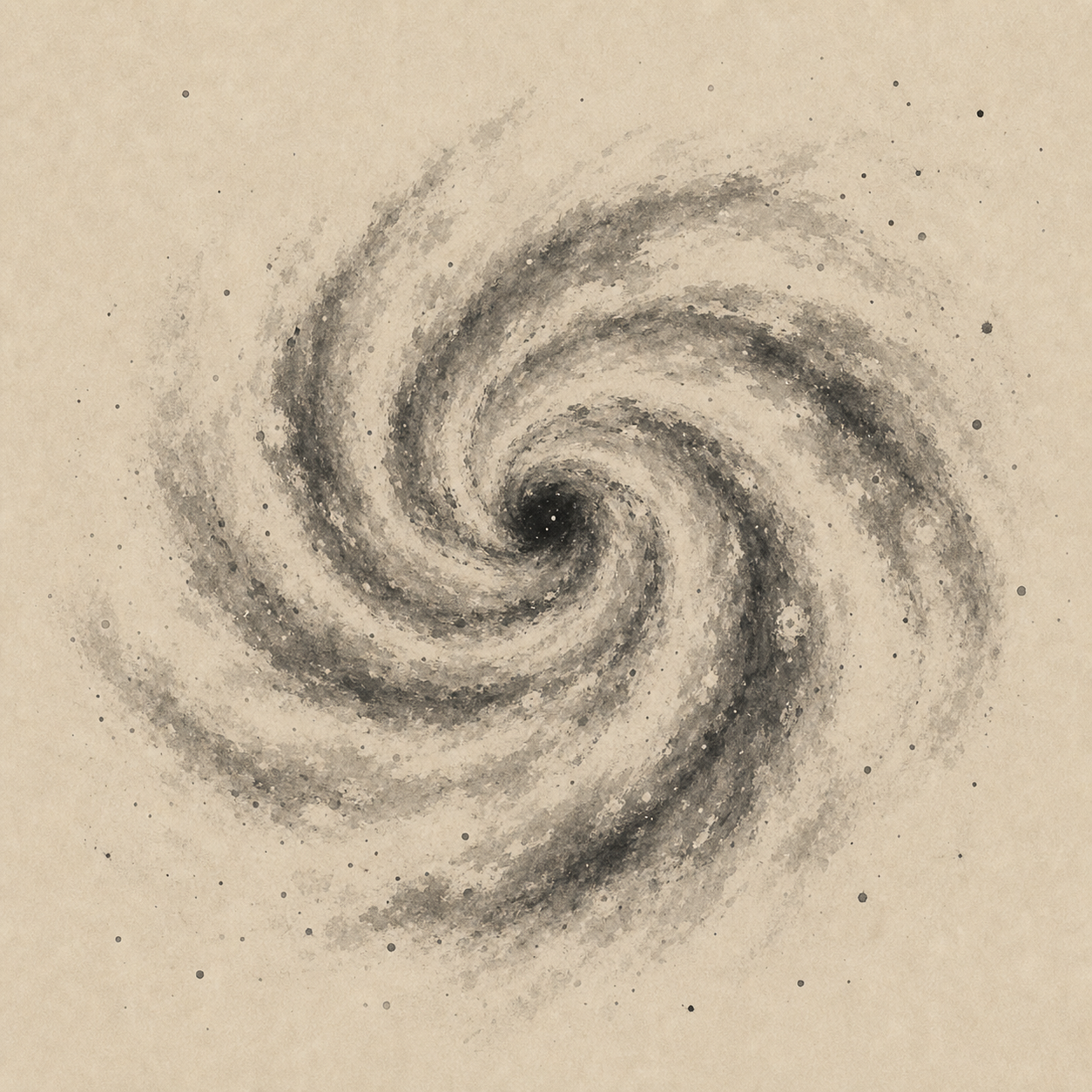
The Hubble classification (1926) sorts galaxies by shape: ellipticals (smooth, spheroidal, old stars, little gas), spirals (a disk with central bulge and winding arms, actively forming stars), barred spirals (the Milky Way's type), and a few in-between and irregular classes. The Milky Way is a barred spiral roughly 100,000 light-years across holding a few hundred billion stars; the Sun sits out in the disk, some 25,000 light-years from the centre. At that centre lies Sgr A∗, a supermassive black hole about 4 million times the Sun's mass, weighed by tracking the orbits of stars whipping around it — a thirty-year campaign that won Andrea Ghez and Reinhard Genzel the 2020 Nobel Prize. Remarkably, nearly every galaxy with a central bulge harbours such a black hole, and its mass tracks the bulge closely: the more massive the bulge, and the faster its stars swarm (their velocity dispersion, the spread of their orbital speeds), the heavier the black hole. That tight link implies black hole and host somehow grow up together, by a mechanism still debated. Galaxies gather under gravity into groups and clusters — from our own Local Group (more than eighty known galaxies, dominated by Andromeda and the Milky Way) up to the Virgo and Coma clusters, with a thousand or more members each, bathed in million-degree, X-ray-emitting gas. On the largest scales, galaxies trace a cosmic web of filaments strung around great empty voids. And the single most consequential fact about all of it is that most of the gravitating mass is invisible: spiral galaxies spin too fast at their edges to be held together by their visible stars alone, clusters bend background light far more than their visible matter could, and simulations reproduce the real universe only if they include dark matter — unseen mass we detect solely through its gravity. A large galaxy's dark-matter halo outweighs everything visible in it by five to ten times, and discovering what that matter actually is remains one of the central open problems in physics.