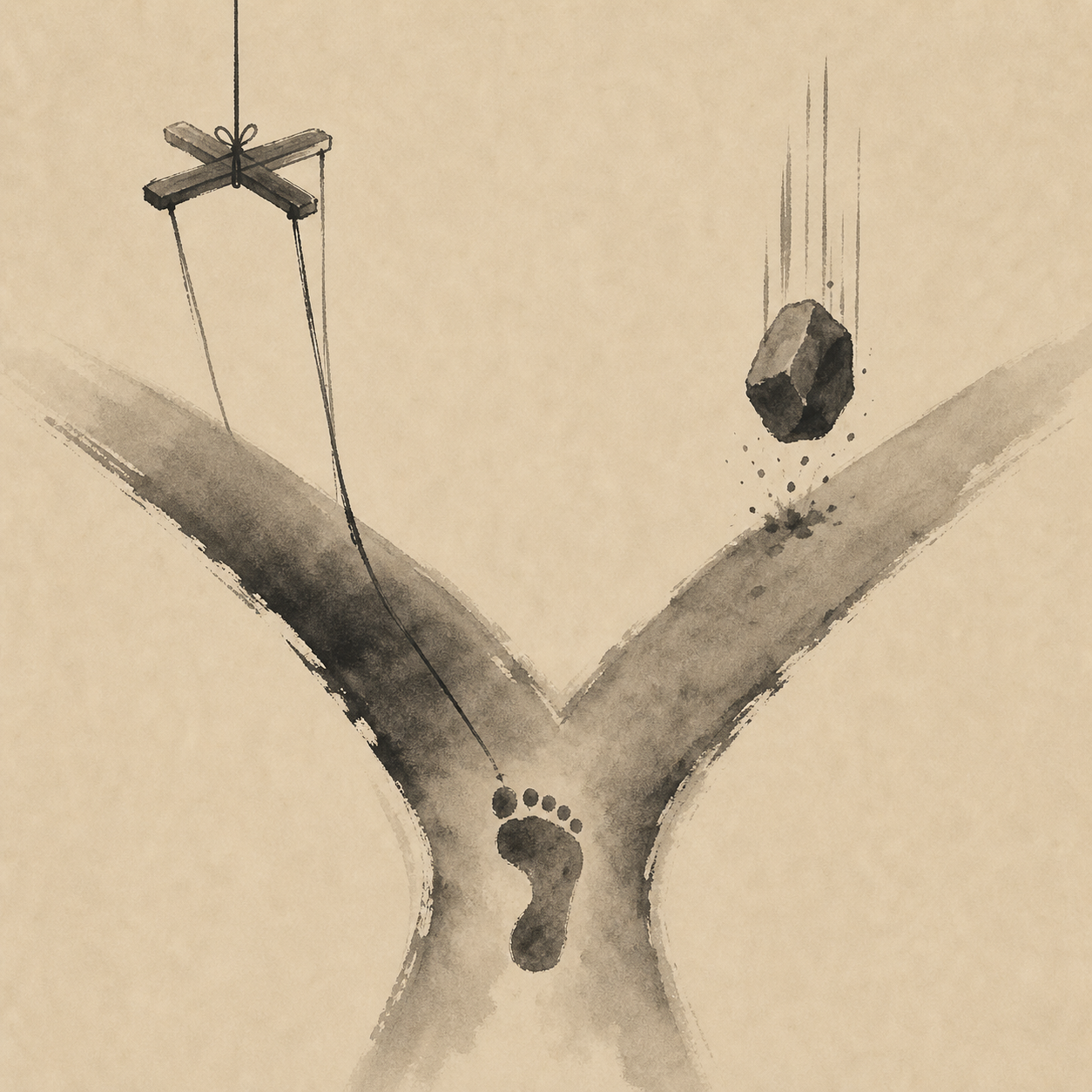
Free Will & Determinism
- Determinism — prior causes necessitate every eventnot yet tested
- Hard determinism — free will as illusionnot yet tested
- Libertarian free will and agent causationnot yet tested
- Compatibilism — caused in the right waynot yet tested
The argument is older than philosophy itself. If the universe is deterministic — if every event is the necessary consequence of prior events plus the laws of nature — how can any human action be genuinely free? When you choose chocolate over vanilla, was that choice up to you, or was it the inexorable working-out of physical and biological causes that began before you were born? The Stoics, Augustine, Aquinas, the medieval Islamic philosophers, the Reformation theologians, Descartes, Spinoza, Leibniz, Hume, Kant, James, the existentialists, and contemporary philosophers from Daniel Dennett to John Searle to Galen Strawson have all weighed in. The argument has not closed in 2,500 years; the contemporary version is being shaped by neuroscience, quantum mechanics, and the practice of holding people legally and morally responsible.
Three durable positions divide the field. Hard determinism holds that the universe is deterministic, human actions are caused by prior events, we are not genuinely free, and therefore not morally responsible in the deep sense; its living heirs, Galen Strawson and Derk Pereboom, reach the same verdict without that premise — Pereboom's hard incompatibilism denies deep responsibility whether reality is deterministic or indeterministic, and Strawson's argument that no one can be the cause of themselves appeals to neither. Libertarian free will (no relation to political libertarianism) holds that genuine freedom requires agent causation or event indeterminism with the agent's contribution somewhere in the causal chain not determined by prior physical events; Kant, William James, Robert Kane, and Timothy O'Connor hold versions, and the quantum-indeterminism move proposes that quantum randomness in the brain supplies the slack — but randomness is not freedom (a coin flip making your decision is neither yours nor deliberate). Compatibilism — the dominant view in contemporary academic philosophy — holds that the two are compatible: "free" does not mean uncaused but caused in the right way, by your own deliberation, beliefs, and desires rather than external compulsion. It is defended by Hume, P. F. Strawson (the reactive attitudes of gratitude, resentment, and indignation presuppose responsibility), Daniel Dennett (Elbow Room, Freedom Evolves), Susan Wolf, and Harry Frankfurt (free will is acting on desires you reflectively endorse). The empirical literature has reshaped the conversation: Benjamin Libet's 1980s experiments measured readiness potentials in motor cortex before subjects reported the conscious decision to move, and John-Dylan Haynes (2008) showed fMRI patterns in prefrontal cortex predict simple choices up to ten seconds in advance. Whether these undermine free will depends entirely on which conception you hold: compatibilists shrug, libertarians worry, hard determinists feel vindicated. Criminal-justice systems presuppose enough free will for retributive punishment to make sense; if hard determinism is right, justice should shift toward consequentialist rather than retributive justifications.