Externalities
- Spillover costs that miss the pricenot yet tested
- Pigouvian taxes at marginal social costnot yet tested
- Coase — bargaining over property rightsnot yet tested
- Cap-and-trade and the wider policy menunot yet tested
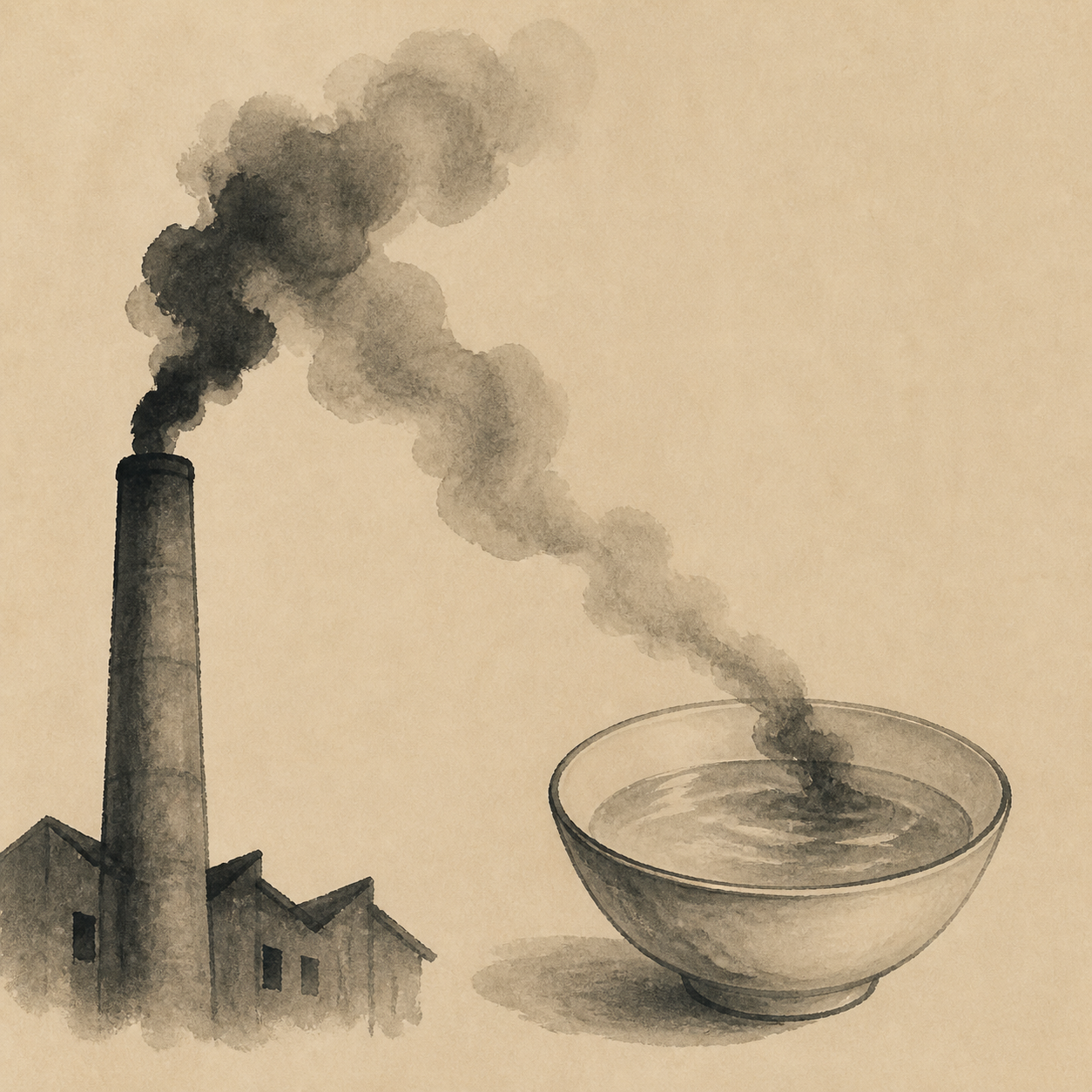
Arthur Cecil Pigou, in The Economics of Welfare (1920), formalized one of the most consequential ideas in modern economics: a transaction's price may not capture all of its costs and benefits because some spill onto third parties who were not part of the deal. Pigou's textbook example was a factory chimney that pays for coal, labour, and capital but does not pay for the soot it deposits on neighbouring laundry. His prescription, the Pigouvian tax, was to tax the externality at marginal social cost so the polluter internalizes the spillover. Forty years later Ronald Coase's The Problem of Social Cost (1960) reframed the discussion: with zero transaction costs and well-defined property rights, the parties would bargain to the efficient allocation regardless of who held the initial right. The two frameworks — tax-the-externality and assign-the-rights — structure essentially every modern environmental and technology-policy debate.
The technical claim is precise. When costs or benefits are external to a transaction, the market price equals the private cost rather than the social cost, and the equilibrium quantity comes out too high for negative externalities (pollution, congestion, antibiotic resistance) or too low for positive ones (vaccination, basic research, education). Aggregate welfare is left on the table whenever the price signal misses a chunk of what the action does in the world. The policy menu has four basic tools. A Pigouvian tax (or subsidy) set equal to marginal external cost is the textbook prescription; modern carbon pricing (Sweden since 1991, British Columbia from 2008 until its repeal in 2025, the EU ETS as a quantity-based variant) is its most consequential application. Cap-and-trade sets the quantity by regulation and lets the market discover the price; the 1990 US Acid Rain Program for sulphur dioxide is the canonical success, with SO₂ emissions falling faster and at lower cost than the EPA had projected. Coasean bargaining works elegantly when the parties are few and identifiable but breaks down when they are many and diffuse, as with every fossil-fuel emitter and every future climate victim. Direct regulation — catalytic-converter mandates, building codes, vaccine requirements — is often less efficient than price-based tools but politically more tractable. The deeper point, due to Buchanan and Tullock, is that identifying an externality is not sufficient to identify a policy: the cost of the intervention itself — administrative cost, deadweight loss, capture risk — has to be weighed against the cost of the uncorrected externality.