Euclidean Geometry
- Angle measures and the triangle 180°not yet tested
- Parallel lines never meetnot yet tested
- Polygon sides and area formulasnot yet tested
Around 300 BCE, in the city of Alexandria — newly founded by Alexander the Great and rapidly becoming the intellectual center of the ancient world — a Greek mathematician named Euclid compiled a textbook called the Elements. Thirteen books, 465 propositions, all derived by deductive logic from a tiny base of five postulates and five common notions. The book was used as the standard geometry curriculum for the next 2300 years. By many measures, the Elements is the most successful textbook ever written. More than its content, what Euclid bequeathed was a method: state your starting assumptions, then derive everything else from them by careful reasoning, without any appeal to intuition or experience. The axiomatic-deductive style of mathematics begins here.
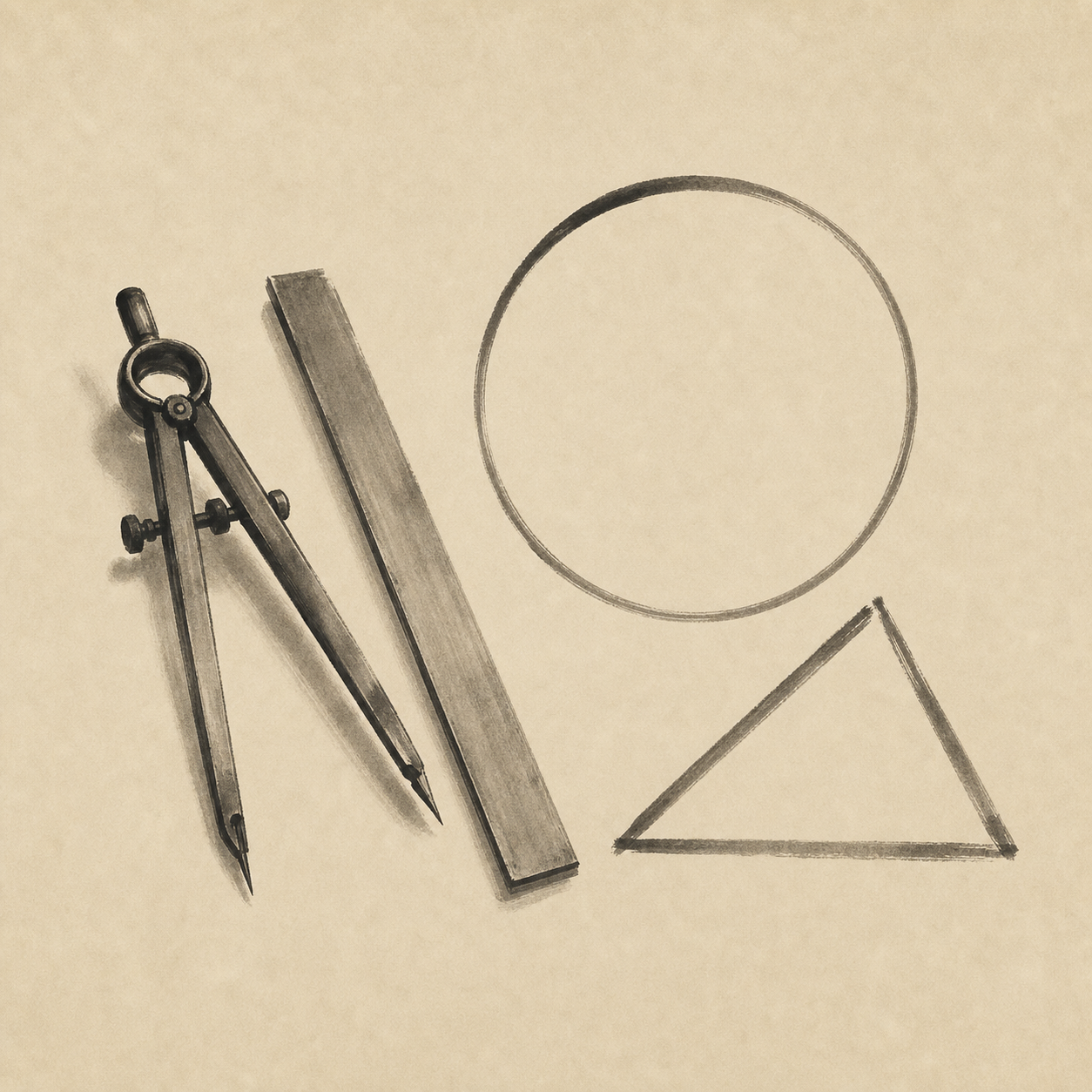
Euclid's five postulates: (1) a straight line can be drawn between any two points; (2) any line segment can be extended indefinitely; (3) a circle can be drawn with any center and radius; (4) all right angles are equal to one another; (5) the parallel postulate — in Euclid's own form, if a line crossing two others makes the interior angles on one side sum to less than two right angles, those two lines, extended far enough, meet on that side. The first four feel evident; the fifth famously did not, and for two thousand years mathematicians attempted to derive it from the others. The attempts failed, until in the early nineteenth century Lobachevsky and Bolyai (independently) and Riemann (in his own framework) showed that consistent geometries exist in which the parallel postulate fails. Hyperbolic geometry (infinitely many parallels) and spherical geometry (no parallels — all great circles eventually meet) are now central objects of study. Euclidean geometry's signature theorems include the angle sum of a triangle is 180° (this fails in non-Euclidean geometries), the Pythagorean theorem, criteria for triangle congruence and similarity (SSS, SAS, ASA), properties of circles (the inscribed angle theorem, the power of a point), and the constructibility of regular polygons with compass and straightedge — Gauss showed the regular 17-gon is constructible. Hilbert's 1899 axiomatization (twenty-some axioms instead of Euclid's ten) made the framework fully rigorous; Euclid had hidden assumptions about betweenness and continuity that two thousand years of geometers had not noticed. The deeper observation is that Euclidean geometry is what most human spatial intuition assumes — flat planes, parallel lines that don't meet, angles that sum to 180°. The intuition is correct locally, but globally the universe is curved.