Entropy, Second Law
- Isolated entropy never decreasesnot yet tested
- S = k log W: counting microstatesnot yet tested
- Why time has a directionnot yet tested
- Local order, cosmic heat death, informationnot yet tested
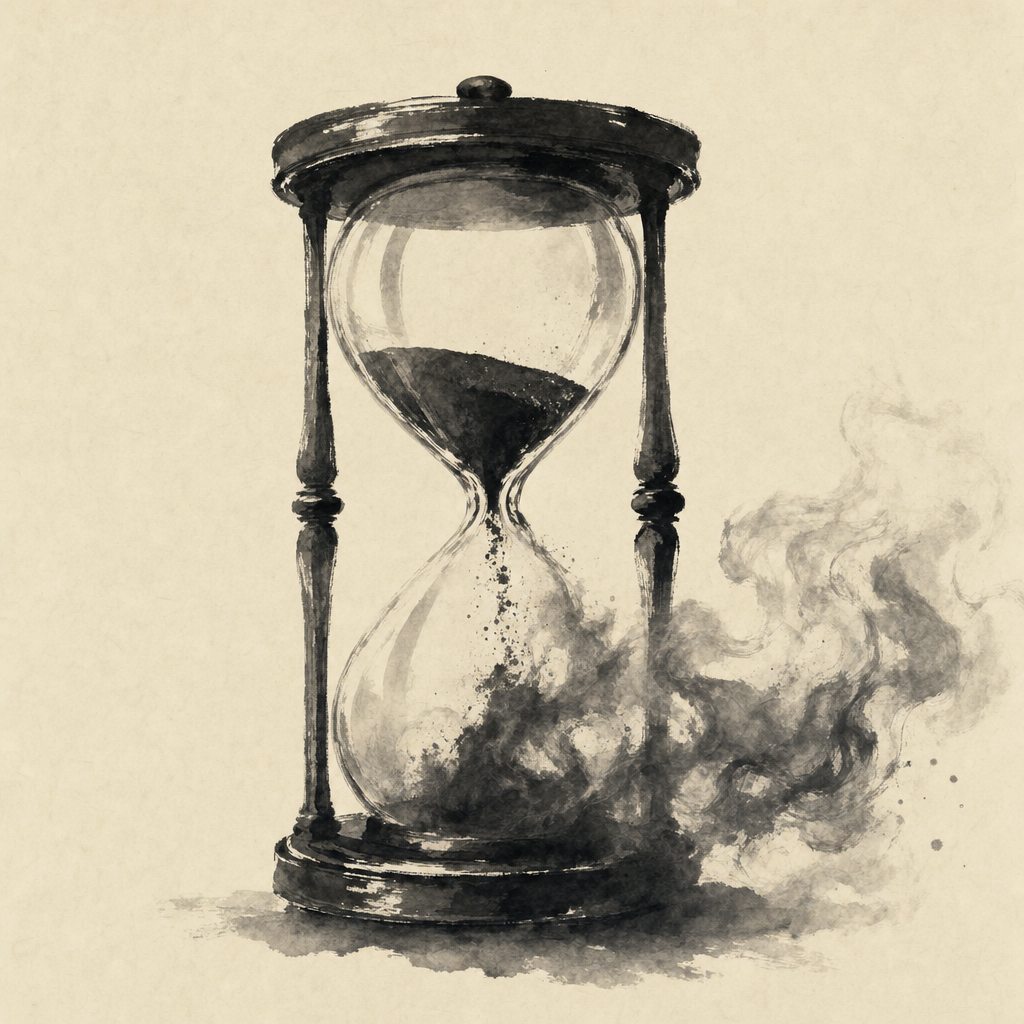
In 1865, the German physicist Rudolf Clausius coined a new word — entropy — and used it to formulate one of the most consequential statements in science: the entropy of an isolated system never decreases. The law was born not in cosmology but in engineering: Sadi Carnot, studying steam engines in the 1820s, had already found that no engine can turn heat entirely into work — some is always surrendered to a colder reservoir — and Clausius distilled that practical defeat into a universal principle. Heat flows from hot to cold; ordered states decay into disordered ones; the universe, taken as a whole, is running down toward uniform tepid equilibrium. The Second Law of Thermodynamics was the first physical law to single out a direction of time, and it has resisted every attempt to wriggle out of its implications.
The microscopic explanation came from Boltzmann in the 1870s. Entropy is the logarithm of the number of microstates compatible with a given macrostate — the more ways a system can be arranged while looking the same from outside, the higher its entropy. A shuffled deck makes the point: there is exactly one fully ordered arrangement and astronomically many disordered ones, so shuffling almost never restores order — not because order is forbidden but because it is outnumbered beyond imagining. Boltzmann carved the relation S = k log W — entropy is a constant times the logarithm of that count — onto his own tombstone. Order is statistically rare; disorder is statistically generic. The Second Law says systems drift from rare configurations to common ones, and the drift is overwhelmingly probable rather than logically necessary — but for systems with billions of particles, overwhelmingly probable is effectively certain. Calling this disorder is a useful lie; the deeper statement is that energy and matter spread out to occupy every state available to them, and 'order' is just our name for the few arrangements we happen to notice. Maxwell's demon — an imaginary imp who sorts fast molecules from slow to cheat the law — was finally exorcised only in the twentieth century: to keep sorting, the demon must erase its memory, and erasing information itself costs entropy, sealing the leak. Life is a local entropy decrease, paid for by a much larger entropy increase elsewhere (the Sun pours out radiation; we organize a small fraction of it into ourselves). The heat death of the universe — Clausius's term — is the eventual end state in which all energy gradients have been spent and nothing more can happen. Whether this is the actual cosmological future is a question modern physics has not closed: dark energy, accelerating expansion, and unresolved questions about quantum gravity all complicate the picture.