Electronic Music & Recording Technology
- Schaeffer's concert of noises on tapenot yet tested
- Recording itself as compositional mediumnot yet tested
- Moog to MIDI to clip-based softwarenot yet tested
- Salsa and other Caribbean dance genresnot yet tested
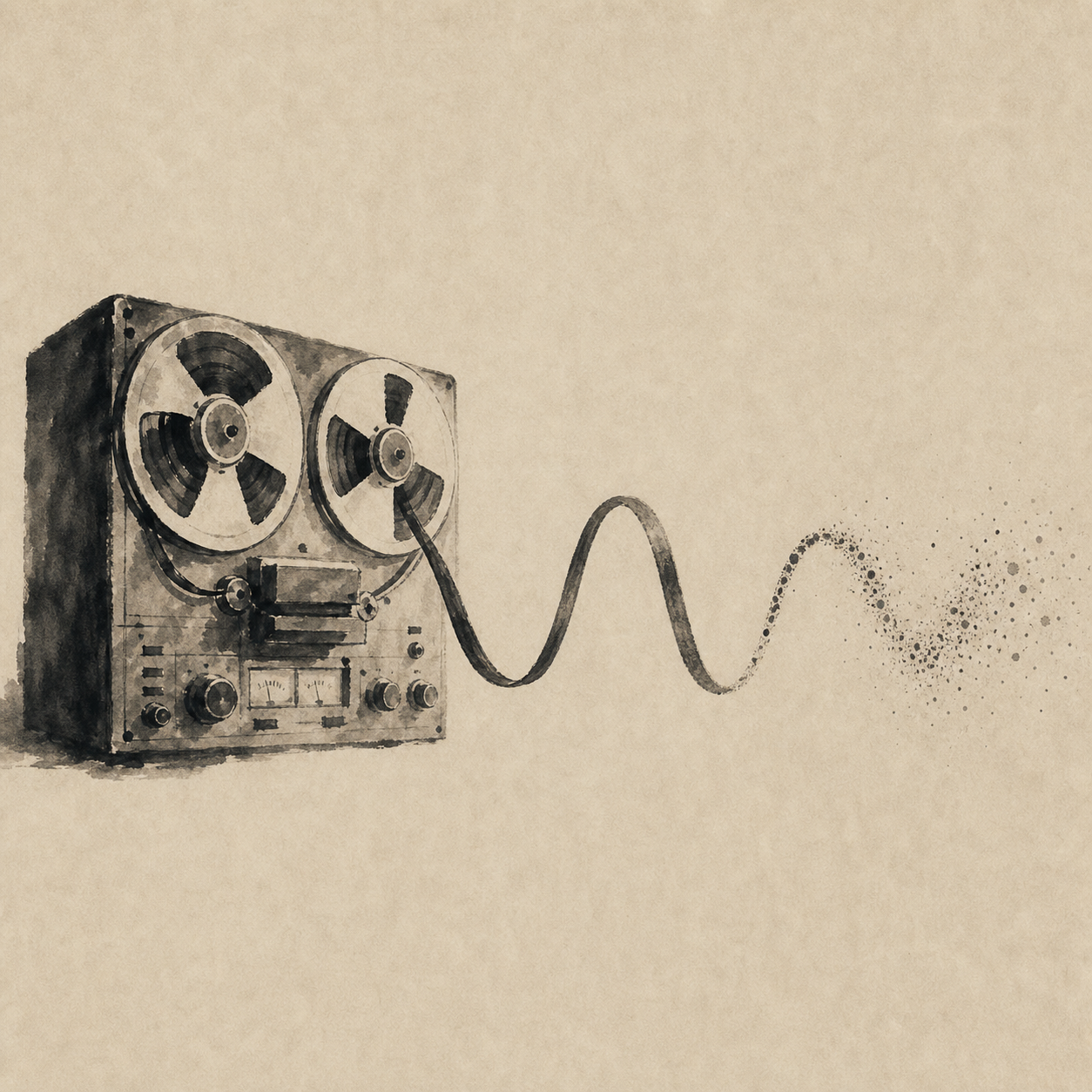
On October 5, 1948, the Radiodiffusion française broadcast a Concert de bruits — a concert of noises — assembled by a 38-year-old radio engineer named Pierre Schaeffer from recorded sound alone: a locomotive, a piano, percussion, voices, struck pots. Schaeffer had manipulated the recordings on shellac discs and the newly available magnetic tape — cutting, looping, reversing, varying playback speed, layering. He called the result musique concrète. The structural claim was radical: recording itself is a compositional medium; the studio is an instrument; any sound is potentially music if a composer chooses to organize it. Within a decade Karlheinz Stockhausen at WDR Cologne was building Studie I (1953) entirely from synthesized sine tones — opposite aesthetic, identical structural claim. Music's raw material had expanded from instrument-played pitches to the entire sonic world.
Two intersecting threads shaped the field. The first was the discovery that recording is itself a compositional medium. Pierre Schaeffer's musique concrète worked with the world's recorded sounds; Karlheinz Stockhausen's Studie I worked from synthesized sine tones — opposite aesthetics, identical structural claim: any sound is potentially music, and the studio is the instrument that organizes it. After the war, publicly funded and university studios developed tape techniques before many of those tools became widely available to commercial musicians — Schaeffer's GRM in Paris, Stockhausen's WDR in Cologne, Milton Babbitt's Columbia-Princeton studio, and the BBC Radiophonic Workshop that produced Delia Derbyshire's Doctor Who theme.
The second thread was the synthesizer's arc from hardware to software. Robert Moog's 1964 modular instrument made voltage-controlled oscillators, filters, and amplifiers patchable, and Wendy Carlos's Switched-On Bach brought the result to mass audiences four years later. Moog's portable Minimoog and Yamaha's FM-based DX7 defined two successive pop eras; MIDI, standardized by Dave Smith in 1983, has gone almost unchanged since and remains the lingua franca of digital music. Samplers in the 1980s made any recorded sound playable from a keyboard, and Ableton Live moved arrangement into software with a clip-based paradigm that came to dominate electronic-music creation. Brian Eno's Music for Airports gave ambient its name in 1978. From tape splice to clip-based arrangement, the arc is one of production tools themselves becoming the determinative musical material.