Electromagnetic Waves & Light
- Spectrum from radio to gammanot yet tested
- Wavelength, colour, the rainbownot yet tested
- Light as a transverse EM wavenot yet tested
- Refraction, prisms, Doppler shiftnot yet tested
When James Clerk Maxwell wrote down his equations of electricity and magnetism in 1865, they carried a startling implication: empty space itself should be able to carry waves, and those waves should travel at one precise speed — which came out, on calculation, to match the measured speed of light. Maxwell drew the only possible conclusion. Light itself was an electromagnetic wave. Within two decades Heinrich Hertz had produced and caught such waves in his laboratory at frequencies far below anything visible — radio waves — confirming the guess. At a stroke the whole electromagnetic spectrum, from radio through visible light to X-rays and gamma rays, stood revealed as a single phenomenon wearing different wavelengths.
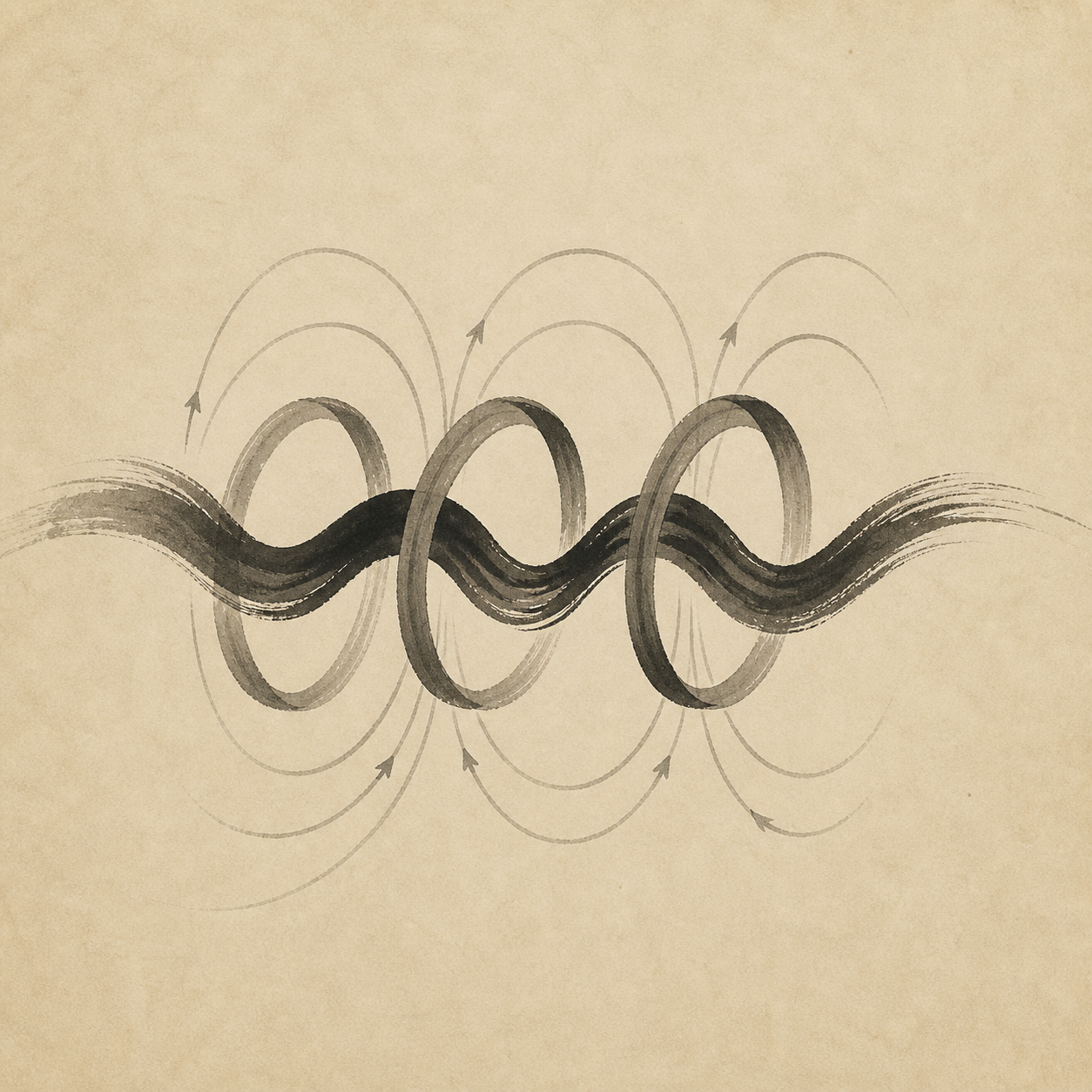
The mechanism is a kind of perpetual handoff. A changing electric field creates a magnetic field; the changing magnetic field creates an electric field; each regenerates the other, and the pair sails forward through empty space at the speed of light, needing no medium to carry it. That was the first shock — light required no invisible ether, only the fields themselves. The second and deeper idea is that a single family of waves, differing in nothing but wavelength, spans more than fifteen orders of magnitude and behaves so differently at each end that it took genius to see they were one thing. Radio waves slip through walls; microwaves warm water; a narrow band we see as color; X-rays pass through flesh; gamma rays shatter molecules. What unifies them is one set of equations; what distinguishes them is how the wave couples to matter, and that coupling explains nearly everything we do with the spectrum. The energy a wave carries rises with its frequency, so the same kind of field is a harmless warmth at one wavelength and a cell-damaging ray at another. Matter, for its part, responds only where the wave's energy matches some gap it already has: our eyes evolved to catch exactly the band the sun pours out most strongly, whose energy happens to fit the pigments of the retina; a microwave oven works differently — its field grips the lopsided water molecule and twists it, across a broad band of frequencies rather than at one special note; X-ray crystallography can map atoms because its wavelength is about the spacing between them. Diffraction, refraction, the reddening of light from a receding galaxy — all of it falls out of the same equations, so that one compact law reaches from the warmth of sunlight on skin to the bending of starlight around a distant galaxy.