Electric & Magnetic Fields
- Ohm's law: V = IRnot yet tested
- Amperes, volts, and ohmsnot yet tested
- Magnetic poles and the compassnot yet tested
- Lorentz force on a chargenot yet tested
Coulomb's law gives the force between two static charges, but it leaves a strange question unanswered: how does one charge "know" where the other is? The two charges might be a meter apart in vacuum; nothing connects them; and yet they exert force on each other across the gap. Action at a distance — the same problem that haunted Newton's gravity — was the embarrassment of nineteenth-century electromagnetism. The answer was developed by Michael Faraday in the 1830s and James Clerk Maxwell in the 1860s: the charges do not act on each other directly; they create a field that fills space, and the field acts locally wherever another charge happens to be. The electric field and magnetic field are the carriers of electromagnetic influence, and once you take them seriously as physical objects, electromagnetism becomes a field theory rather than a particle theory.
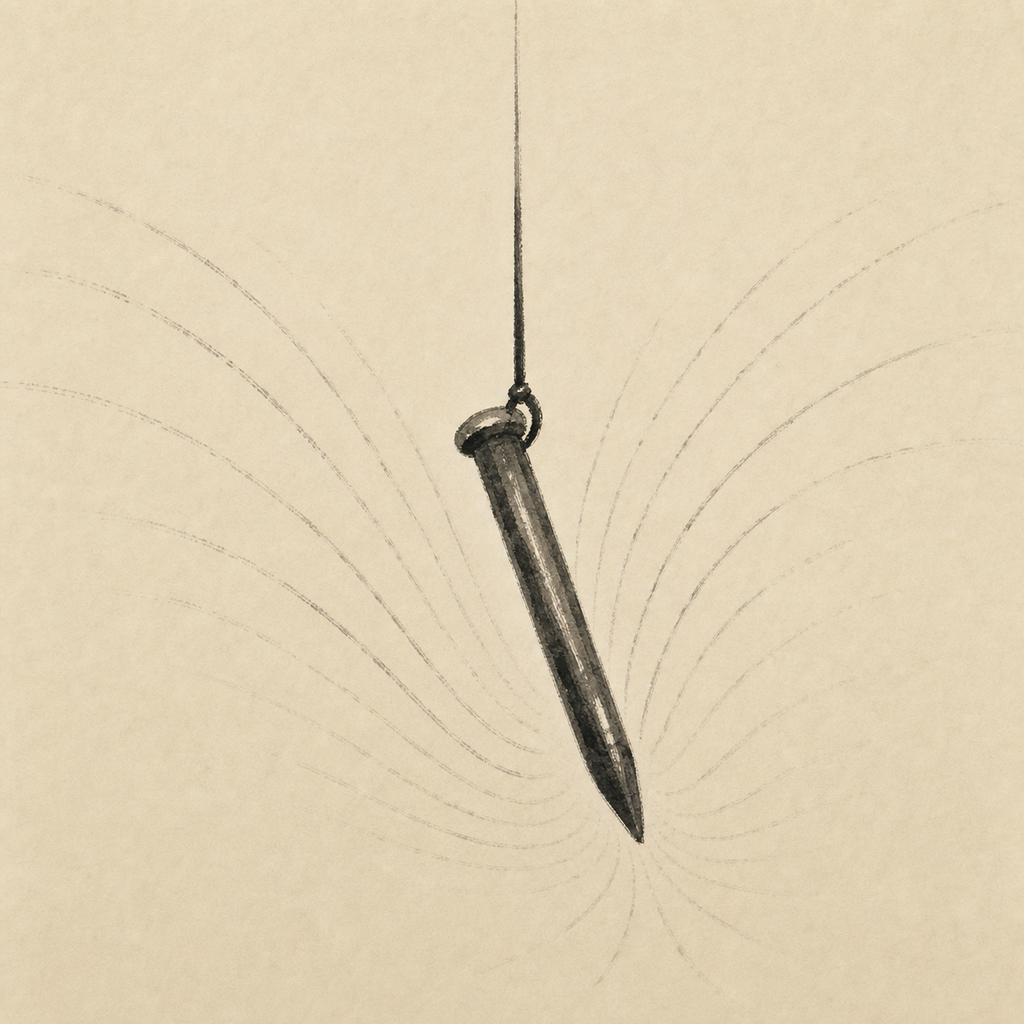
An electric field 𝐄(x, y, z) is a vector quantity defined at every point in space: it is the force per unit charge a small test charge would feel if placed at that point. Around a single point charge q, Coulomb's law gives 𝐄 = k·q·𝐫̂ / r², radial and proportional to 1/r². For multiple charges, fields superpose linearly. Electric field lines (Faraday's visualization) point in the direction of 𝐄 and have density proportional to its magnitude. A magnetic field 𝐁 is similarly a vector field, with the catch that it acts on moving charges (and current loops): the force on a charge q moving with velocity 𝐯 is 𝐅 = q·𝐯 × 𝐁 (the Lorentz force). Magnetic fields are produced by moving charges (current-carrying wires generate 𝐁) and by intrinsic magnetic moments (electrons and atomic nuclei have small built-in magnets). Faraday's law (1831): a changing magnetic flux through a circuit induces an electric field and hence a current. Ampère's law (with Maxwell's correction): a changing electric field produces a magnetic field, just as a current does. The two laws together are the coupling — the reason electricity and magnetism are not separate phenomena but two faces of one. Field energy: the fields themselves carry energy (½ε₀|𝐄|² per unit volume for the electric field, |𝐁|²/(2μ₀) for the magnetic), and this energy can flow through space. Field momentum: fields also carry momentum, which is why light pressure is real and solar sails work. The conceptual move — that fields are physical entities, on the same ontological footing as particles — was philosophically wrenching at first. By the end of the nineteenth century it was settled: the universe contains both particles and fields, and the fields are at least as fundamental.