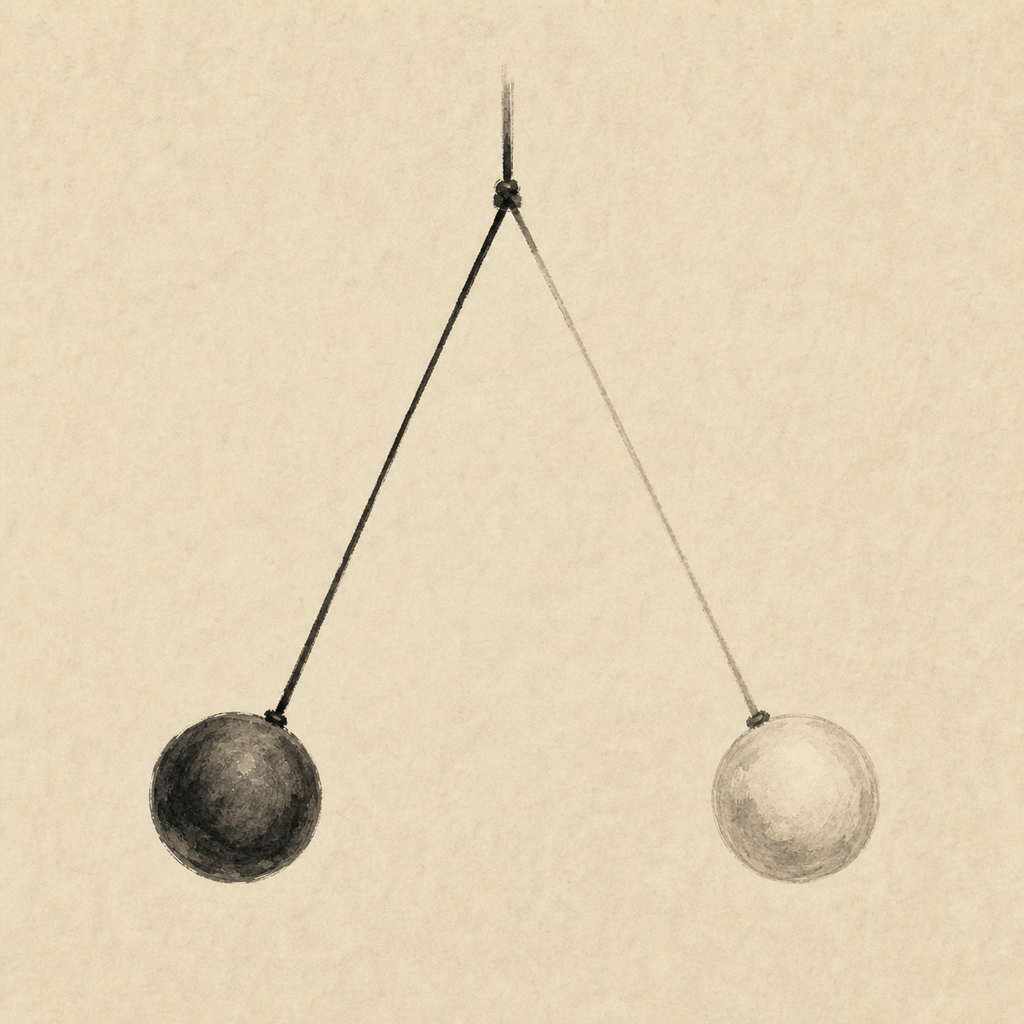
Electric Charge & Coulomb's Law
- Positive and negative charge, and the electron's signnot yet tested
- Like charges repel, unlike attractnot yet tested
- F = k·q₁·q₂ / r², an inverse-square lawnot yet tested
- Lightning as a large electric dischargenot yet tested
Charles Augustin de Coulomb — a French military engineer — published in 1785, four years before the French Revolution, the result of a series of exquisitely careful experiments with a torsion balance. The instrument: a thin wire suspending a horizontal rod with a small charged ball at one end. As Coulomb brought a second charged ball nearby, the rod rotated until the wire's restoring torque balanced the electric force. By measuring the angle, Coulomb measured the force. By varying the distances and charges, he established what is now called Coulomb's law: the electrostatic force between two point charges is proportional to the product of their charges and inversely proportional to the square of the distance between them. The law was almost identical in form to Newton's law of universal gravitation, with one philosophically devastating difference: charge can be negative, and like charges repel while unlike charges attract. Electromagnetism, from this beginning, was always going to be richer than gravity.
Electric charge is a fundamental property of matter. There are two kinds — positive and negative — and matter is neutral when the two are balanced. Quantization (recognized only after Millikan's 1909 oil-drop experiment): all charges are integer multiples of the elementary charge e ≈ 1.602 × 10⁻¹⁹ coulombs, the charge on a single proton (positive) or electron (negative). Coulomb's law: F = k·q₁·q₂ / r², where k ≈ 8.99 × 10⁹ N·m²/C² is Coulomb's constant and the force is along the line connecting the charges, attractive for opposite signs and repulsive for like signs. The law's structural similarity to universal gravitation — both are inverse-square central forces — is striking, and underlies many parallels in solution methods (Gauss's law applies to both, potential descriptions look identical, the orbits of charged particles in a Coulomb field can be ellipses or hyperbolas just as in gravity). The differences run deeper: charges come in two signs (allowing cancellation, hence the existence of nearly-neutral matter at macroscopic scales), the coupling constant of the electric force is roughly 10³⁹ times larger than gravity (so atoms are held together electrically, not gravitationally), and moving charges produce magnetic effects that have no gravitational analog (until general relativity, where one finds a frame-dragging effect that loosely resembles magnetism for moving masses). Conductors allow charge to move freely; insulators don't; semiconductors allow charge to move under controlled conditions and are the foundation of modern electronics. Charge conservation: the total electric charge of an isolated system is exactly conserved, with no known exceptions in any physical process. The conservation is closely related to a deep symmetry of electromagnetism (gauge invariance) — Noether's theorem in action again.