Ecosystems & Trophic Levels
- Lindeman's 10% rule and the energy pyramidnot yet tested
- Trophic levels, food webs, and keystone speciesnot yet tested
- Why meat takes ten times the land of plantsnot yet tested
- Tropical rainforests at the equatornot yet tested
Raymond Lindeman was a 26-year-old American postdoctoral fellow at Yale in 1942 when he submitted a paper to the journal Ecology analyzing energy flow in Cedar Bog Lake, Minnesota — the lake he had spent his Minnesota doctorate on. The paper proposed that ecological systems be understood quantitatively, as flows of energy from primary producers through herbivores, carnivores, and apex predators, with each transfer losing roughly 90% of the available energy at the previous level to respiration, heat, and incomplete digestion. The paper was initially rejected; Lindeman's supervisor G. Evelyn Hutchinson intervened on the strength of an idea so foreign to ecological writing of the time that the editors had not known what to do with it. It was accepted and published. Lindeman did not see it printed: he died of a liver ailment a few months earlier, at twenty-six. The Trophic-Dynamic Aspect of Ecology — the title of the paper — has the force of a foundational insight; almost everything quantitative about modern ecology dates from it.
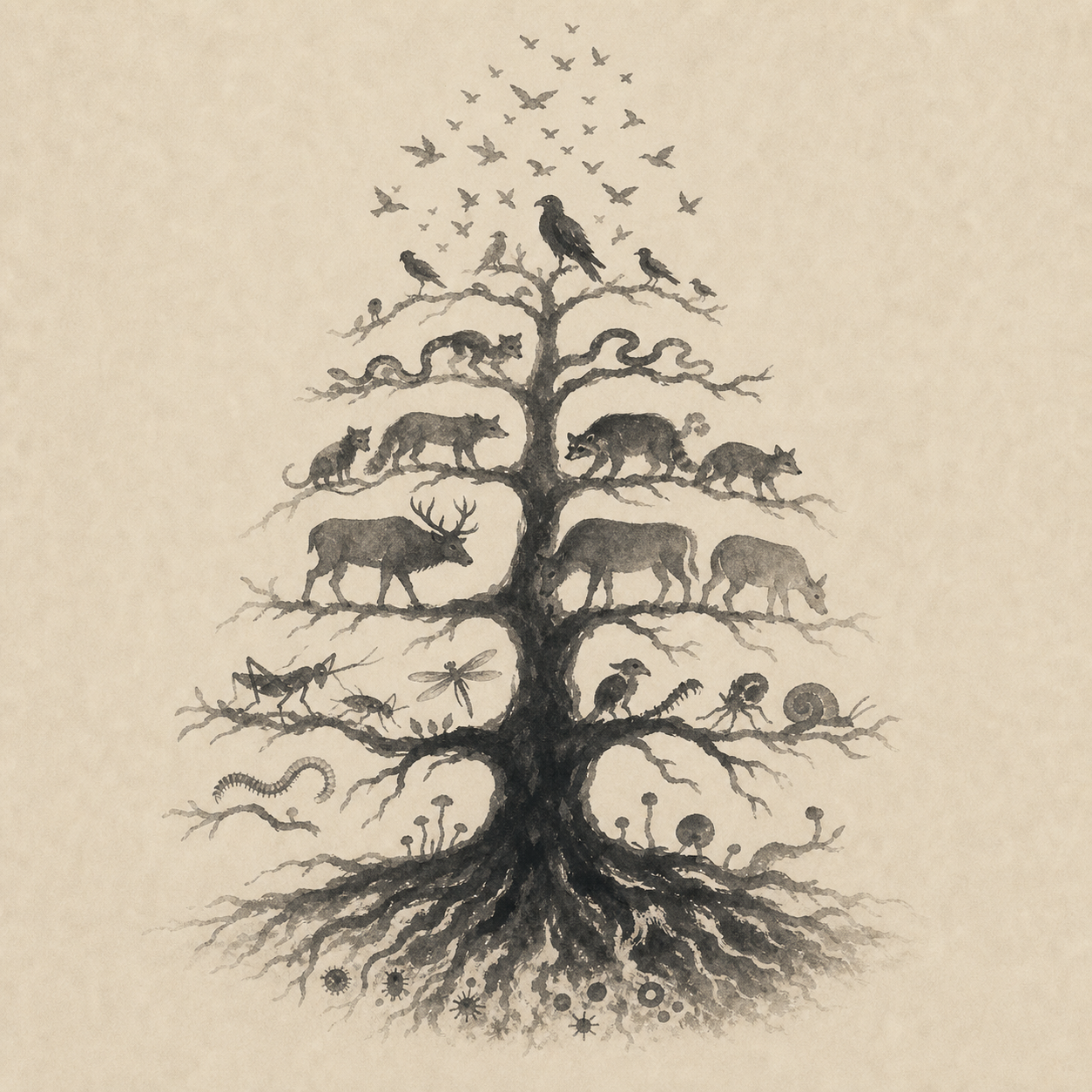
The 10% rule — Lindeman's average — is an order-of-magnitude empirical regularity rather than a sharp constant: it varies from a few percent in inefficient terrestrial food chains to nearly twenty percent in highly productive marine ones. What it means structurally is a pyramidal ecosystem — there must be far more grass than rabbits, far more rabbits than foxes, far more foxes than the rare apex predators. By the time you reach the fifth level only ~10⁻⁴ of the original primary production remains, which is why food chains are typically only four or five links long and why apex predators (lions, killer whales, sharks) are rare and characteristically vulnerable to disruption of any link below them. The same arithmetic explains a piece of dietary geography: a calorie-equivalent meat diet requires roughly an order of magnitude more land than a plant-based one, because you are eating one trophic level higher. Poore and Nemecek (Science, 2018) estimated that a global shift toward plant-based diets would free up roughly 76% of agricultural land — the single largest available environmental intervention by spatial extent.
Real ecosystems are food webs, not chains. Most species eat several things and are eaten by several. Network ecology studies these webs as graphs and finds them sparse but structured — connectance is typically 5 to 20% in observed systems, with compartmentalization and nested sub-webs that random networks would not produce. The structural-vulnerability question is downstream: removing the right node does not just lose one species, it changes how energy and nutrients flow through everything below it. Robert Paine's 1966 experiment removing Pisaster sea stars from intertidal communities at Mukkaw Bay showed exactly that, and named the phenomenon keystone species. The framework underwrites contemporary thinking about trophic cascades — wolves at Yellowstone, sea otters in California kelp, sharks on Caribbean reefs — and explains why standing biodiversity often depends, surprisingly, on a small number of species whose absence rearranges the rest.