DNA Structure & Replication
- Double helix & two strandsnot yet tested
- The four bases (A, T, C, G)not yet tested
- Base pairing (A↔T, C↔G)not yet tested
- RNA vs DNA (uracil for thymine)not yet tested
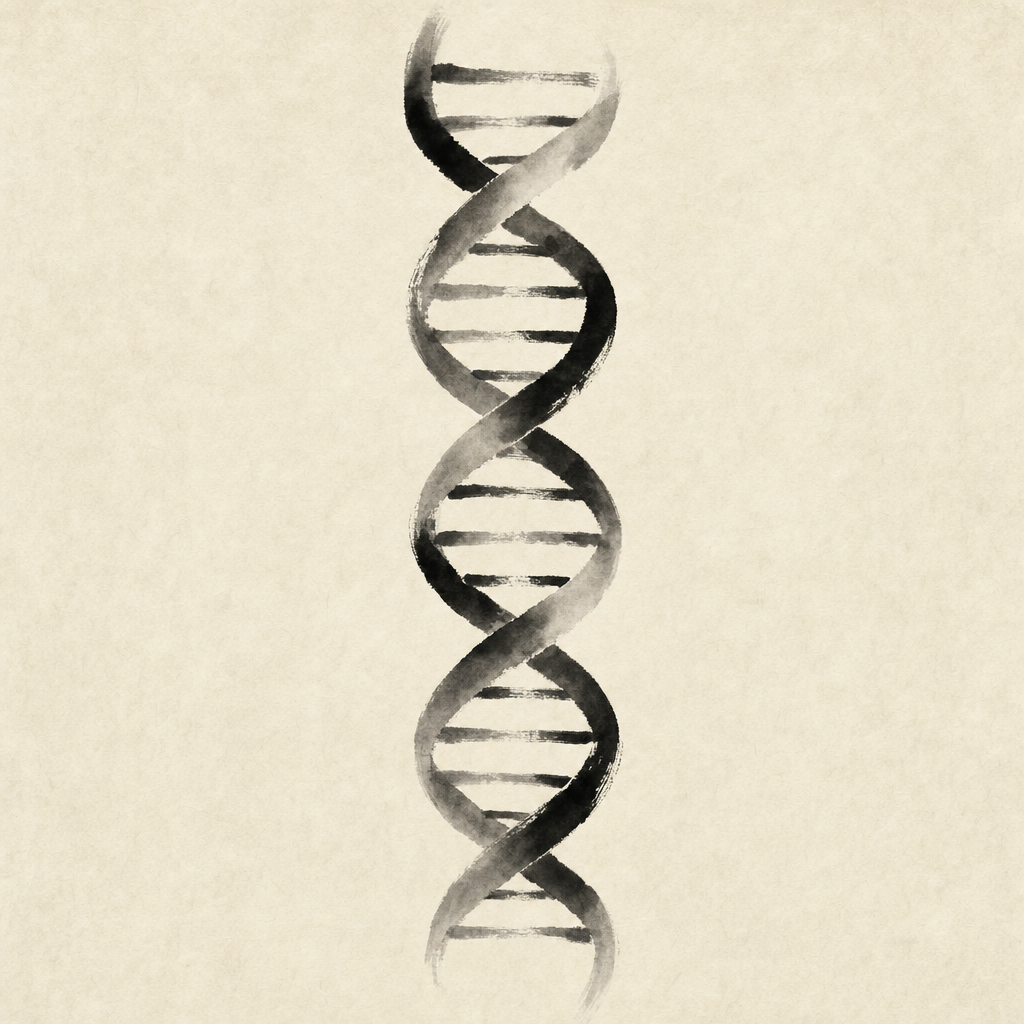
On 28 February 1953, James Watson and Francis Crick walked into a Cambridge pub at lunchtime and announced they had figured out the secret of life. Their two-page Nature paper that April sketched a double helix of two complementary strands paired base-to-base — adenine with thymine, cytosine with guanine — and ended with the now-famous understatement that this pairing "immediately suggests a possible copying mechanism for the genetic material." Storage and inheritance collapsed into a single molecule.
DNA is a polymer of nucleotides: deoxyribose and phosphate form the backbone, one of four bases projects inward. Watson-Crick pairing — A with T across two hydrogen bonds, C with G across three — locks two complementary strands into a helix of 3.4-nm pitch and ten base pairs per turn. The geometry had been visible in Rosalind Franklin's X-ray diffraction Photo 51, shown to Watson without her permission; she died of ovarian cancer in 1958 at thirty-seven, and the 1962 Nobel went to Watson, Crick, and Wilkins. Replication is semi-conservative (Meselson-Stahl, 1958): each parent strand templates a new daughter, leaving every daughter helix with one old strand and one new. The machinery is elaborate — helicase unwinds, primase lays RNA primers, single-strand binding proteins hold the strands open, topoisomerase relaxes supercoiling, polymerase synthesizes, ligase joins fragments — and the three billion base pairs of the human genome are copied from thousands of origins in parallel during the six to eight hours of S phase. Fidelity is extraordinary: polymerase proofreads as it goes, mismatch repair sweeps up afterward, and the residual error rate is around one in 10⁹ bases. Histones package the strand into nucleosomes, nucleosomes into chromatin, chromatin into the 23 chromosome pairs of a human cell, while UV, ionizing radiation, and oxidative byproducts of metabolism wound the DNA continuously and a battery of repair pathways — base excision, nucleotide excision, double-strand-break, mismatch — undoes the damage. When those pathways fail, cancer and inherited disorders like xeroderma pigmentosum follow.