Deep Time & Geological Eras
- Patterson's 4.55-billion-year radiometric agenot yet tested
- Hadean through Phanerozoic, the nested time scalenot yet tested
- Five resets punctuating the Phanerozoicnot yet tested
- The Holocene epoch and the rejected Anthropocenenot yet tested
In 1650, Archbishop James Ussher placed the creation of the Earth on Sunday, October 23, 4004 BCE. The dating was rigorous for its method and off by a factor of 750,000. Two centuries later, Lord Kelvin calculated Earth's age from how fast a molten sphere of Earth's size would cool — arriving at 20 to 400 million years. He did not know about radioactive decay, which generates heat in Earth's interior and slows the cooling enormously. The real answer came in 1956: Clair Patterson used the uranium-lead decay system in iron meteorites to date the planet at 4.55 ± 0.07 billion years. Life appeared by 3.5 Gyr, multicellular life by 1 Gyr, the Cambrian Explosion 538 Myr ago, Homo sapiens ~300 Kyr ago. The temporal scale of Earth history is the most counterintuitive number in science.
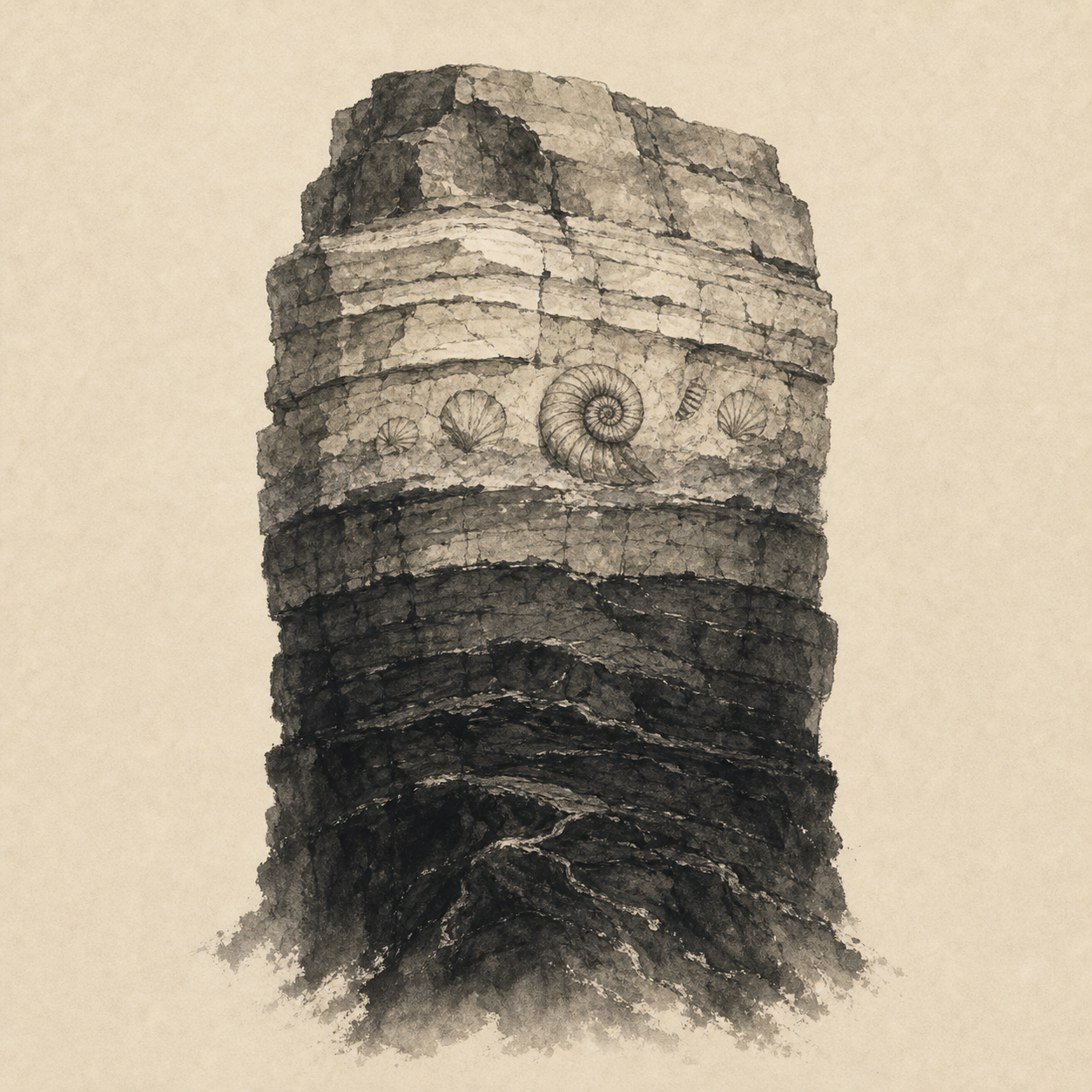
The geological time scale is divided into nested units of eons, eras, periods, epochs, and ages, each defined by stratigraphic markers — the rock record's own punctuation. Earth's four eons run from the Hadean (4.55 to 4.0 Gyr ago, when the planet was still molten and the Moon-forming impact occurred), through the Archean (4.0 to 2.5 Gyr, when life appeared and cyanobacteria evolved oxygenic photosynthesis), and the Proterozoic (2.5 to 0.54 Gyr, including the Great Oxidation Event around 2.4 Gyr that raised atmospheric oxygen from near zero to a few percent and killed most existing anaerobic life), to the Phanerozoic — visible life — beginning with the Cambrian Explosion of animal body plans 538 Myr ago. The Phanerozoic itself divides into the Paleozoic, ending in the Great Dying mass extinction 252 Mya; the Mesozoic, the age of dinosaurs from 252 to 66 Mya; and the Cenozoic, the age of mammals to the present, with the genus Homo appearing ~2.5 Mya, anatomically modern humans ~300 Kyr, agriculture ~12 Kyr, and industrial civilization ~250 years. The pattern across the Phanerozoic is long stable intervals punctuated by mass-extinction reorganizations — five major events have reset the standing biota, with recovery taking five to ten million years each time. The most-recent stratigraphic question is whether human activity has driven Earth into a new epoch. In 2000, Paul Crutzen and Eugene Stoermer proposed the Anthropocene, with the Anthropocene Working Group recommending formalization in 2019 and proposing a golden spike at Crawford Lake, Ontario, dated to ~1950. In March 2024, the parent commission rejected the proposal — Anthropocene-as-a-formal-epoch did not pass — though the informal use continues and the formal stratigraphic status remains Holocene. The deeper point is the cognitive one: almost no human intuition about time works at geological scale, and practicing thinking on these scales is a discipline-specific skill earth science teaches and almost no other does.