Cybernetics
- Wiener's 1948 founding of cyberneticsnot yet tested
- Sensor, comparator, actuator: the feedback loopnot yet tested
- Ashby's Law of Requisite Varietynot yet tested
- Fragmentation into AI, control theory, and cognitive sciencenot yet tested
Between 1946 and 1953, in the basement of New York's Beekman Hotel, the Macy Conferences on Cybernetics convened a roving group of mathematicians, neurophysiologists, anthropologists, and information theorists — Norbert Wiener, John von Neumann, Claude Shannon, Margaret Mead, Gregory Bateson, Warren McCulloch among them — to ask how control, communication, and computation operate across biological organisms and engineered systems alike. The unifying concept that emerged was feedback: cybernetics models many regulating and goal-directed systems — from thermostats and homeostatic bodies to animals pursuing prey — as sensing a state and responding to deviations from a reference condition. Wiener gave the field its name in his 1948 book Cybernetics: Or Control and Communication in the Animal and the Machine — the title is the thesis.
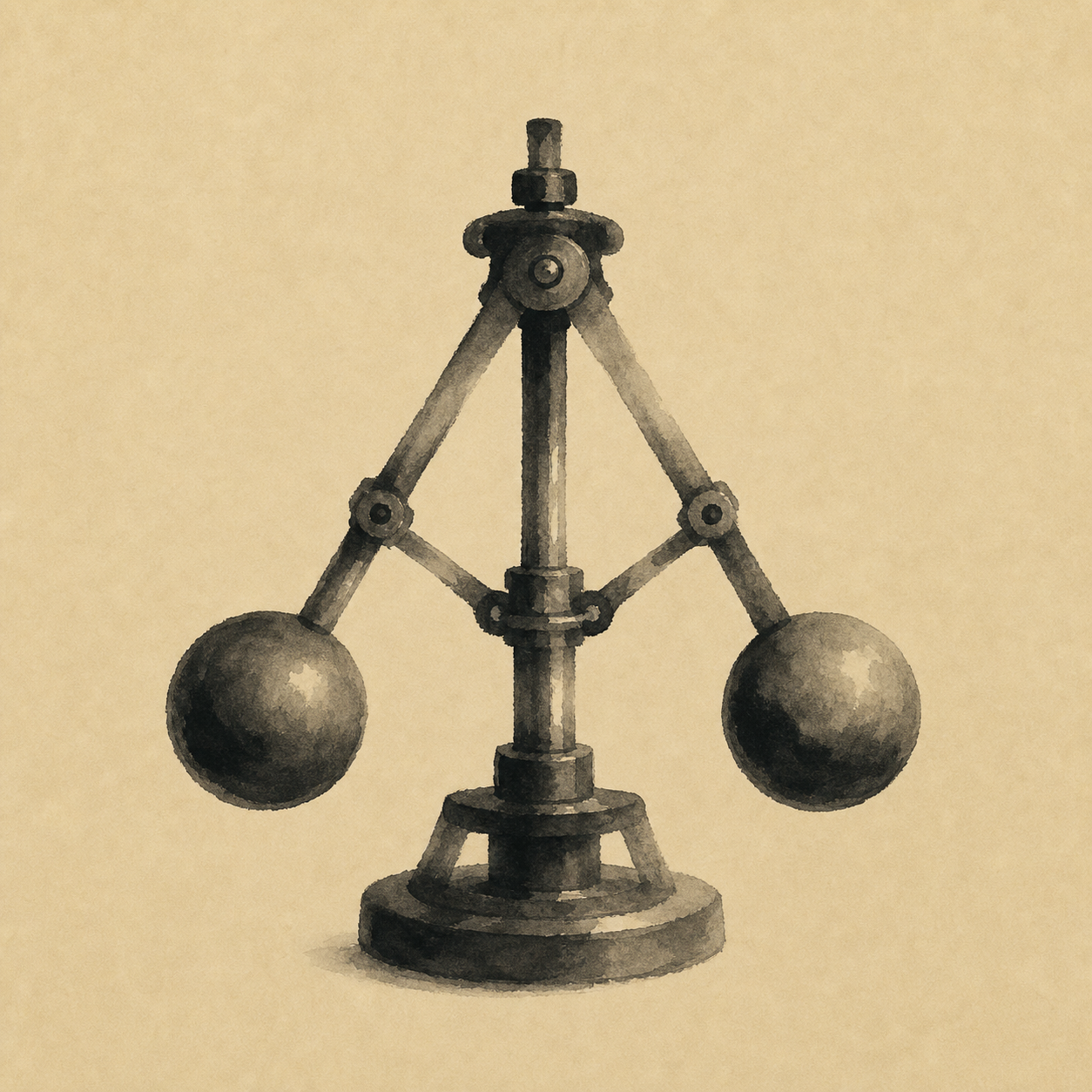
The cybernetic picture of any goal-directed system is simple enough to fit on a napkin: a sensor measures the current state, a comparator checks it against a reference value, an actuator corrects the discrepancy, and the environment loops back into the sensor. Negative feedback — corrective action that reduces the discrepancy — produces stability and goal pursuit, while positive feedback — action that amplifies it — produces growth, runaway, and tipping points; the same loop, with a sign change, distinguishes a thermostat from a population explosion. The biological body had been described in essentially these terms by Cannon in 1926 under the name homeostasis, but cybernetics extended the framework to engineered systems and, more provocatively, to purpose itself. Rosenblueth, Wiener, and Bigelow's 1943 paper Behavior, Purpose, and Teleology — the seminal statement — argued that purpose is negative feedback toward a goal, no vital force required, which dragged teleology out of metaphysics and into physics. Ashby's Law of Requisite Variety sharpened the regulation question: a controller needs at least as many degrees of freedom as the disturbances it must absorb, so a thermostat with only ON and OFF cannot precisely control temperature. The reason cybernetics fragmented after the Macys was that its scope was too large for one discipline — AI (named at the Dartmouth Conference, 1956) absorbed the cognitive-machine work, control theory the engineering, cognitive science and neuroscience-as-information-processing the biological side, and information theory the communication channel. The names dispersed and cybernetics slowly disappeared from the academic mainstream, while its concepts — feedback, homeostasis, regulation, error correction, requisite variety, purpose-as-feedback — became foundational vocabulary across all the descendant fields.