CRISPR & Gene Editing
- Bacterial immune system repurposed as scissorsnot yet tested
- Cas9, guide RNA, and the cell's repair pathwaysnot yet tested
- Base editors, prime editors, and Cas13not yet tested
- He Jiankui's embryos and the Casgevy approvalnot yet tested
Jennifer Doudna and Emmanuelle Charpentier met for the first time at a conference in Puerto Rico in March 2011. Doudna ran a structural-biology lab at Berkeley studying RNA; Charpentier was a microbiologist at Umeå studying the adaptive immune system bacteria had evolved against viruses. Bacteria collect snippets of viral DNA in a genomic region called CRISPR and use them, via the protein Cas9, to recognize and cut matching viral DNA on subsequent infection. What Doudna and Charpentier realized — and tested in 2012 — was that the CRISPR-Cas9 system could be reprogrammed to cut any DNA sequence by changing the guide-RNA. Within a year Feng Zhang's lab at the Broad Institute had adapted Cas9 to mammalian and human cells. Doudna and Charpentier shared the 2020 Nobel.
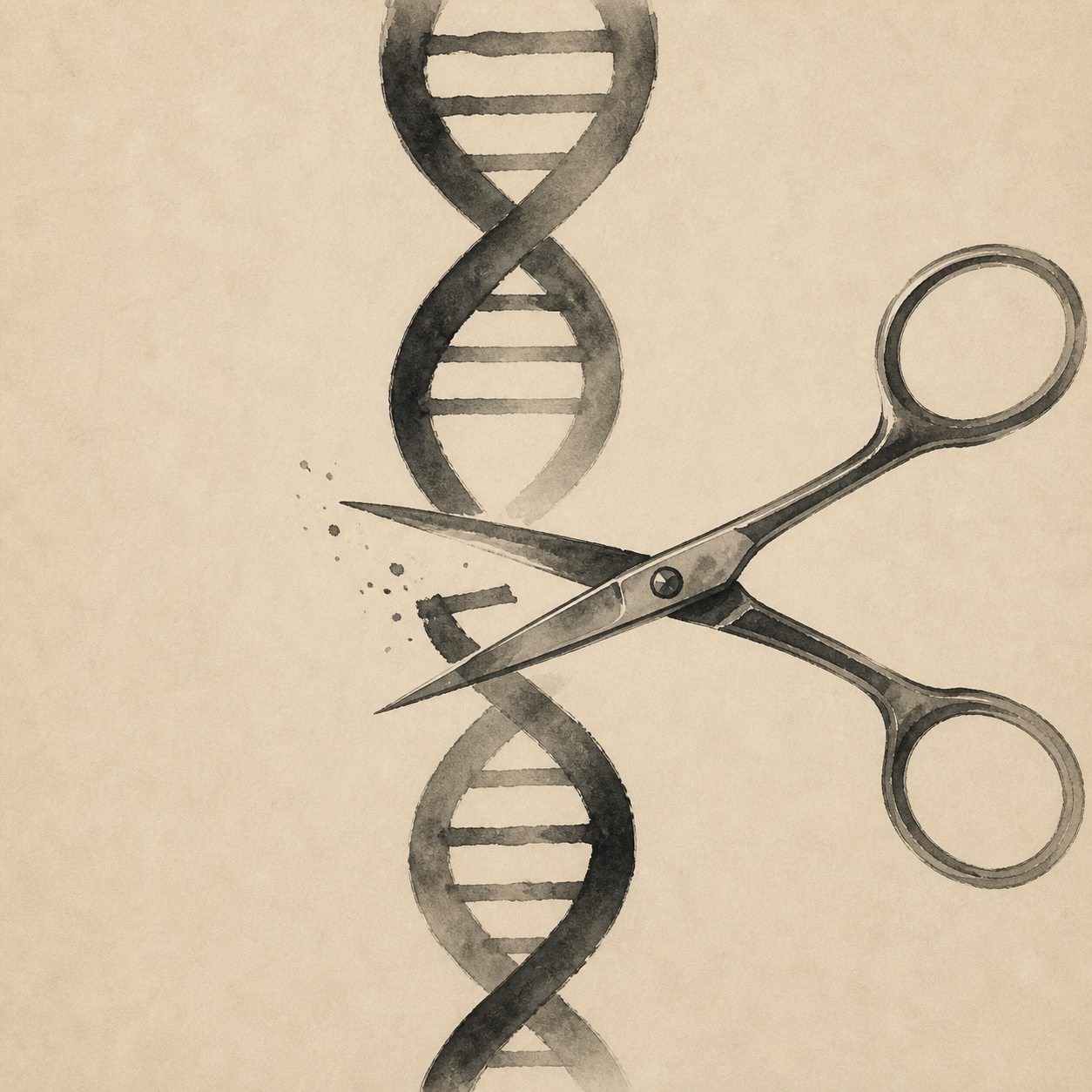
CRISPR-Cas9 is a programmable molecular scissors. The system has two functional components: the Cas9 enzyme (a nuclease that cuts both strands of DNA at the location it is directed to) and a guide RNA that base-pairs with the target DNA sequence — approximately 20 nucleotides long and the only thing that changes between editing targets. The system also requires a short protospacer adjacent motif (PAM) immediately downstream of the target site. Once Cas9 cuts the double strand, the cell's native repair machinery takes over. Non-homologous end joining is error-prone — it rejoins the cut ends but typically introduces small insertions or deletions that disrupt the reading frame, producing a knockout. Homology-directed repair uses a template to write in a specific sequence — this is how precise edits are made — but is several orders of magnitude less efficient and requires the cell to be in S/G2 phase, the technology's main limit. The original Cas9 has been extensively engineered. Base editors (David Liu's lab, 2016) fuse a catalytically-dead Cas9 to a deaminase, converting one base to another without cutting. Prime editors (Liu, 2019) extend the approach to small insertions and deletions using a reverse transcriptase. Cas13 targets RNA. CRISPR diagnostics (SHERLOCK, DETECTR) use collateral cleavage to detect specific sequences with high sensitivity (FDA emergency-use authorization for COVID-19 followed in 2020). The most consequential ethical event in the technology's history was He Jiankui's November 2018 announcement that he had used CRISPR to edit the CCR5 gene in human embryos that had been implanted and gestated. The intervention was germline (inherited by descendants) and medically unnecessary. The international scientific community condemned the experiment uniformly; He was sentenced to three years in Chinese prison. The somatic-vs-germline distinction crystallized: somatic edits affect only the treated individual; germline edits affect future generations who cannot consent and remain under a de facto international moratorium.