Copernicus to Newton
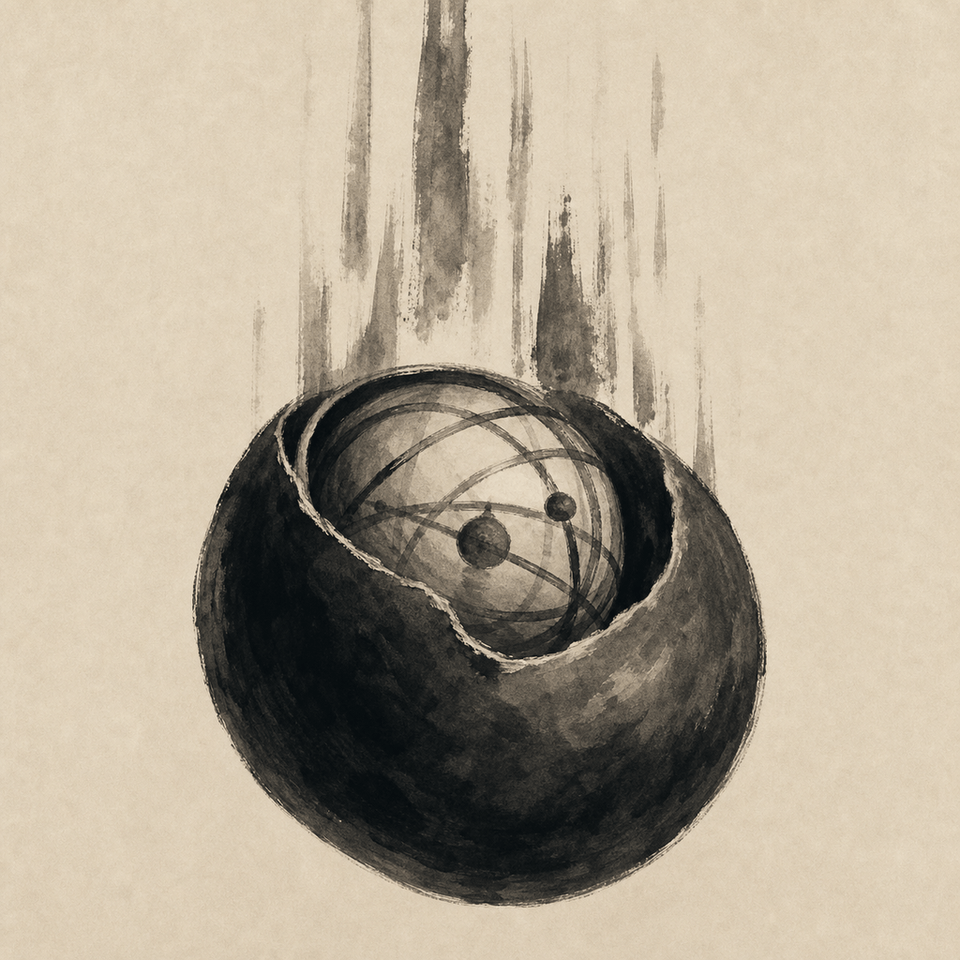
In 1543, on his deathbed, a cautious Polish canon named Nicolaus Copernicus published a book arguing that the Earth moved around the Sun, rather than the other way around. He hedged his metaphysics — an anonymous preface framed the model as a mere calculation device — but the geometry was unmistakable. In 1687, one hundred and forty-four years later, Isaac Newton published the Principia, giving a single set of laws — three of motion plus universal gravitation — that explained why the planets follow the very orbits Copernicus had sketched and Kepler had measured. In a century and a half, the centre of the universe moved from us to nobody in particular, and the cosmos became something written in equations.
The intervening century housed the actual revolution. Tycho Brahe's obsessively precise naked-eye observations at Uraniborg gave Johannes Kepler the data to wring out three planetary laws — including the heretical finding that orbits are ellipses, not the perfect circles antiquity had demanded, and that planets sweep equal areas in equal times. Galileo's telescope showed Jupiter's four moons (a miniature system not centred on Earth), the full phases of Venus (impossible under pure geocentrism), and mountains on a Moon supposed to be a perfect celestial sphere; his 1633 trial showed the cost of saying so aloud. Descartes proposed that nature was mechanical — matter in motion, reducible to physics and geometry — and helped invent the analytic geometry that made motion calculable. Newton's synthesis was to see that the force pulling an apple down and the force holding the Moon in orbit are the same force, and to prove with his new calculus that an inverse-square law yields Kepler's ellipses exactly. By the time he was done, a new conception of knowing had taken hold: knowledge was quantifiable, replicable, public, and progressive. Aristotle had been the authority for two thousand years; Newton displaced him within a generation. The Royal Society, founded in 1660, institutionalized the method — publish, let others replicate, accept correction. This is the cultural infrastructure on which everything we still call modern science rests, and it was assembled by a handful of men who mostly never met.