Conservation of Momentum
- Momentum as mass times velocity, a vectornot yet tested
- Total momentum constant in a closed systemnot yet tested
- Conservation as a consequence of the third lawnot yet tested
- Noether symmetry, relativity, and missing momentumnot yet tested
In 1644, the French philosopher René Descartes proposed that the total quantity of motion in the universe was conserved. He was wrong about the precise quantity — he conserved |mv|, ignoring direction — but the structural intuition, that something gets handed around between bodies during a collision and the total stays the same, was correct. Christiaan Huygens corrected Descartes in the 1650s by treating velocity as a vector, and Newton built the corrected version into the third law of his 1687 Principia. Conservation of momentum — that the total linear momentum of an isolated system never changes, no matter how its parts collide, explode, or interact — is one of the most empirically robust statements in physics, and it has survived every theoretical revolution since Newton.
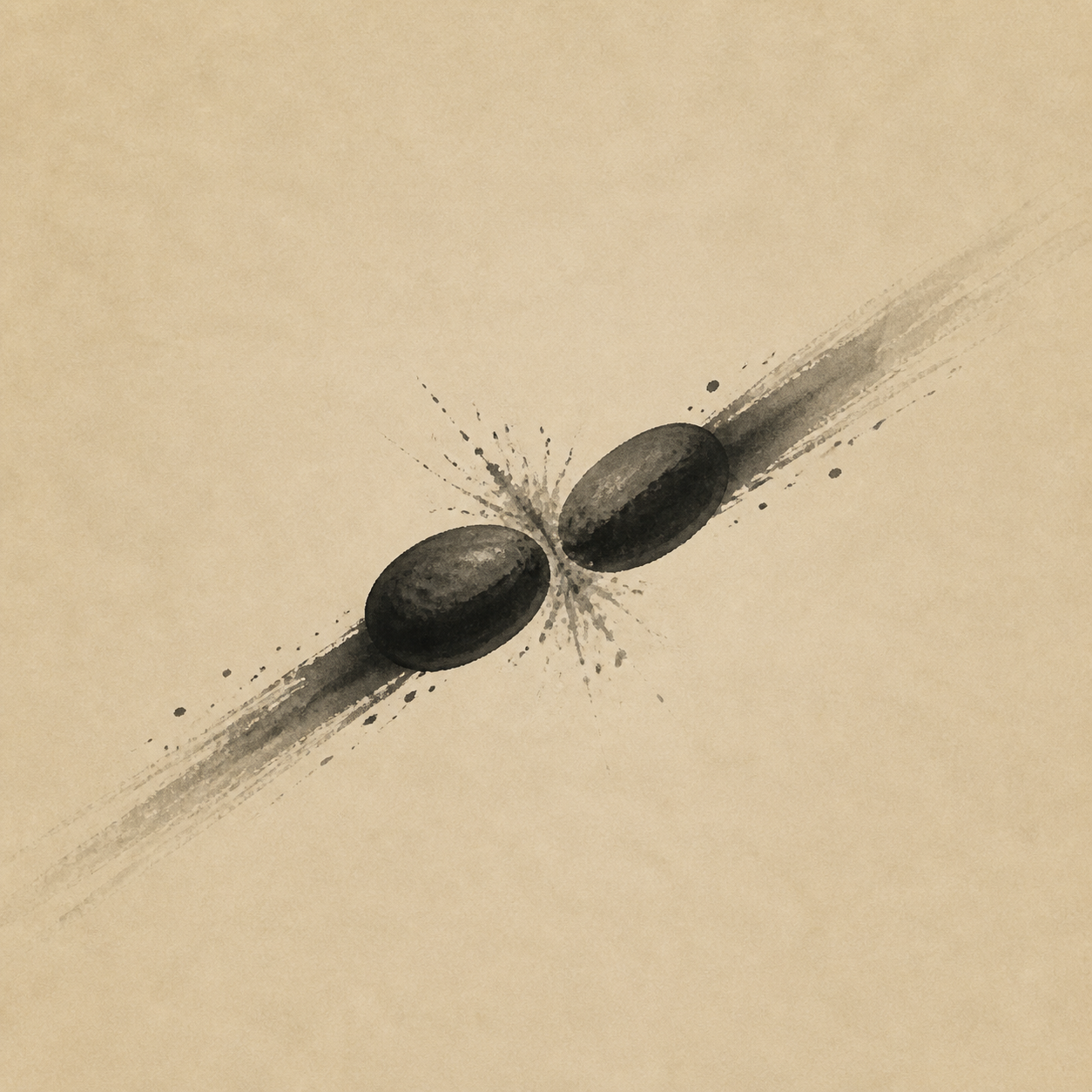
Momentum is mass times velocity: 𝐩 = m·𝐯, a vector quantity. For a system of multiple bodies, the total momentum is the vector sum of individual momenta. Conservation of momentum: in the absence of external forces, the total momentum of a closed system is constant. The conservation follows directly from Newton's third law: if body A exerts force 𝐅 on body B, then B exerts −𝐅 on A; integrating over time, the impulses cancel and the total momentum is unchanged. Elastic collisions preserve both kinetic energy and momentum; inelastic collisions preserve only momentum (the lost energy goes to heat or deformation). Rocket propulsion (the rocket gains forward momentum exactly equal in magnitude to the rearward momentum of the exhaust), recoil from firing a bullet, the frictionless puck on an air table — all are immediate consequences. Generalizing: Noether's theorem (1918) shows that momentum conservation arises from the spatial-translation symmetry of the laws of physics — they don't change if you move your experiment to a different place. Special relativity modifies the formula: relativistic momentum is 𝐩 = γm𝐯, where γ = 1/√(1 − v²/c²); the conservation law is preserved, but the formula adjusts. Quantum mechanics makes momentum an operator whose eigenvalues are the possible measurement outcomes, with the de Broglie relation p = h/λ tying particle momentum to wavelength. The conservation survives intact: in every interaction at every scale ever measured, the total momentum balances. The principle is so reliable that missing momentum in a particle-physics experiment is one of the most powerful diagnostics for detecting otherwise-invisible particles — neutrinos were first inferred this way in beta decay (Pauli, 1930), and dark-matter searches at colliders look for the same signature today.