Conditional Probability
- P(A|B) as a shrunken, re-scaled universenot yet tested
- Chain rule and independence as P(A|B)=P(A)not yet tested
- Bayes' theorem as belief-update from evidencenot yet tested
- The base-rate trap of a 99%-accurate testnot yet tested
In 1990, the columnist Marilyn vos Savant published the answer to a reader's question about a game show: behind one of three doors is a car, behind the others, goats; you pick a door, the host (who knows where the car is) opens a different door revealing a goat, and asks if you want to switch. Should you switch? Vos Savant said yes — switching wins the car two-thirds of the time. She received roughly ten thousand letters in response, including many from PhDs in mathematics, telling her she was wrong. She wasn't. The Monty Hall problem is the most famous illustration of a deeper point: human intuition about probability when new information arrives is unreliable, and the formal cure is the calculus of conditional probability.
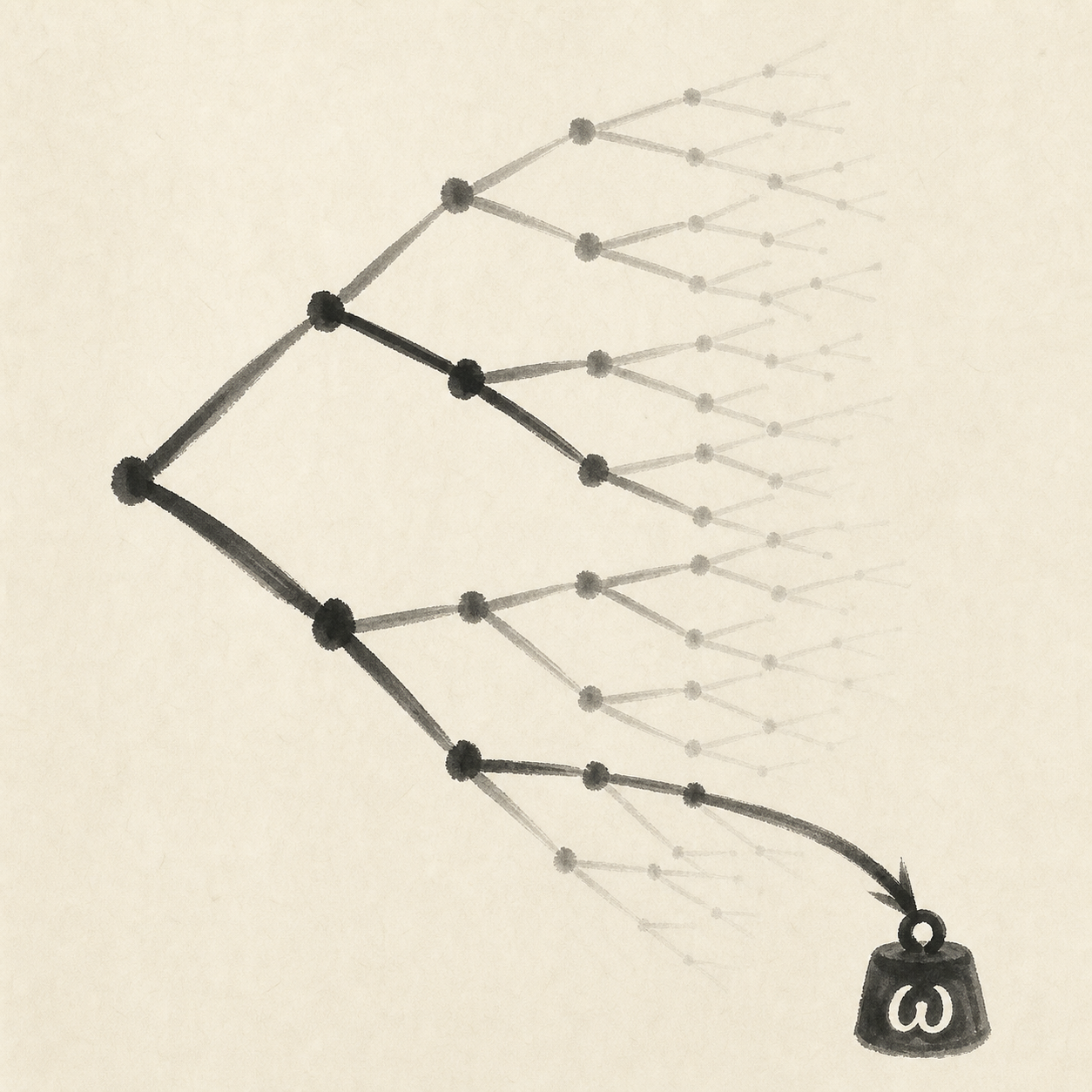
The conditional probability of event A given event B is defined as P(A|B) = P(A ∩ B) / P(B), provided P(B) > 0 — the probability that both A and B occur, normalized by the probability of B. The intuition: once you know B has occurred, the relevant universe shrinks from the full sample space to just the part where B is true, and probabilities re-scale to sum to one inside that subspace. The definition immediately gives the chain rule of probability: P(A ∩ B) = P(A|B)·P(B) = P(B|A)·P(A), letting joint probabilities decompose into conditional pieces. Independence is the special case in which conditioning changes nothing: A and B are independent iff P(A|B) = P(A). Conditional probability is the engine of evidential reasoning. Bayes' theorem — P(H|E) = P(E|H)·P(H) / P(E) — is just the chain rule rearranged, but its content is profound: it tells you how to update belief in a hypothesis as evidence arrives. The base-rate fallacy — the persistent error of forgetting how rare a condition is when interpreting a positive test — is the everyday name for failing to compute P(A|B) correctly. A 99%-accurate cancer test, applied to a population where 1 in 1000 has cancer, returns a positive result that is correct only about 9% of the time — a fact that disturbs medical students, contradicts intuition, and is a direct consequence of conditional probability arithmetic.