Composition & the Golden Section
- Rule of thirds and visual weightnot yet tested
- Leading lines, negative space, symmetry, aspect ratiosnot yet tested
- The golden ratio's overclaimed status in artnot yet tested
- φ as the most irrational number and phyllotaxisnot yet tested
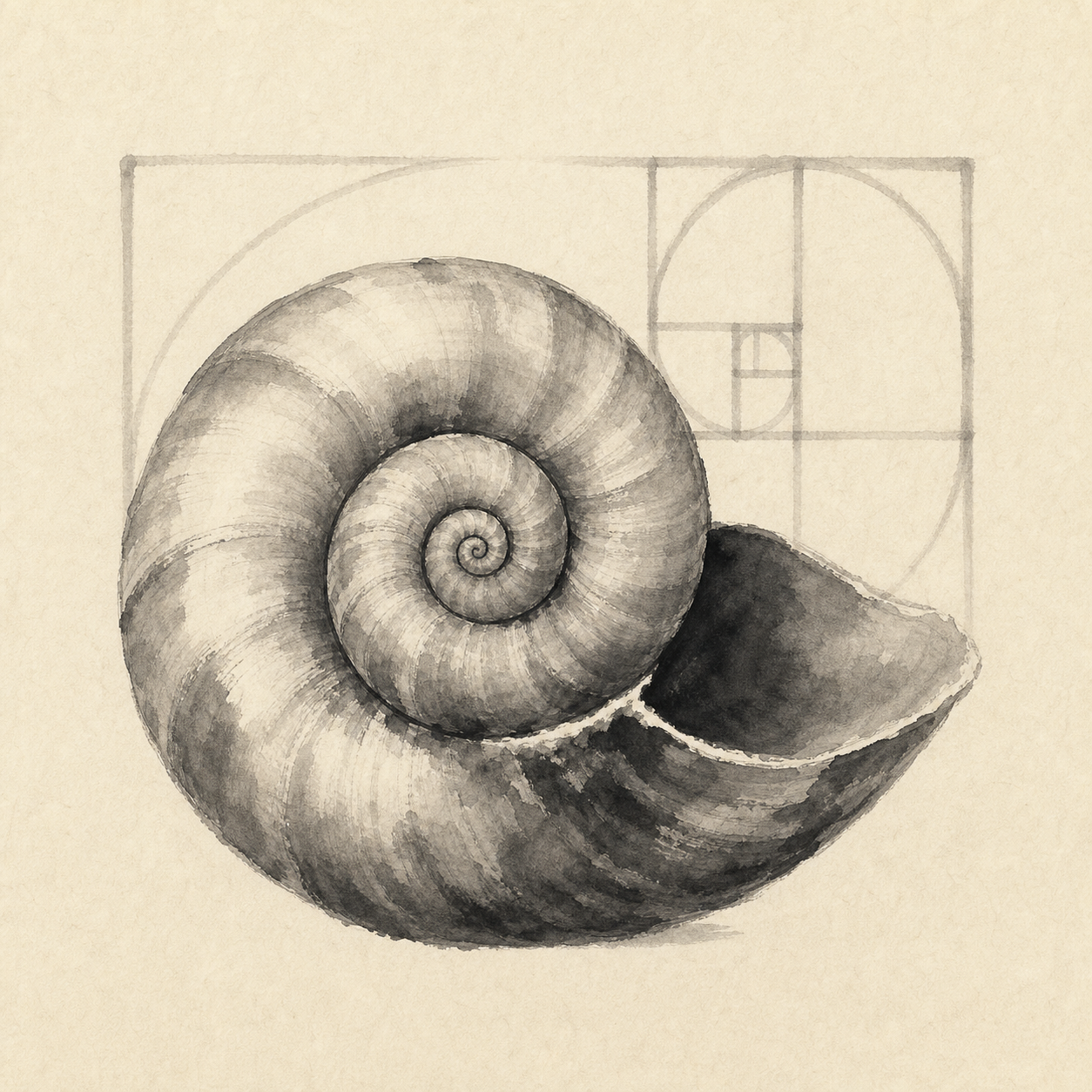
Where the eye stops first, and what holds it there. The question of composition — the spatial organisation of elements within a frame — is one every painter, photographer, designer, and cinematographer eventually confronts. The most-cited formula is the golden ratio, φ ≈ 1.618, derived from a geometric construction in Euclid's Elements (~300 BCE) and applied, allegedly, in everything from the Parthenon to Leonardo's Mona Lisa to the Apple logo. The cultural reputation is enormous; the empirical psychological evidence that φ has a special perceptual or aesthetic status is much weaker than the reputation suggests. Proportional thinking matters; the specific ratio of φ is one tool among many, not a privileged one.
Composition theory contributes a small set of robust practical heuristics developed across painting, photography, and cinema. The rule of thirds — divide the frame into a 3×3 grid and place key elements on the gridlines or intersections — is approximate, is not a golden-ratio derivation despite repeated claims, and is empirically supported: photographers who follow it produce images viewers rate as more engaging than centred or random placements. Visual weight matters: faces and especially eyes, high contrast, saturated colour, sharp focus, and leading lines attract the eye, and composing means balancing those weights so the gaze moves in an intended path. Negative space is as compositionally important as the filled regions, leading lines (a road, a railing, a horizon) route the eye, and the choice between symmetry (formal, stable, hierarchical) and asymmetry (dynamic, modern, casual) is rhetorical — cinema's aspect ratios (4:3, 16:9, 2.35:1, IMAX 1.43:1) make the framing decision itself a tool. The golden ratio does have some genuine mathematical and natural status — φ is in a precise sense the most irrational number (continued-fraction expansion [1;1,1,1,…]) and arises in phyllotaxis and in the Fibonacci counts of sunflower florets and pinecone spirals — though not, despite the poster, in the nautilus shell, which spirals logarithmically at quite a different ratio — but its presence in human art is mostly retrospective attribution: the Parthenon's golden-ratio dimensions are a posteriori curve-fits, and Vitruvian Man uses human-body proportions, not φ. Many claimed golden-ratio artworks fail when measured carefully, empirical preference studies show small and inconsistent effects, and the ratio's cultural status is partly self-fulfilling. What survives skepticism is the working tradition — proportional thinking matters, and the heuristics (rule of thirds, the diagonal method, dynamic symmetry) work.