Comparative Planetology
- Venus and the broken carbon thermostatnot yet tested
- Mars: frozen core, stripped atmospherenot yet tested
- Earth's coincidence of stabilizersnot yet tested
- The thermostat question turned on Earthnot yet tested
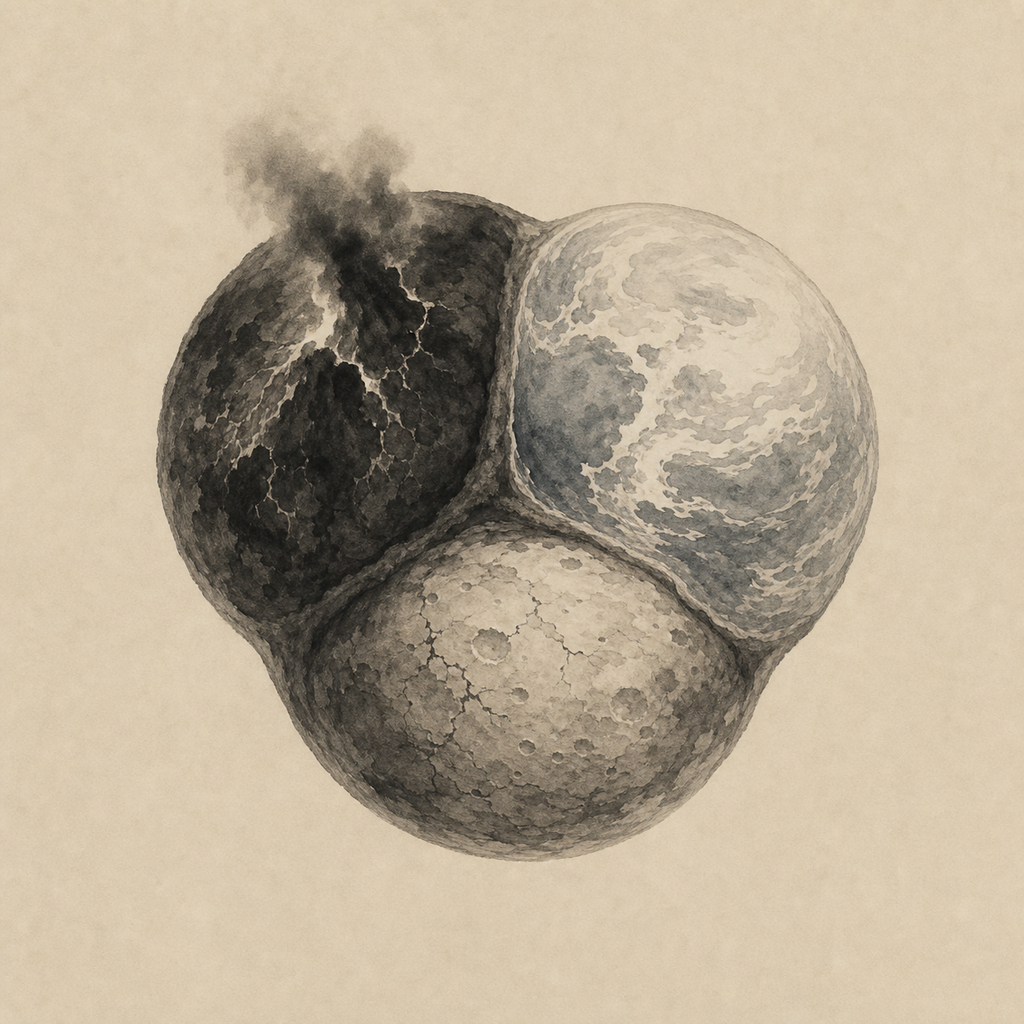
Earth, Venus, and Mars started out as three sister worlds. They formed in the same protoplanetary disk from broadly similar chemistry, ended up at orbital distances spanning barely a factor of two (0.72, 1.00, and 1.52 AU), inherited rocky cores in the same approximate size class, and almost certainly all began their atmospheric lives outgassing the same volcanic mix of CO₂, water vapour, and nitrogen. They should have aged into something like each other. Instead: a 470°C runaway-greenhouse cooker holding 92 atmospheres of CO₂; a temperate water world with the only known biosphere; a frozen near-vacuum at 0.006 atmospheres averaging −60°C. The same setup, three radically different endpoints. Comparative planetology asks why — and increasingly, given Earth's trajectory, where Earth is going.
Venus shows what happens when the carbon thermostat breaks. A little extra solar flux relative to Earth pushed early Venus warm enough to keep more water vapour in its atmosphere; water vapour is itself a powerful greenhouse gas, so the surface warmed further, evaporating more water, in a positive-feedback runaway. Once steam-saturated, ultraviolet high in the column photodissociated H₂O molecules and the freed hydrogen escaped to space, leaving Venus with no surface water. The second failure: Venus has no working plate tectonics. On Earth, weathering of silicate rock pulls CO₂ out of the air, oceans dissolve it, and subduction recycles it through the mantle — a slow chemical thermostat that has held Earth's climate within liveable bounds for billions of years. Venus has none of those return paths, so volcano-released CO₂ kept accumulating; the surface is now under a hundred-bar carbon-dioxide blanket.
Mars failed the other way. At roughly a tenth of Earth's mass, Mars cooled fast inside; its iron core cooled enough to stop convecting around four billion years ago, and once the core stopped convecting it stopped sustaining a global magnetic field. Without a magnetosphere, charged particles strip atmospheric molecules off the top a few ions at a time. The MAVEN spacecraft has been measuring this loss since 2014; the rates are slow but cumulative. Mars almost certainly had liquid surface water: orbital and rover observations of deltas, channels, sedimentary rocks, and hydrated minerals provide strong evidence. As the atmosphere thinned, water either escaped to space or froze into the regolith. Earth's distinction is not any single feature but a coincidence of stabilizers: the right size for sustained tectonic recycling, the right distance for liquid water, a still-convecting core driving a protective magnetic field, and a long-term carbon cycle that pulls CO₂ excursions back toward equilibrium.