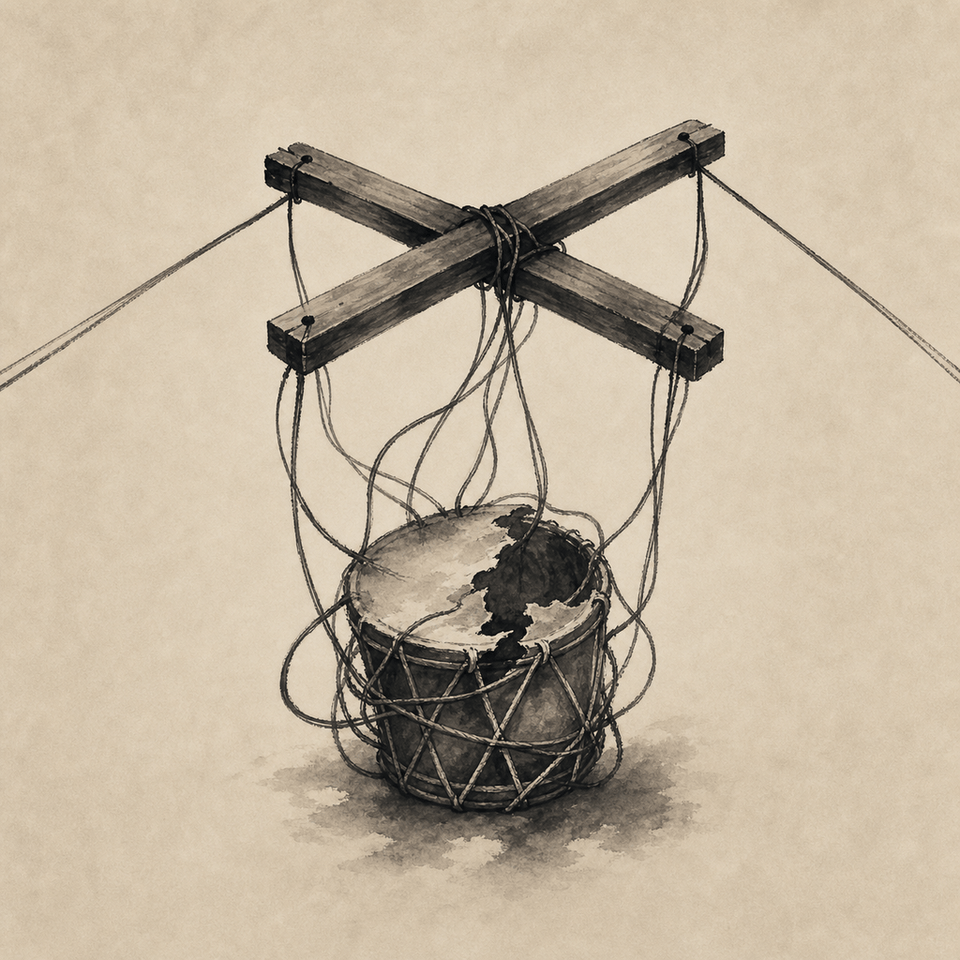
Cold War Proxy Wars
Between 1945 and 1991, the United States and the Soviet Union avoided direct military conflict — but their proxies fought everywhere else. Because nuclear deterrence made a head-on war between them suicidal, the superpowers waged their rivalry by other means, on other people's soil. Greek civil war, Korea, Vietnam, the Congo, Angola, Mozambique, Ethiopia–Somalia, Nicaragua, El Salvador, Afghanistan, Yemen. Tens of millions died in wars whose local logic — ethnic, anti-colonial, dynastic — was overlaid with superpower competition for arms, money, and ideological allegiance. Local actors made choices of their own, but outside patronage could turn a village conflict into a front in a planetary contest.
The proxy-war system was rational from the superpower perspective and catastrophic from everyone else's. Direct US–USSR conflict was constrained by nuclear deterrence — mutually assured destruction made victory indistinguishable from annihilation — so the rivalry flowed instead into third-country conflicts that offered ways to test resolve, drain the adversary, and shift alignment without risking Moscow or Washington. Korea, Vietnam, and 1980s Afghanistan were the largest theatres; smaller ones spanned the decolonising world. The decolonization wave of the 1950s and 60s supplied the raw material: dozens of new, institutionally thin states whose internal struggles each side could read as a referendum on its model and arm accordingly. Both poured weapons, advisers, and money into conflicts that often had nothing originally to do with the Cold War — Angola's MPLA–UNITA–FNLA war, where Cuban troops and South African forces intervened on opposite sides; the Horn of Africa's Ogaden war, in which Moscow switched clients from Somalia to Ethiopia almost overnight; Nicaragua's Sandinista–Contra struggle. The consequences for host societies were severe: prolonged conflict, militarized politics, economic destruction, and post-Cold War legacies of weapons stockpiles and traumatized populations that still cap state capacity decades later. Crucially, when the superpowers lost interest, the wars rarely ended — they merely went unfunded and unmediated, leaving Somalia and Afghanistan to collapse into the 1990s. The system also produced blowback: the Afghan jihad created armed networks and sanctuaries later used by Al-Qaeda, though the CIA did not directly fund bin Laden; investigations later confirmed drug trafficking by some Contra-linked groups, not the claim that the CIA created the crack epidemic. And the covert nature of it all — plausible deniability — corroded democratic oversight at home, culminating in scandals like Iran–Contra.