Cinema & Montage
- Hollywood and the Academy Awardsnot yet tested
- Landmark directors: Hitchcock, Spielbergnot yet tested
- Silent-era founders: Chaplin, Disneynot yet tested
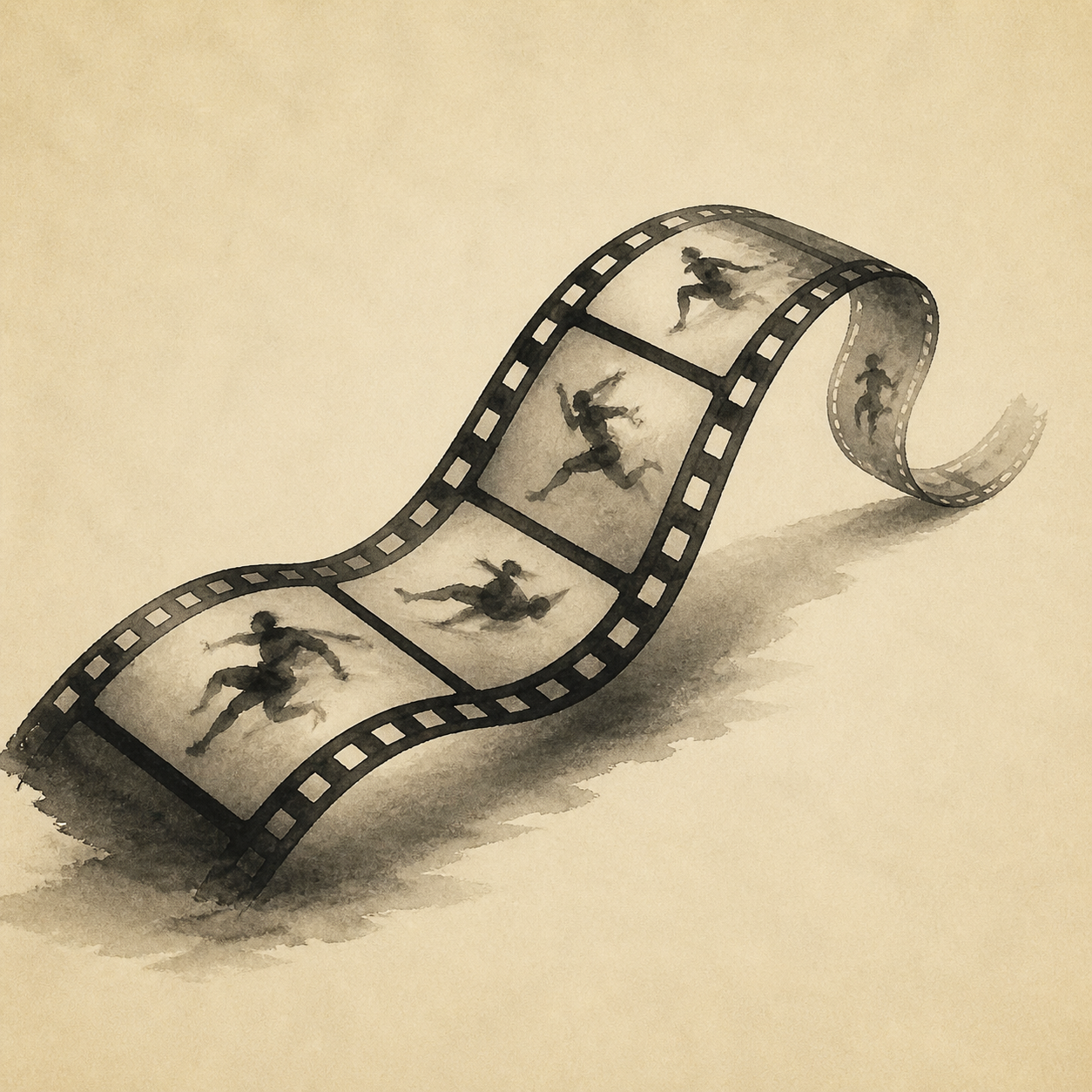
In 1925, the Soviet director Sergei Eisenstein released Battleship Potemkin — a film about a 1905 mutiny aboard a tsarist warship — and demonstrated, with what he called the Odessa Steps sequence, that cinema's distinctive expressive power was not in the individual shot but in the cut between shots. A close-up of a screaming woman; a wide shot of soldiers' boots advancing; a baby carriage rolling down a vast staircase; a smashed pince-nez; a stone lion seeming to rise to its feet — no individual shot says what the sequence says. The meaning is generated in the audience's mind by the juxtaposition. Eisenstein called the technique montage and claimed, theoretically and grandiloquently, that it was the entire art of cinema. He was overstating; he was also, mostly, right.
The deep claim of montage theory is that the basic unit of cinema is not the shot but the cut between shots. Lev Kuleshov demonstrated this around 1918 with what is now called the Kuleshov effect: an unchanging close-up of an actor's face was intercut, in turn, with a bowl of soup, a corpse in a coffin, and a child playing, and audiences confidently read the same expression as hunger, then grief, then fondness. The face had not changed; the meaning had been generated entirely by the juxtaposition. Eisenstein took the result as the foundation of an entire art form, theorizing several gradations of cut — from rhythmic cuts on motion to intellectual montage that pairs unrelated images to produce a third idea (politician and peacock) — and arguing that the cinema's expressive power lay in this constructive activity of the audience's mind, working at the speed of the projector.
What happened in practice is that two great editorial traditions sit alongside each other. Continuity editing, codified by D. W. Griffith and the Hollywood studios through the 1930s, designs every cut to be invisible — eyeline matches, the 180-degree rule, matching on action, the shot-reverse-shot of dialogue — so that the diegetic world feels continuous and the technique disappears. Discontinuity editing — Soviet montage, the French New Wave's jump cuts in Breathless, the experimental cinema of Maya Deren and Stan Brakhage — does the opposite, foregrounding the cut as expressive material. The complement to both is mise-en-scène: everything in front of the camera, staged in long takes by directors like Mizoguchi, Ophuls, and the late Kubrick, where meaning accrues within the shot rather than between shots. Pacing, measured as average shot length, ranges from Tarkovsky's thirty-plus seconds to contemporary action cinema's under three; both can produce great work, and the contemporary mainstream uses both with considerable fluency.