Cellular Respiration
- Mitochondria & the cellular sitenot yet tested
- Inputs (glucose, O₂) & outputs (CO₂, H₂O)not yet tested
- ATP yield per glucose moleculenot yet tested
- Glycolysis · Krebs · electron transportnot yet tested
Every animal on Earth runs on the same metabolism. The combustion of sugar plus oxygen yields carbon dioxide plus water plus energy, and that energy — captured in the molecular currency of ATP — powers everything from a hummingbird's wings to a thought. Cellular respiration is the same chemistry as fire, but slow, controlled, and routed through cellular machinery that extracts energy in stages rather than releasing it all at once. Seen another way, it is photosynthesis run in reverse — plants build sugar from carbon dioxide and sunlight, animals burn that sugar back to carbon dioxide — so respiration is one half of the planet's great carbon-and-energy cycle. The process is so universal that the same enzymes appear in bacteria and in human muscle cells, evidence of common ancestry going back about 3.5 billion years.
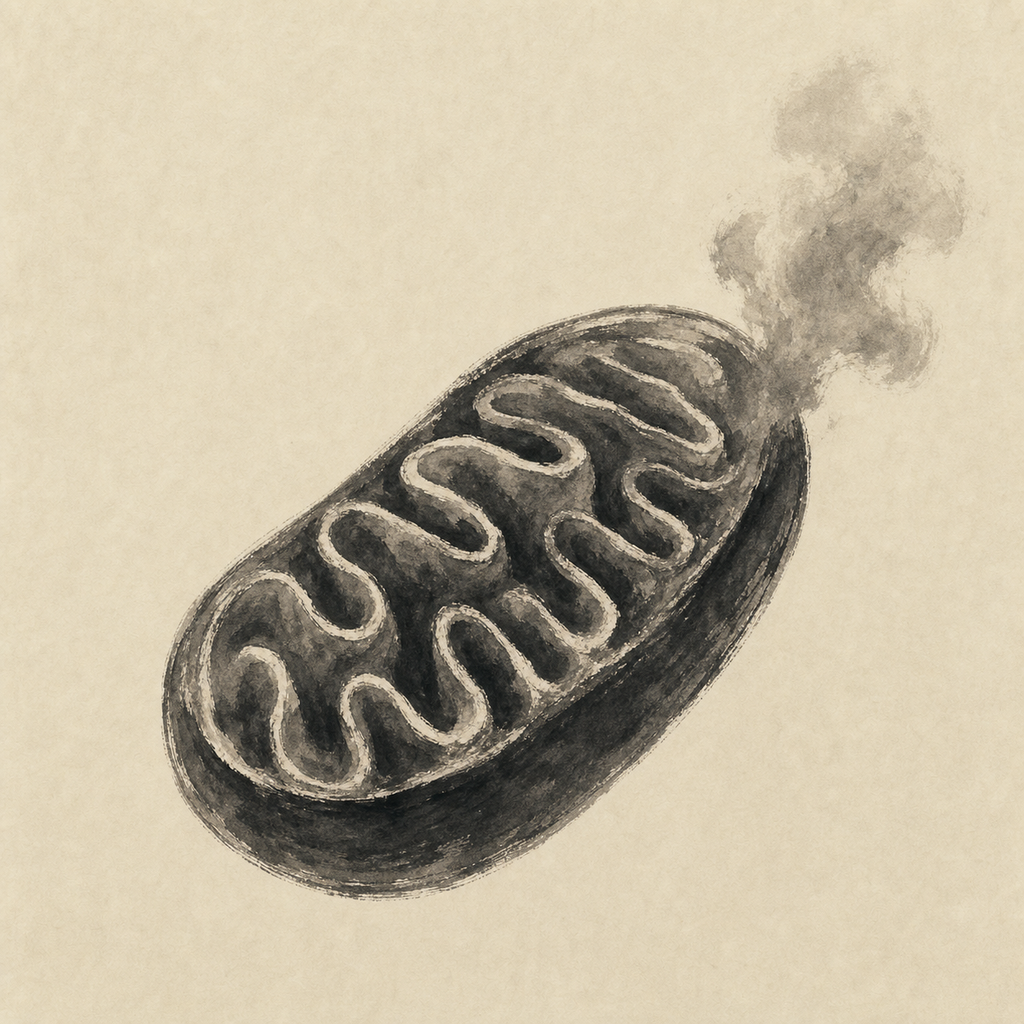
The full pathway is one of biochemistry's masterpieces, and it unfolds in three stages. Glycolysis (in the cytoplasm) splits a six-carbon glucose into two three-carbon pyruvates, netting two ATP. The citric acid cycle — the Krebs cycle, inside the mitochondria — oxidizes pyruvate completely to carbon dioxide, the exhaled gas, while charging up electron carriers (NADH, FADH₂). Then comes oxidative phosphorylation, also in the mitochondria, where the great majority of the energy is actually banked. The electron transport chain (on the inner mitochondrial membrane) feeds electrons from those carriers down a cascade of redox steps, using the released energy to pump protons across the membrane and build an electrochemical gradient — a stored proton-motive force. Oxygen waits at the end of the chain as the final electron acceptor, combining with electrons and protons to form water; without it the whole line backs up, which is why we must breathe. ATP synthase — a remarkable rotary enzyme, a molecular turbine — then lets the protons flow back through it, spinning a rotor that phosphorylates ADP into ATP. That coupling of a proton gradient to ATP synthesis is chemiosmosis, Peter Mitchell's heretical 1961 idea that won him the 1978 Nobel Prize. Total yield: about 30 to 32 ATP per glucose, vastly more than glycolysis alone — the whole point of staging the burn rather than letting it flash off as heat is to trap that energy in usable form before it escapes. The mitochondria themselves are descended from ancient bacteria engulfed by a larger cell roughly two billion years ago — the endosymbiotic origin of mitochondria (Lynn Margulis, 1967) is now accepted. They retain their own DNA (inherited maternally in animals), their own ribosomes, and their own membrane lipids. The pathway in E. coli and the pathway in your liver cell share most of the same enzymes, and the ATP synthase rotor is found essentially unchanged across the tree of life.