Cascading Failures
- One component's failure propagating network-widenot yet tested
- Optimization strips out the buffers resilience needsnot yet tested
- Dominoes, hub failures, runs, and supply chainsnot yet tested
- Self-organized criticality and the circuit-breaker remedynot yet tested
On August 14, 2003, at 2:14 PM Eastern time, a software bug in the energy management system at FirstEnergy Corporation in Akron, Ohio, silenced the alarms that would have told operators their high-voltage transmission lines were failing one after another. Just under two hours later the grid gave way — and the cascade itself took three minutes. By the end, 55 million people across eight US states and Ontario had lost power, in the largest blackout in North American history. Five years later, in September 2008, a different cascade unfolded: Lehman Brothers declared bankruptcy on the 15th, AIG was rescued the next day by an $85 billion federal credit line that ultimately grew to $182 billion, money market funds saw runs, commercial-paper markets froze. Central banks injected trillions worldwide. The global financial system, like the Northeast power grid five years earlier, had experienced a cascading failure — interconnections that produced efficiency in normal times had become channels for failure propagation under stress.
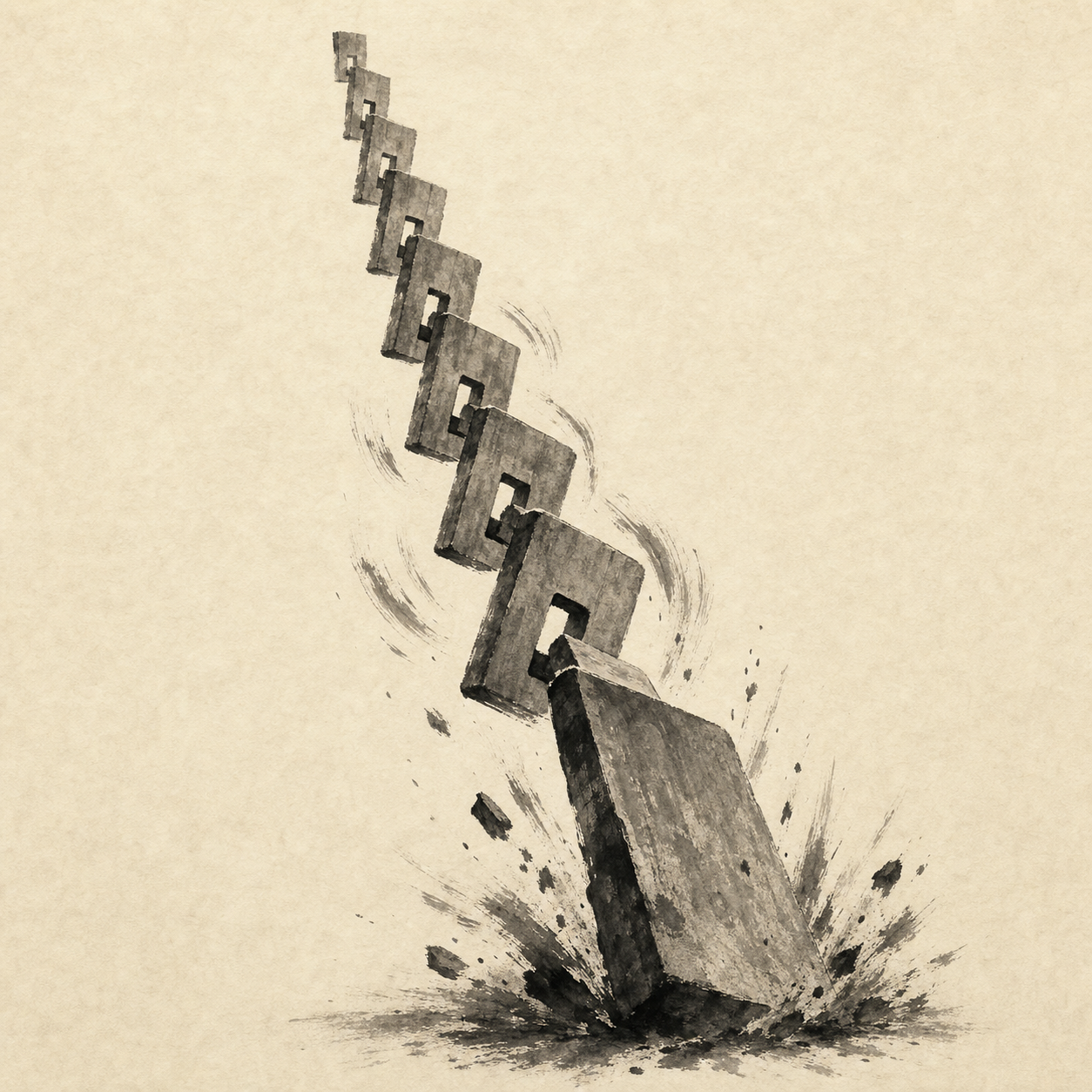
Cascading failure is the structural pattern in which the failure of one component propagates through a tightly-coupled network, possibly producing a system-wide collapse much larger than any isolated failure. The conditions that produce it are well-understood: strong interdependencies, limited spare capacity (systems optimized for normal-load efficiency have little reserve for absorbing redirected load), fast propagation, and reinforcing feedback in which each failure makes the next more likely. The deeper structural point is that optimization for efficiency tends to produce fragility — in a tightly-coupled network, redundancy and slack are waste in normal operation, market discipline removes them, and the normal-condition optimum removes precisely the buffers needed for abnormal-condition resilience. The 2008 financial crisis is the textbook case: the system had become more efficient through consolidation, securitization, and mathematical risk management, and each efficiency gain contributed to fragility. Cascades come in recognizable types: domino sequences through a network (the classic blackout pattern), centralized-hub failures (the Cloudflare and AWS US-East-1 outages), self-fulfilling information cascades (bank runs), supply-chain cascades (the 2021 Suez Canal blockage, the 2020-2022 semiconductor shortage), and concurrent cascades across domains. The theoretical frameworks are substantial. Duncan Watts's 2002 cascade model on networks shows that cascade size depends on network topology and threshold distribution. Self-organized criticality (Per Bak's sandpile model) describes dynamics in which most perturbations cause small avalanches and rare perturbations arbitrarily large ones. The standard interventions — redundancy, decoupling tightly-coupled subsystems, circuit-breakers, pre-arranged crisis response — are well-known but expensive to maintain and politically difficult to defend in normal times, when their cost is visible and their value is not.