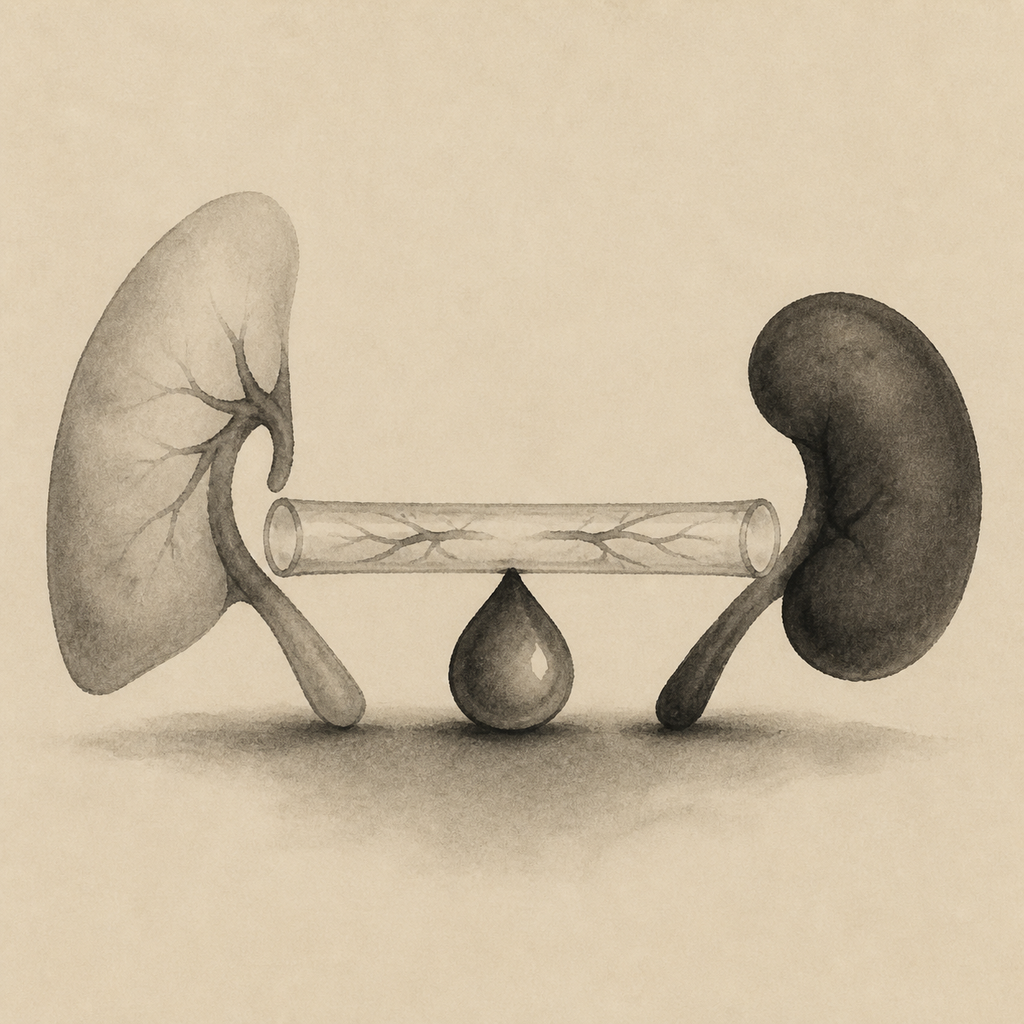
Buffers & Physiological pH
- The lethal pH 7.35–7.45 windownot yet tested
- Bicarbonate, the lung-fast and kidney-slow knobsnot yet tested
- Phosphate, histidine, and hemoglobin inside cellsnot yet tested
- Acidosis in CKD, DKA, and COPDnot yet tested
Human arterial blood is held in a band so narrow it almost beggars belief: pH 7.35 to 7.45, every minute of every day, for a lifetime. Slip below 7.35 and enzymes lose grip, cardiac muscle weakens, consciousness clouds; rise above 7.45 and calcium falls out of solution and nerves fire on their own. A drop to 6.8 or a climb to 7.8 is generally fatal within hours. The body that produces, in the course of ordinary metabolism, enough acid each day to dissolve a small chunk of limestone nevertheless keeps its own internal pH steadier than any laboratory reagent jar. The mechanism is invisible, automatic, and shared by every cell.
The trick is the bicarbonate buffer: a partnership between dissolved CO₂ and the bicarbonate ion HCO₃⁻, with carbonic acid as the fleeting middleman. Add metabolic acid and bicarbonate absorbs the proton, generating CO₂ that the lungs blow off; add a base and CO₂ hydrates back into bicarbonate to neutralize it. Because the lungs can vary CO₂ excretion in seconds and the kidneys can vary bicarbonate retention over hours, the body has both a fast knob and a slow one acting on the same equilibrium. The Henderson-Hasselbalch equation written for blood — pH = 6.1 + log([HCO₃⁻]/0.03·pCO₂) — captures the arrangement on a single line, and a clinician reading an arterial blood gas reads exactly those three numbers to decide whether a patient is in respiratory acidosis, metabolic acidosis, or some compensated mixture of both.
Inside cells the chemistry is different. The dominant intracellular buffer is the phosphate system (H₂PO₄⁻ ↔ HPO₄²⁻, pKa 6.86, well-suited to cytoplasmic pH near 7.2), supplemented by the histidine side-chains of proteins, which act as buffers in their own right because their imidazole groups have a pKa right at physiological pH. Hemoglobin exploits the same chemistry: as it releases oxygen in working tissues, its histidine residues pick up protons, helping carry the metabolic acid back to the lungs. The compartments matter: extracellular pH is bicarbonate-dominated and respiratory; intracellular pH is phosphate- and protein-dominated and slower to move. Loss of either control system is recognizable as a clinical syndrome.