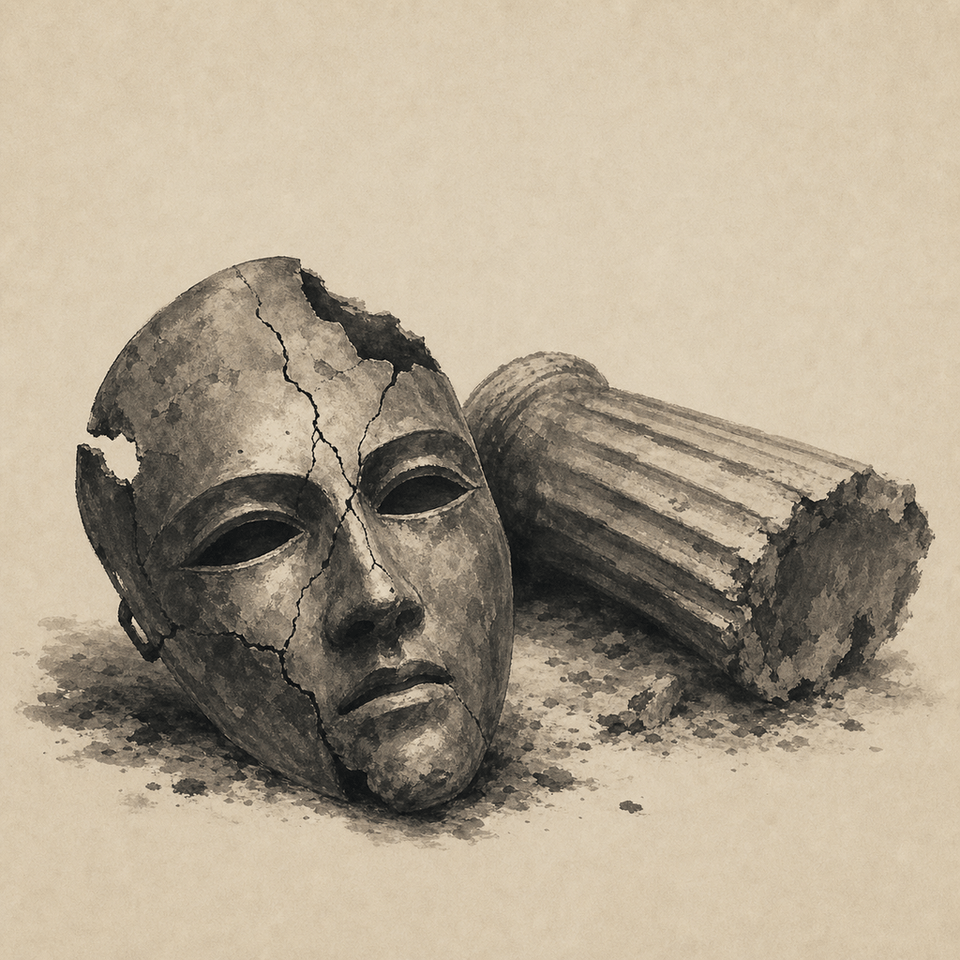
Bronze Age Collapse
For four centuries the eastern Mediterranean had been a single working economy. Egyptian pharaohs corresponded with Hittite kings in the Akkadian diplomatic lingua franca; Mycenaean Greek pottery turned up in Cypriot and Levantine ports; tin from Afghanistan and copper from Cyprus met in Anatolian smelters and emerged as the bronze that armed Babylonian, Egyptian, and Hittite soldiers alike. Royal houses intermarried, exchanged gifts of gold and lapis, and ran a courier system that crisscrossed the whole region. It was the world's first globalization — a dense web of palaces and trade routes that was fragile, prosperous, and almost entirely forgotten until archaeologists dug it back up. No one alive then could have imagined how quickly it would all come apart.
Then, within roughly fifty years around 1177 BCE, every major palace from Pylos in Greece to Ugarit on the Syrian coast was burned to the ground. The Hittite Empire — for two centuries Egypt's equal, with which Ramesses II had signed history's first surviving peace treaty after Kadesh — vanished outright; its capital Hattusa was abandoned and never rebuilt as a city. Egypt repelled the invaders under Ramesses III but staggered into a centuries-long decline, losing its Levantine empire. The Mycenaean palace economy collapsed and writing itself — Linear B, used only for palace inventories — disappeared from Greece for some four hundred years, the so-called Greek Dark Age. The last letters from Ugarit, baked hard in the fire that destroyed the city, beg allied kings for grain and warn of enemy ships off the coast. The cause is genuinely contested: a multi-decade drought attested in pollen and ice cores, drought-driven mass migration, the mysterious seaborne raiders modern scholars call the Sea Peoples, a swarm of earthquakes along the Anatolian fault, internal revolt against palace elites — and probably all of them at once, each amplifying the others. The lesson historians keep returning to is that highly connected systems are not merely vulnerable to cascading failure; their very interdependence — the tin that had to travel two thousand miles to make a sword — is what turns a regional shock into a total one. When the palaces that coordinated the trade burned, the trade that fed the palaces stopped, and the spiral closed on itself. Specialization is efficiency until the links break.