Atomic Structure
- Nucleus, electron cloud, and orbitsnot yet tested
- Protons, neutrons, and electronsnot yet tested
- Charges of the three particlesnot yet tested
- Quarks inside the nucleonsnot yet tested
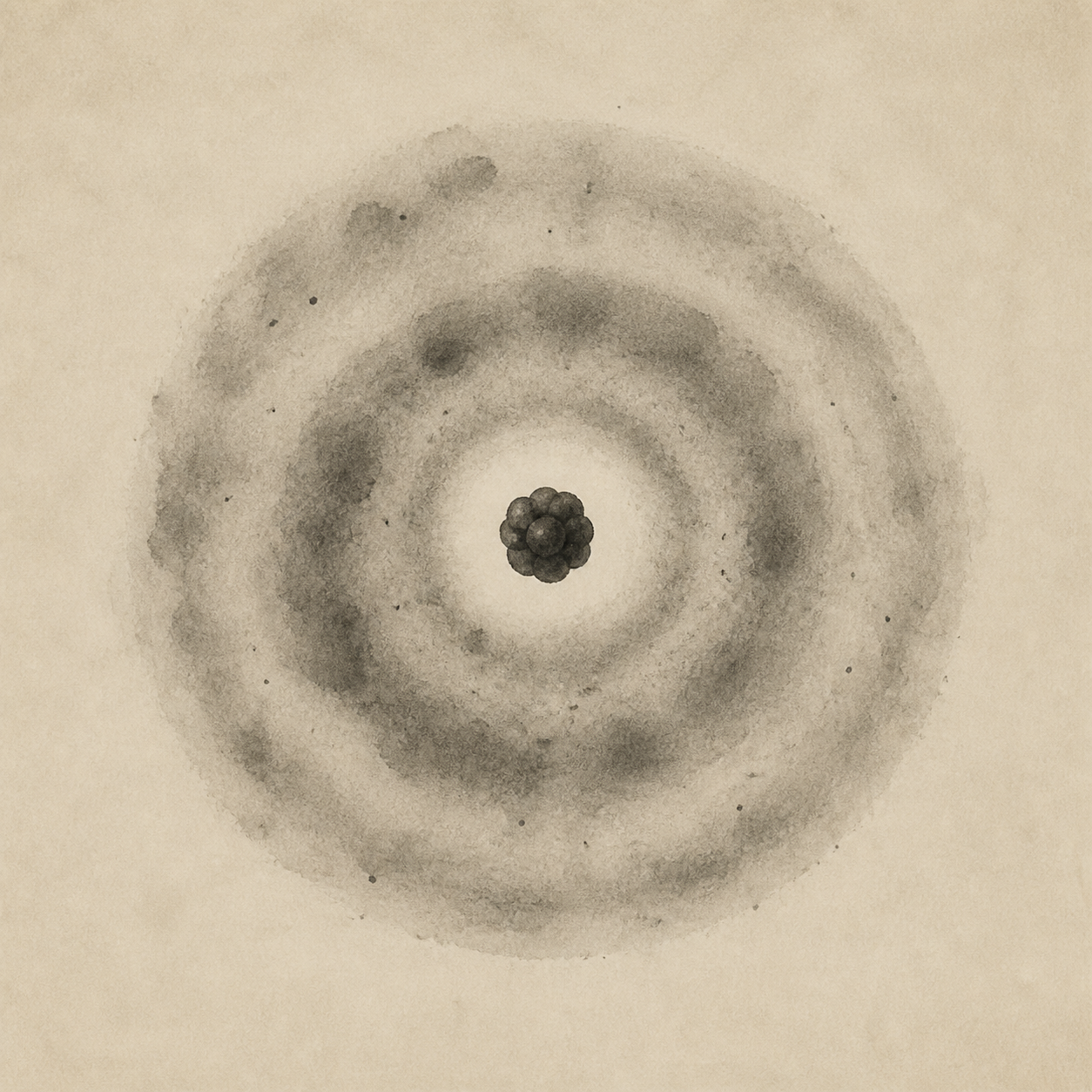
In 1909, at Manchester, Ernest Rutherford had Hans Geiger and Ernest Marsden fire a beam of alpha particles at a sheet of gold foil so thin it was nearly transparent, expecting them to pass almost straight through — that was what the reigning plum-pudding model, an atom of diffuse positive jelly studded with electrons, predicted. Most did. But about one in eight thousand bounced sharply back, some almost the way they had come. "It was," Rutherford said, "as though you had fired a fifteen-inch shell at a piece of tissue paper and it came back and hit you." There was only one explanation: nearly all of the atom's mass, and all of its positive charge, sat crushed into a nucleus a hundred thousand times smaller than the atom itself. Everything else is empty space.
So the atom is almost nothing — a dense nucleus of protons and neutrons, and a vast, near-empty cloud where the electrons live. The nucleus carries the weight; a proton outweighs an electron more than eighteen hundred times over. But it is the electrons, smeared through that cloud, that do all of chemistry. How many protons sit in the nucleus fixes which element it is; how the electrons arrange themselves fixes how that element behaves. And their arrangement obeys one strange, powerful rule. Electrons do not circle like planets — quantum mechanics smears each into an orbital, a three-dimensional haze of probability — and the Pauli exclusion principle forbids any two of them from occupying the exact same state. That single prohibition is why matter has structure at all. Unable to crowd together into the lowest orbital, electrons are forced to stack outward into successive shells: two fit in the first, eight in the next, and so on up. Every regularity of the periodic table is a shadow of that stacking. Elements share a column because they share the same number of electrons in their outermost shell, and it is that exposed, unfinished outer shell that reaches out to form every chemical bond. The whole of chemistry, in the end, is atoms trying to complete a shell.